Araújo-Vilges Keline Medeiros de, Oliveira Stefan Vilges de, Couto Shirley Claudino Pereira, Fokoue Harold Hilarion, Romero Gustavo Adolfo Sierra, Kato Massuo Jorge, Romeiro Luiz Antonio Soares, Leite José Roberto Souza Almeida, Kuckelhaus Selma Aparecida Souza
a Laboratory of Cell Immunology, Faculty of Medicine , University of Brasilia Campus Darcy Ribeiro , Brasilia - DF , Brazil.
b Laboratory of Medical Parasitology and Vector Biology, Faculty of Medicine , University of Brasilia , Brasilia - DF , Brazil.
Pharm Biol. 2017 Dec;55(1):1601-1607. doi: 10.1080/13880209.2017.1313870.
Plants of the Piperaceae family produce piplartine that was used to synthesize the cinnamides.
To assess the effects of piplartine (1) and cinnamides (2-5) against the protozoa responsible for malaria and leishmaniasis, and peritoneal cells of Swiss mice.
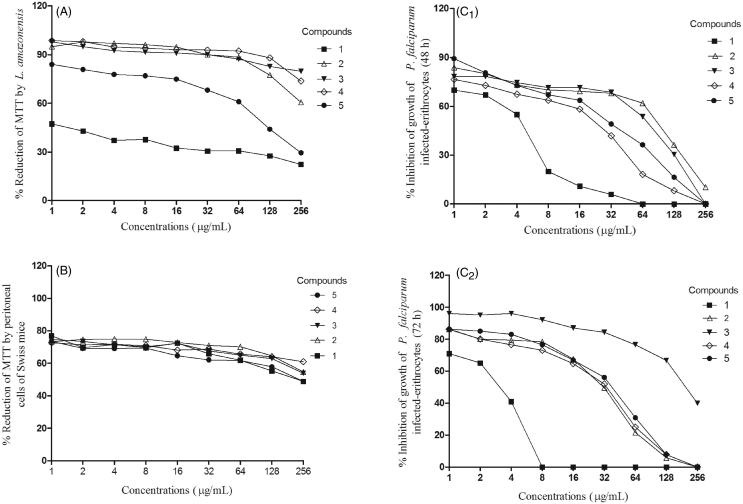
Cultures of Leishmania amazonensis, Plasmodium falciparum-infected erythrocytes, and peritoneal cells were incubated, in triplicate, with different concentrations of the compounds (0 to 256 μg/mL). The inhibitory concentration (IC) in L. amazonensis and cytotoxic concentration (CC) in peritoneal cell were assessed by the MTT method after 6 h of incubation, while the IC for P. falciparum-infected erythrocytes was determined by optical microscopy after 48 or 72 h of incubation; the Selectivity Index (SI) was calculated by CC/IC.
All compounds inhibited the growth of microorganisms, being more effective against P. falciparum after 72 h of incubation, especially for the compounds 1 (IC = 3.2 μg/mL) and 5 (IC = 6.6 μg/mL), than to L. amazonensis (compound 1 = 179.0 μg/mL; compound 5 = 106.0 μg/mL). Despite all compounds reducing the viability of peritoneal cells, the SI were <10 to L. amazonensis, whereas in the cultures of P. falciparum the SI >10 for the piplartine (>37.4) and cinnamides 4 (>10.7) and 5 (= 38.4).
The potential of piplartine and cinnamides 4 and 5 in the treatment of malaria suggest further pre-clinical studies to evaluate their effects in murine malaria and to determine their mechanisms in cells of the immune system.
胡椒科植物产生的胡椒碱被用于合成肉桂酰胺。
评估胡椒碱(1)和肉桂酰胺(2 - 5)对引起疟疾和利什曼病的原生动物以及瑞士小鼠腹膜细胞的作用。
将亚马逊利什曼原虫、恶性疟原虫感染的红细胞和腹膜细胞的培养物一式三份,与不同浓度的化合物(0至256μg/mL)一起孵育。孵育6小时后,通过MTT法评估亚马逊利什曼原虫的抑制浓度(IC)和腹膜细胞的细胞毒性浓度(CC),而孵育48或72小时后,通过光学显微镜确定恶性疟原虫感染红细胞的IC;通过CC/IC计算选择性指数(SI)。
所有化合物均抑制微生物生长,孵育72小时后对恶性疟原虫更有效,尤其是化合物1(IC = 3.2μg/mL)和5(IC = 6.6μg/mL),比对亚马逊利什曼原虫更有效(化合物1 = 179.0μg/mL;化合物5 = 106.0μg/mL)。尽管所有化合物都降低了腹膜细胞的活力,但对亚马逊利什曼原虫的SI <10,而在恶性疟原虫培养物中,胡椒碱(>37.4)、肉桂酰胺4(>10.7)和5(= 38.4)的SI>10。
胡椒碱以及肉桂酰胺4和5在疟疾治疗中的潜力表明,需要进一步进行临床前研究,以评估它们在鼠疟中的作用,并确定它们在免疫系统细胞中的作用机制。