Klingmüller Angela, Caplan Jeremy B, Sommer Tobias
Department for Systems Neuroscience, Medical Center Hamburg-Eppendorf, 20246 Hamburg, Germany.
Psychology Department, Neuroscience and Mental Health Institute, University of Alberta, Edmonton, AB T6G 2R3, Canada.
Learn Mem. 2017 Apr 17;24(5):216-224. doi: 10.1101/lm.045047.117. Print 2017 May.
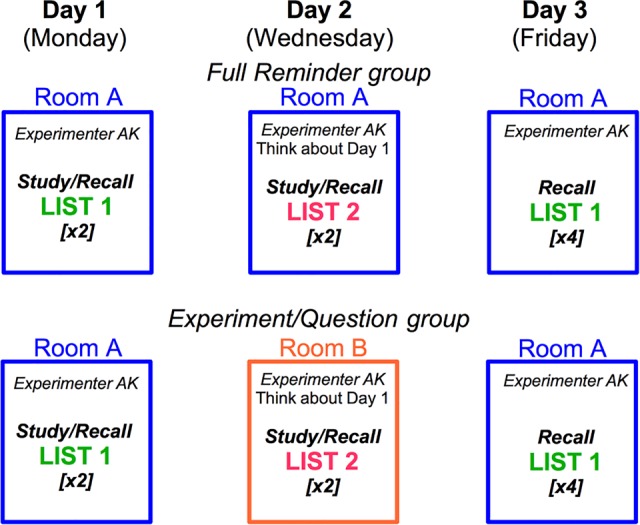
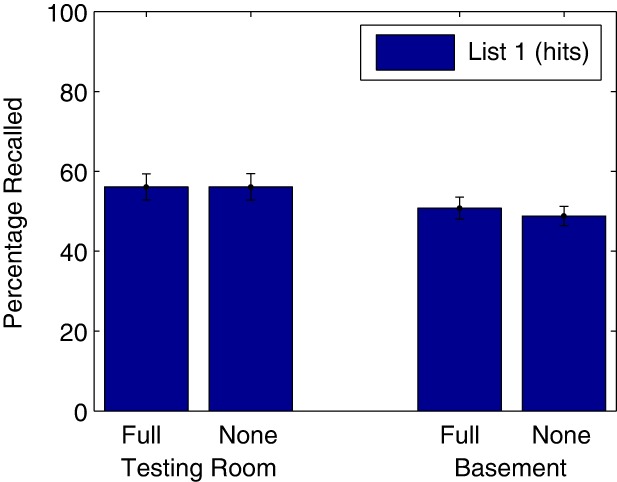
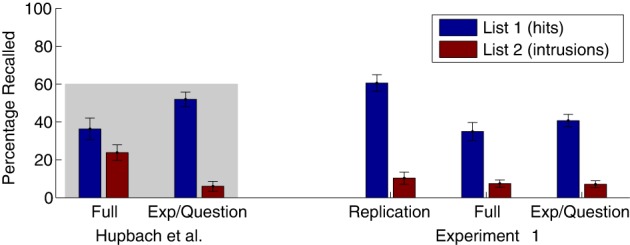
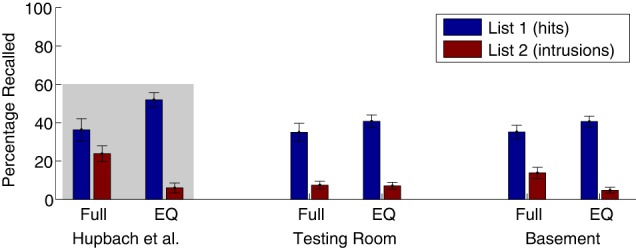
It would be profoundly important if reconsolidation research in animals and other memory domains generalized to human episodic memory. A 3-d-list-discrimination procedure, based on free recall of objects, with a contextual reminder cue (the testing room), has been thought to demonstrate reconsolidation of human episodic memory (as noted in a previous study). Our goal was to replicate the central result, a high intrusion rate during recall of the target list, and evaluate the reconsolidation account relative to an alternative account, based on state-dependent learning and interference. First, replication was not straightforward (Experiment 1). Second, using a very unique, highly salient context (Experiment 2), the method produced a qualitative replication, but it was small in magnitude. A critical assumption of the reconsolidation account, that the target list is reactivated and destabilized during re-exposure to the study context, was not supported (Experiment 3). Although troubling for the reconsolidation account, the findings can be easily accommodated by an alternative account that does not assume additional neurobiological processes underlying the destabilization of consolidated memories, instead explaining intrusion rates simply in terms of well-established cognitive effects, such as item-to-context binding and interference during retrieval.
如果动物的重新巩固研究以及其他记忆领域的研究能够推广到人类情景记忆,那将具有极其重要的意义。一种基于物体自由回忆、带有情境提醒线索(测试房间)的三维列表辨别程序,被认为可以证明人类情景记忆的重新巩固(如先前一项研究所指出)。我们的目标是复制核心结果,即目标列表回忆期间的高侵入率,并相对于基于状态依存学习和干扰的另一种解释,评估重新巩固的解释。首先,复制并非易事(实验1)。其次,使用一个非常独特、高度突出的情境(实验2),该方法实现了定性复制,但幅度较小。重新巩固解释的一个关键假设,即在重新接触学习情境期间目标列表会被重新激活并变得不稳定,并未得到支持(实验3)。尽管这对重新巩固解释来说令人困扰,但这些发现可以很容易地被另一种解释所容纳,该解释不假定巩固记忆的不稳定背后存在额外的神经生物学过程,而是简单地根据已确立的认知效应,如项目与情境的绑定以及检索期间的干扰,来解释侵入率。