Sun Congcong, Chang Lixian, Zhu Xiaofan
Center for Pediatric Blood Disease, State Key Laboratory of Experimental Hematology, Institute of Hematology and Blood Diseases Hospital, Chinese Academy of Medical Sciences, and Peking Union Medical College, Tianjin, P.R. China.
Oncotarget. 2017 May 23;8(21):35445-35459. doi: 10.18632/oncotarget.16367.
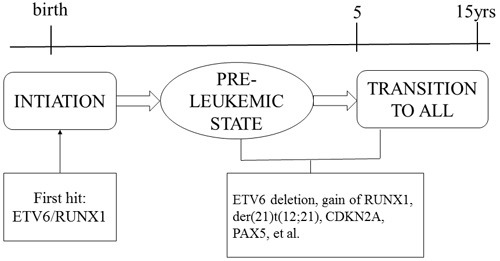
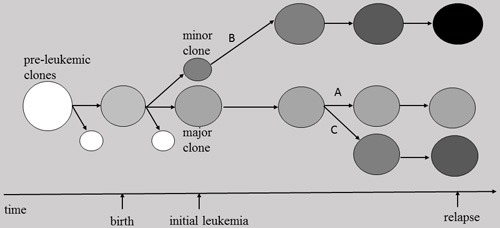
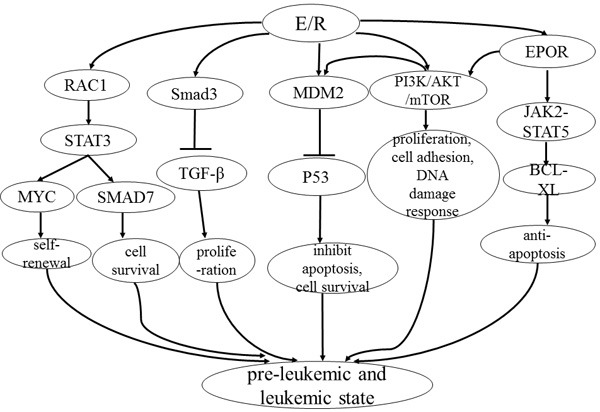
ETV6/RUNX1 (E/R) is the most common fusion gene in childhood acute lymphoblastic leukemia (ALL). Multiple lines of evidence imply a "two-hit" model for the molecular pathogenesis of E/R-positive ALL, whereby E/R rearrangement is followed by a series of secondary mutations that trigger overt leukemia. The cellular framework in which E/R arises and the maintenance of a pre-leukemic condition by E/R are fundamental to the mechanism that underlies leukemogenesis. Accordingly, a variety of studies have focused on the relationship between the clones giving rise to the primary and recurrent E/R-positive ALL. We review here the most recent insights into the pathogenic mechanisms underlying E/R-positive ALL, as well as the molecular abnormalities prevailing at relapse.
ETV6/RUNX1(E/R)是儿童急性淋巴细胞白血病(ALL)中最常见的融合基因。多项证据表明,E/R阳性ALL的分子发病机制存在“双打击”模型,即E/R重排后会发生一系列继发突变,从而引发明显的白血病。E/R产生的细胞框架以及E/R对白血病前期状态的维持是白血病发生机制的基础。因此,各种研究都聚焦于产生原发性和复发性E/R阳性ALL的克隆之间的关系。我们在此回顾对E/R阳性ALL潜在致病机制的最新见解,以及复发时普遍存在的分子异常情况。