Park Eunjeong, Chang Hyuk-Jae, Nam Hyo Suk
Cardiovascular Research Institute, Yonsei University College of Medicine, Seoul, Republic Of Korea.
Department of Cardiology, Yonsei University College of Medicine, Seoul, Republic Of Korea.
J Med Internet Res. 2017 Apr 18;19(4):e120. doi: 10.2196/jmir.7092.
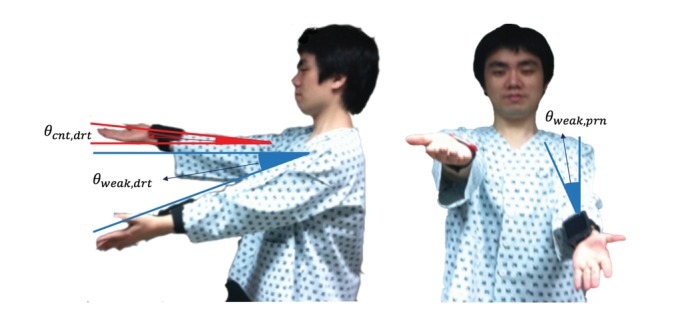
The pronator drift test (PDT), a neurological examination, is widely used in clinics to measure motor weakness of stroke patients.
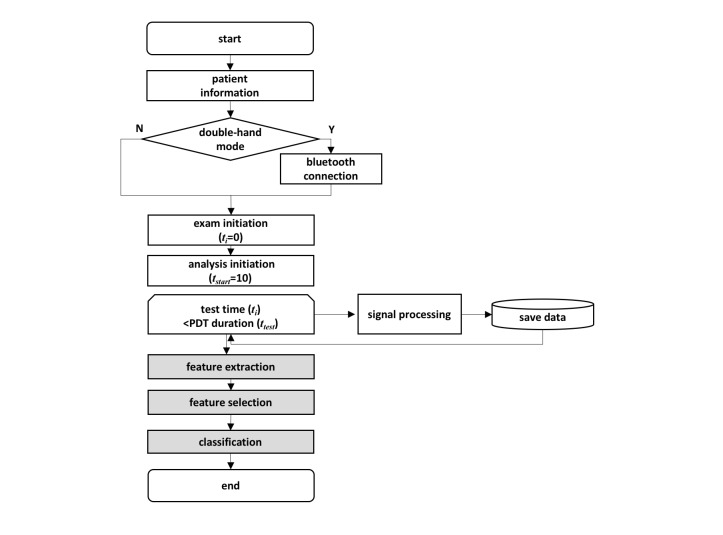
The aim of this study was to develop a PDT tool with machine learning classifiers to detect stroke symptoms based on quantification of proximal arm weakness using inertial sensors and signal processing.
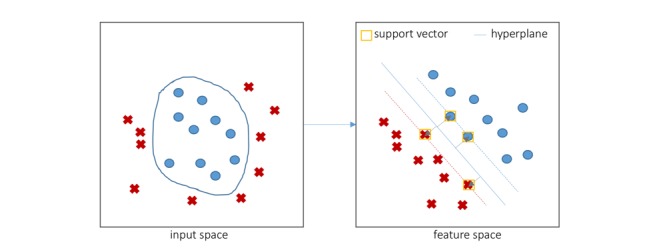
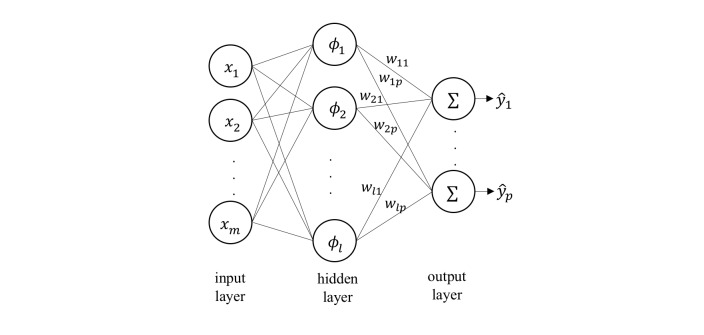
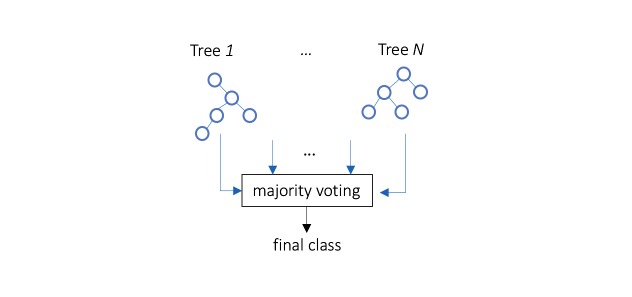
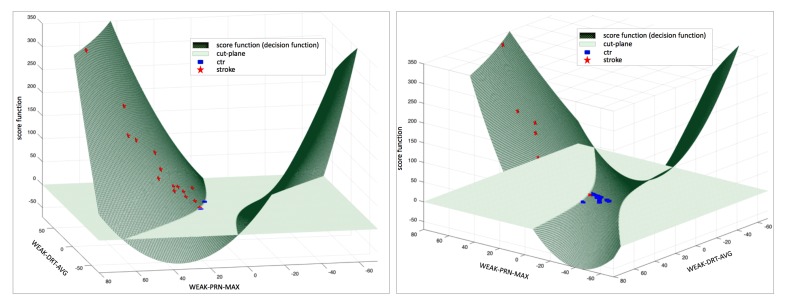
We extracted features of drift and pronation from accelerometer signals of wearable devices on the inner wrists of 16 stroke patients and 10 healthy controls. Signal processing and feature selection approach were applied to discriminate PDT features used to classify stroke patients. A series of machine learning techniques, namely support vector machine (SVM), radial basis function network (RBFN), and random forest (RF), were implemented to discriminate stroke patients from controls with leave-one-out cross-validation.
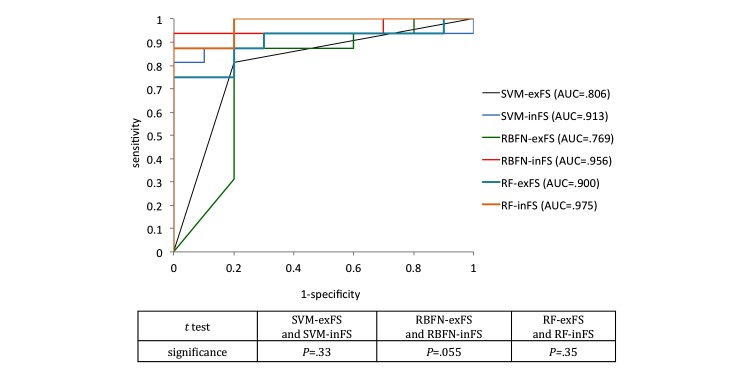
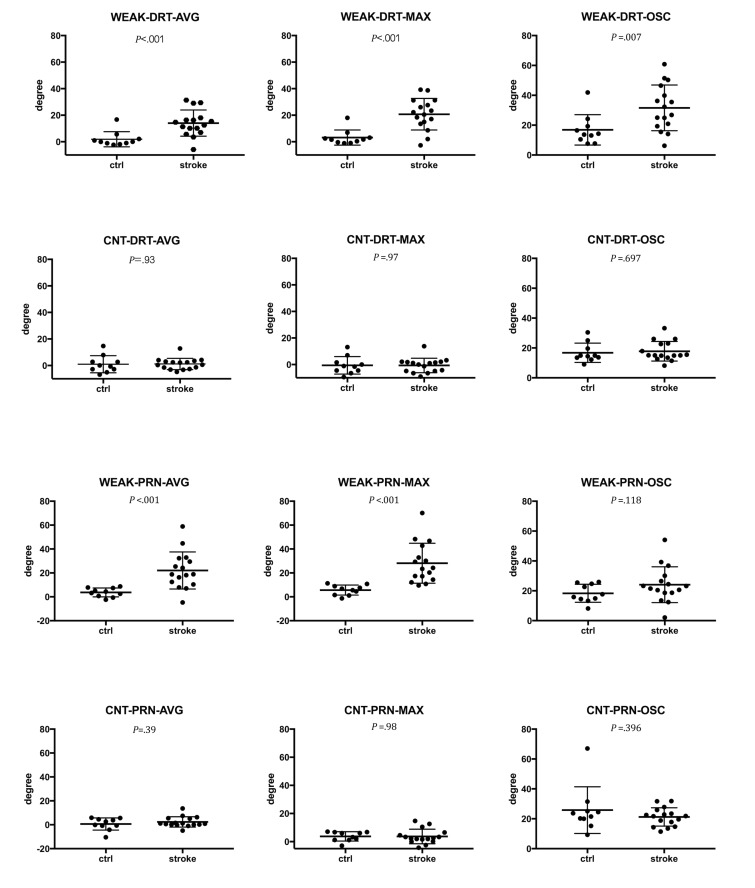
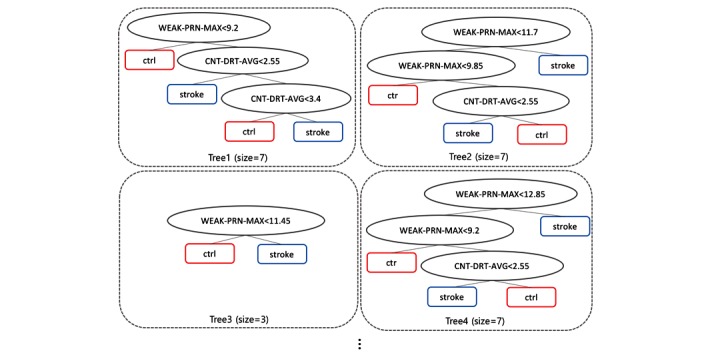
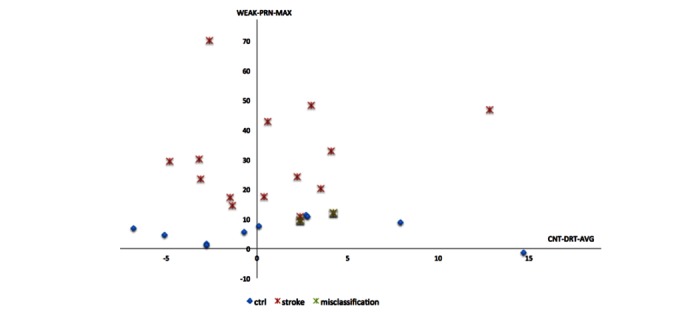
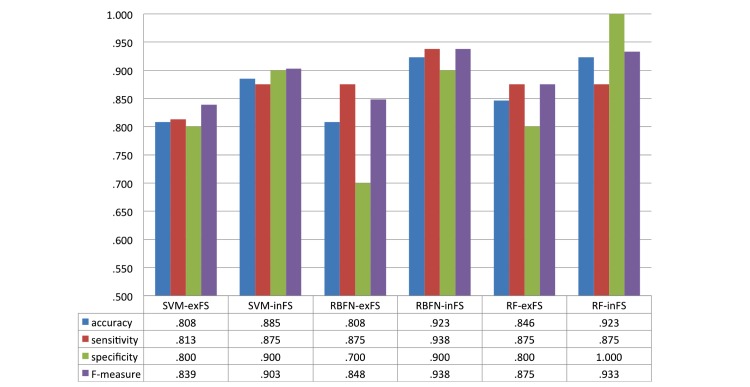
Signal processing by the PDT tool extracted a total of 12 PDT features from sensors. Feature selection abstracted the major attributes from the 12 PDT features to elucidate the dominant characteristics of proximal weakness of stroke patients using machine learning classification. Our proposed PDT classifiers had an area under the receiver operating characteristic curve (AUC) of .806 (SVM), .769 (RBFN), and .900 (RF) without feature selection, and feature selection improves the AUCs to .913 (SVM), .956 (RBFN), and .975 (RF), representing an average performance enhancement of 15.3%.
Sensors and machine learning methods can reliably detect stroke signs and quantify proximal arm weakness. Our proposed solution will facilitate pervasive monitoring of stroke patients.
旋前肌漂移试验(PDT)作为一种神经学检查方法,在临床上被广泛用于评估中风患者的运动功能障碍。
本研究旨在开发一种基于机器学习分类器的PDT工具,通过惯性传感器和信号处理技术量化近端手臂无力,以检测中风症状。
我们从16名中风患者和10名健康对照者的内腕可穿戴设备加速度计信号中提取了漂移和旋前特征。采用信号处理和特征选择方法来区分用于对中风患者进行分类的PDT特征。运用了一系列机器学习技术,即支持向量机(SVM)、径向基函数网络(RBFN)和随机森林(RF),通过留一法交叉验证来区分中风患者和对照者。
PDT工具通过信号处理从传感器中总共提取了12个PDT特征。特征选择从这12个PDT特征中提取了主要属性,以利用机器学习分类阐明中风患者近端无力的主要特征。我们提出的PDT分类器在未进行特征选择时,受试者工作特征曲线(AUC)下面积分别为0.806(SVM)、0.769(RBFN)和0.900(RF),而特征选择后,AUC分别提高到0.913(SVM)、0.956(RBFN)和0.975(RF),平均性能提升了15.3%。
传感器和机器学习方法能够可靠地检测中风体征并量化近端手臂无力。我们提出的解决方案将有助于对中风患者进行广泛监测。