Dehghani Payam, Habib Bettina, Windle Sarah B, Roy Nathalie, Old Wayne, Grondin François R, Bata Iqbal, Iskander Ayman, Lauzon Claude, Srivastava Nalin, Clarke Adam, Cassavar Daniel, Dion Danielle, Haught Herbert, Mehta Shamir R, Baril Jean-François, Lambert Charles, Madan Mina, Abramson Beth L, Eisenberg Mark J
Prairie Vascular Research Network, University of Saskatchewan, Regina, Canada.
Division of Clinical Epidemiology, Lady Davis Institute, Jewish General Hospital/McGill University, Montréal, Quebec, Canada.
J Am Heart Assoc. 2017 Apr 18;6(4):e004785. doi: 10.1161/JAHA.116.004785.
Smoking cessation and weight management are recommended after acute coronary syndrome (ACS); however, little is known about the effects of smoking cessation on weight change after ACS. We aimed to assess the effect of smoking cessation after ACS on weight over a 12-month follow-up period.
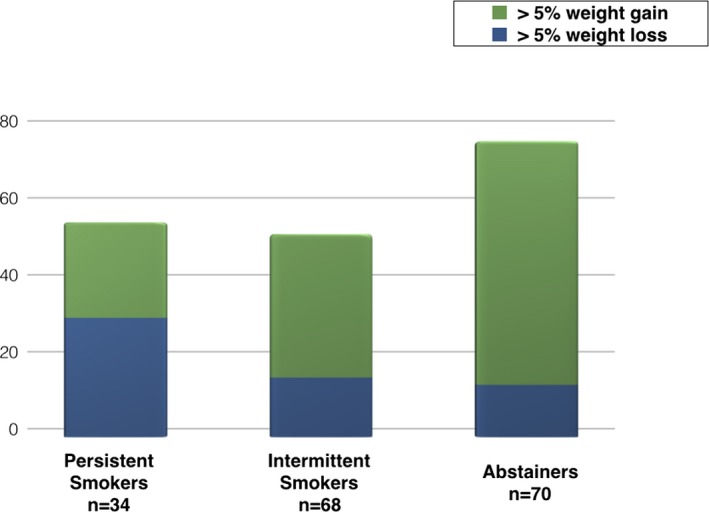
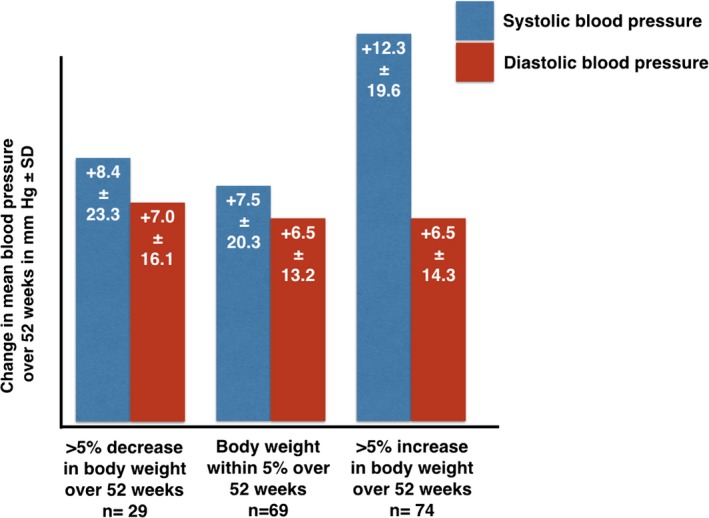
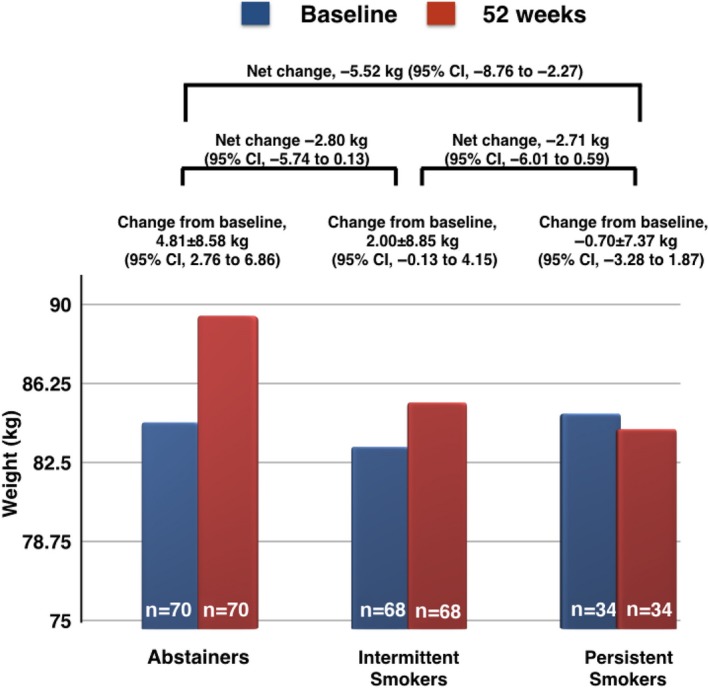
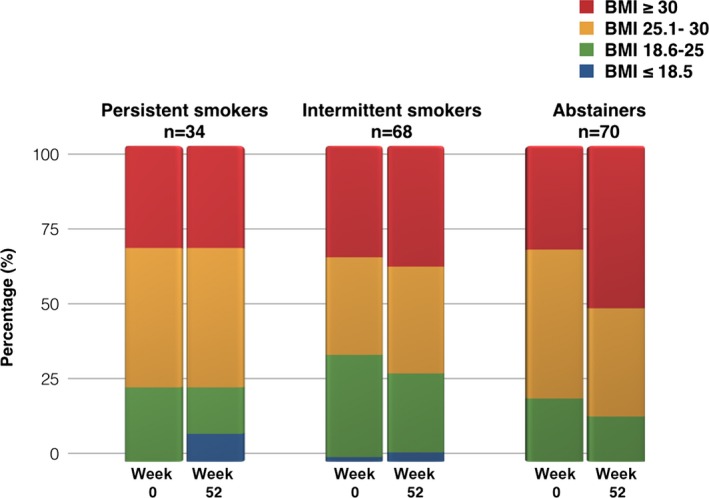
Data were prospectively collected from the EVITA (Evaluation of Varenicline in Smoking Cessation for Patients Post-Acute Coronary Syndrome) trial. Weight change was compared among 3 groups of patients: those who were completely abstinent (n=70), those who smoked intermittently (n=68), and those who smoked persistently (n=34). Patients' mean baseline weight was 83.9 kg (SD 17.7) with a mean body mass index of 28.5 (SD 5.4). Patients smoked a mean of 37.7 years (SD 17.7) and a mean of 21.0 cigarettes (SD 9.0) per day prior to their ACS. Weight change varied across groups, with abstainers gaining a mean of 4.8 kg (SD 8.6), intermittent smokers gaining a mean of 2.0 kg (SD 8.9) and persistent smokers losing a mean of 0.7 kg (SD 7.4). At 52 weeks, abstainers were more likely to gain weight than persistent smokers (difference in means 5.5 kg; 95% CI 2.3-8.8). This weight gain was not associated with an increase in the use of antihypertensive or antidiabetic medications.
Following an ACS, significant weight is gained by patients who quit smoking. Weight-management interventions among smokers who quit after ACS should be a focus of investigation in future research so that the cardiovascular benefits achieved by smoking cessation are not offset by weight gain in this high-risk population.
URL: http://www.clinicaltrials.gov. Unique identifier: NCT00794573.
急性冠状动脉综合征(ACS)后建议戒烟并进行体重管理;然而,关于ACS后戒烟对体重变化的影响知之甚少。我们旨在评估ACS后戒烟在12个月随访期内对体重的影响。
前瞻性收集来自EVITA(急性冠状动脉综合征后患者使用伐尼克兰戒烟的评估)试验的数据。比较了3组患者的体重变化:完全戒烟者(n = 70)、间歇性吸烟者(n = 68)和持续吸烟者(n = 34)。患者的平均基线体重为83.9千克(标准差17.7),平均体重指数为28.5(标准差5.4)。患者在发生ACS之前平均吸烟37.7年(标准差17.7),每天平均吸21.0支烟(标准差9.0)。体重变化在各组之间有所不同,戒烟者平均体重增加4.8千克(标准差8.6),间歇性吸烟者平均体重增加2.0千克(标准差8.9),持续吸烟者平均体重减轻0.7千克(标准差7.4)。在52周时,戒烟者比持续吸烟者更有可能体重增加(平均差值5.5千克;95%置信区间2.3 - 8.8)。这种体重增加与抗高血压或抗糖尿病药物使用的增加无关。
ACS后,戒烟的患者体重显著增加。ACS后戒烟的吸烟者的体重管理干预应成为未来研究的重点,以便戒烟所带来的心血管益处不会被这一高危人群的体重增加所抵消。