Department of Epidemiology, Beijing Anzhen Hospital, Capital Medical University, Beijing Institute of Heart, Lung and Blood Vessel Diseases, Beijing, CN.
Division of Cardiology, University of North Carolina, Chapel Hill, NC, US.
Glob Heart. 2020 Oct 23;15(1):72. doi: 10.5334/gh.784.
Over half of male acute coronary syndrome patients were smokers in China.Smoking was associated with higher risk of critical cardiac symptoms at admission.Only 35.3% of smoking patients received smoking cessation interventions in China.
Smoking cessation is recognized as an effective and cost-effective strategy for improving the prognosis of patients with coronary heart disease. Despite this, few studies have evaluated the smoking prevalence and provision of smoking cessation interventions among patients with acute coronary syndrome (ACS) in China.
To evaluate the smoking prevalence, clinical conditions and in-hospital outcomes associated with smoking, and the provision of smoking cessation interventions among ACS patients in China.
This registry study was conducted using data from the Improving Care for Cardiovascular Disease in China project, a collaborative nationwide registry of the American Heart Association and the Chinese Society of Cardiology. Our study sample comprised 92,509 ACS inpatients admitted between November 2014 and December 2018. A web-based data collection platform was used to report required data.
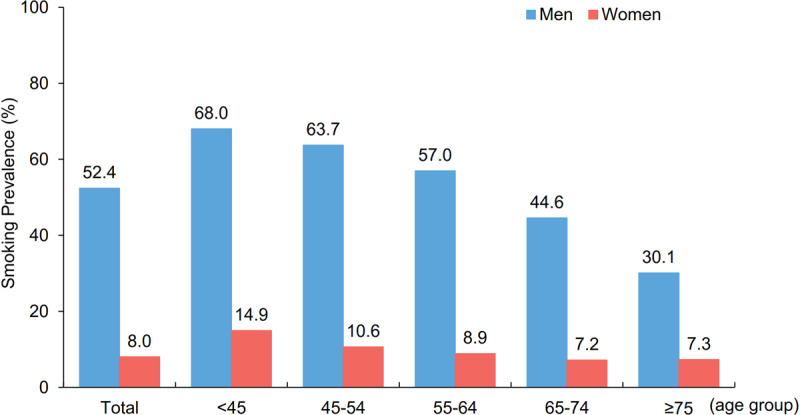
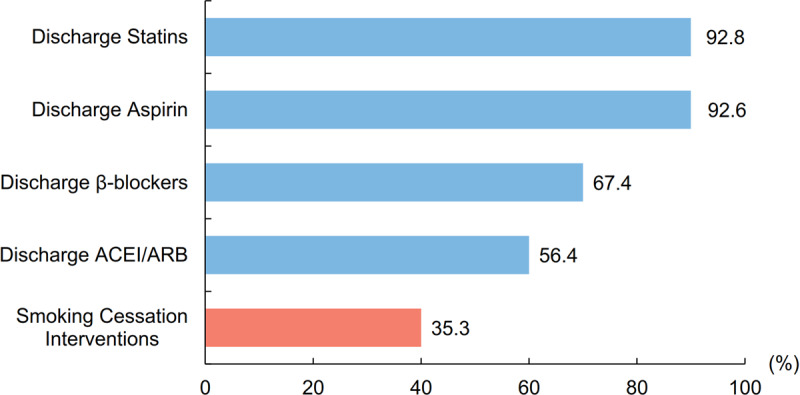
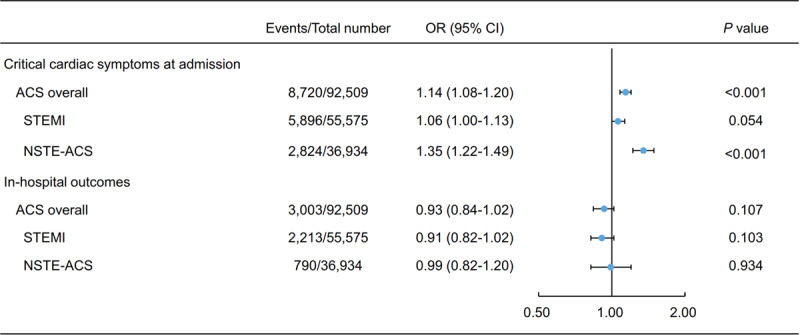
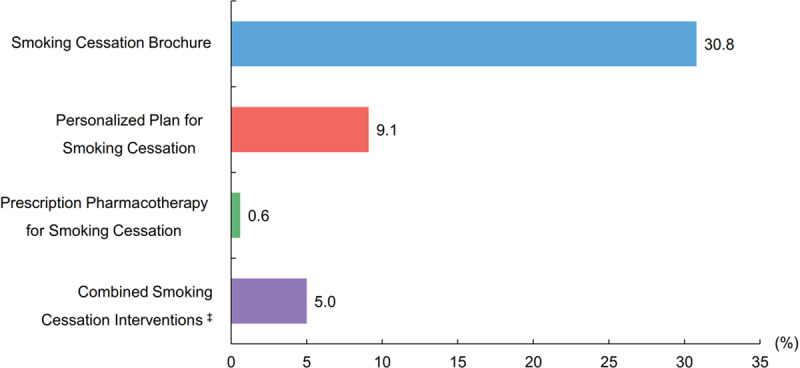
Smoking prevalence among male and female ACS patients was 52.4% and 8.0%, respectively. Patients younger than 45 years had the highest smoking rate (men: 68.0%; women: 14.9%). Compared with non-smokers, smokers had an earlier onset age of ACS and a greater proportion of severe clinical manifestations at admission, including ST-elevation myocardial infarction (67.8% versus 54.8%; p < 0.001) and substantially elevated myocardial injury markers (86.1% versus 83.0%; p < 0.001). After multivariable adjustment, smoking was associated with higher risk of critical cardiac symptoms at admission (OR = 1.14, 95% CI: 1.08-1.20; p < 0.001) and had no direct association with in-hospital outcomes (OR = 0.93, 95% CI: 0.84-1.02; p = 0.107) of ACS patients. Of 37,336 smokers with ACS, only 35.3% received smoking cessation interventions before discharge. There was wide variation in provision of smoking cessation interventions across hospitals (0%-100%).
Smoking is highly prevalent among ACS patients in China. However, smoking cessation interventions are not widely adopted in clinical practice in China as part of formal treatment strategies for ACS patients, indicating an important target for quality improvement.
URL: http://www.clinicaltrials.gov. Unique identifier: NCT02306616.
在中国,超过一半的急性冠状动脉综合征男性患者是吸烟者。吸烟与入院时出现严重心脏症状的风险增加有关。在中国,只有 35.3%的吸烟患者接受了戒烟干预。
戒烟被认为是改善冠心病患者预后的有效且具有成本效益的策略。尽管如此,很少有研究评估中国急性冠状动脉综合征(ACS)患者的吸烟流行率和提供戒烟干预措施。
评估中国 ACS 患者的吸烟流行率、与吸烟相关的临床状况和住院结局,以及提供戒烟干预措施的情况。
本研究使用美国心脏协会和中国心脏病学会合作的全国性登记项目——改善中国心血管疾病护理项目的数据,进行了这项注册研究。我们的研究样本包括 2014 年 11 月至 2018 年 12 月期间收治的 92509 例 ACS 住院患者。使用基于网络的数据收集平台报告所需数据。
男性和女性 ACS 患者的吸烟率分别为 52.4%和 8.0%。年龄小于 45 岁的患者吸烟率最高(男性:68.0%;女性:14.9%)。与不吸烟者相比,吸烟者 ACS 的发病年龄更早,入院时严重临床表现的比例更高,包括 ST 段抬高型心肌梗死(67.8%比 54.8%;p<0.001)和心肌损伤标志物显著升高(86.1%比 83.0%;p<0.001)。多变量调整后,吸烟与入院时严重心脏症状的风险增加相关(OR=1.14,95%CI:1.08-1.20;p<0.001),与 ACS 患者的住院结局无直接关联(OR=0.93,95%CI:0.84-1.02;p=0.107)。在 37336 例吸烟的 ACS 患者中,只有 35.3%在出院前接受了戒烟干预。各医院提供戒烟干预的情况差异很大(0%-100%)。
在中国,ACS 患者中吸烟现象非常普遍。然而,戒烟干预措施在中国并没有作为 ACS 患者正式治疗策略的一部分广泛应用于临床实践,这表明这是一个需要质量改进的重要目标。