Manitoba Institute of Child Health, Winnipeg, Manitoba, Canada.
Diabetes Care. 2013 Sep;36(9):2843-9. doi: 10.2337/dc12-2428. Epub 2013 May 13.
To investigate the associations between changes in body composition and fitness after exercise training and changes in hemoglobin A1c (HbA1c) in individuals with type 2 diabetes.
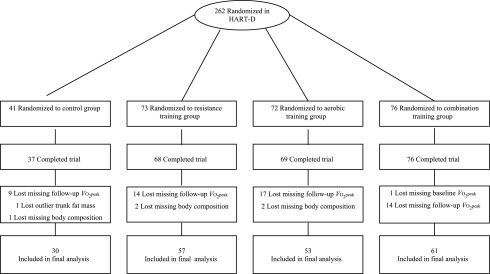
Participants (n = 201) were randomized to aerobic, resistance, or combined training for 9 months. HbA1c, waist circumference, total and trunk fat mass, appendicular fat mass, lean body mass, isokinetic leg muscle strength, peak O2 uptake, and estimated METs were assessed at baseline and follow-up. Change in HbA1c was evaluated across quartiles of change in body composition and fitness.
Change in HbA1c was associated with changes in body weight (r = 0.13, P = 0.052), waist circumference (r = 0.17, P = 0.013), trunk fat mass (r = 0.19, P = 0.005), and estimated METs (r = -0.16, P = 0.023). There was a trend in change in HbA1c across quartiles of waist circumference (P = 0.011), trunk fat mass (P = 0.020), and estimated METs (P = 0.011). Participants with increased estimated METs and reduced trunk fat mass had greater odds of having reduced HbA1c after training (3.48, 1.46-8.31). Finally, participants with increased estimated METs and reduced waist circumference were 2.81 (1.13-6.98) times more likely to have reduced HbA1c and type 2 diabetes medication use than those without improved fitness and central adiposity.
In patients with type 2 diabetes, a reduction in central adiposity and increase in fitness were the most prominent predictors of the change in HbA1c in response to exercise training.
研究 2 型糖尿病患者运动训练后身体成分和体能变化与糖化血红蛋白(HbA1c)变化之间的关系。
将 201 名参与者随机分为有氧运动、抗阻运动或联合训练组,进行 9 个月的训练。在基线和随访时评估 HbA1c、腰围、总体和躯干脂肪量、四肢脂肪量、瘦体重、等速腿部肌肉力量、峰值 O2 摄取量和估计代谢当量(METs)。根据身体成分和体能变化的四分位数评估 HbA1c 的变化。
HbA1c 的变化与体重(r = 0.13,P = 0.052)、腰围(r = 0.17,P = 0.013)、躯干脂肪量(r = 0.19,P = 0.005)和估计 METs(r = -0.16,P = 0.023)的变化相关。腰围(P = 0.011)、躯干脂肪量(P = 0.020)和估计 METs(P = 0.011)的四分位数变化与 HbA1c 的变化呈趋势相关。体能增加和躯干脂肪量减少的参与者在训练后 HbA1c 降低的可能性更大(3.48,1.46-8.31)。最后,与体能未改善和中心性肥胖的参与者相比,体能增加和腰围减少的参与者 HbA1c 降低和 2 型糖尿病药物使用的可能性分别增加了 2.81 倍(1.13-6.98)。
在 2 型糖尿病患者中,中心性肥胖减少和体能增加是运动训练对 HbA1c 变化反应的最显著预测因子。