Kim Ryul, Yoo Dallah, Jung Yu Jin, Han Kyungdo, Lee Jee Young
Department of Neurology, Inha University Hospital, Incheon, Korea.
Department of Neurology, Kyung Hee University Medical Center, Seoul, Korea.
J Clin Neurol. 2020 Jul;16(3):455-460. doi: 10.3988/jcn.2020.16.3.455.
To determine whether the postcessation weight gain modifies the protective effect of smoking on the development of Parkinson's disease (PD).
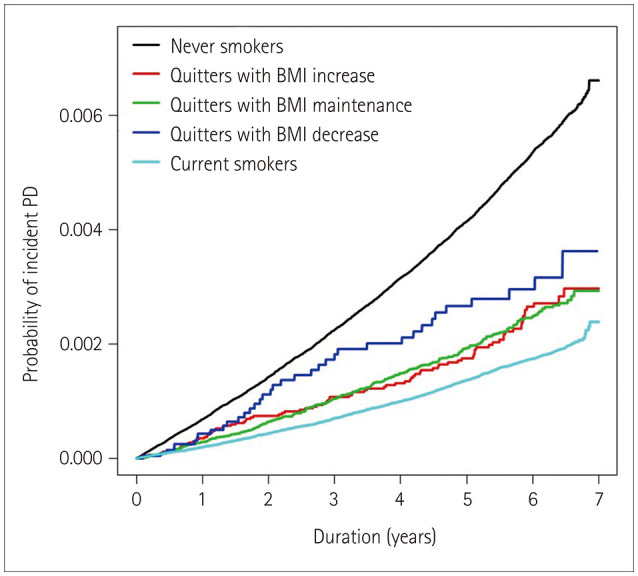
This nationwide cohort study included 3,908,687 Korean males aged ≥40 years who underwent at least 2 health checkups biennially between 2009 and 2015. They were grouped into current smokers; quitters with body mass index (BMI) increase, maintenance, and decrease; and never smokers. The occurrence of incident PD was tracked, and Cox proportional-hazard models were used to adjust for potential confounding factors. We also analyzed the impact of weight change regardless of smoking status in the study population.
There were 6,871 incident PD cases observed during the 13,059,208 person-years of follow-up. The overall risk of PD was significantly lower in quitters than in never smokers [hazard ratio (HR)=0.78, 95% confidence interval (CI)=0.70-0.86]. The risk of PD was still lower in quitters with BMI increase (HR=0.80, 95% CI=0.65-0.98) and in those with BMI maintenance (HR=0.77, 95% CI=0.68-0.87). This tendency was also observed in quitters with BMI decrease (HR=0.76, 95% CI=0.55-1.06), although it was not as robust as in the other two groups. With respect to weight change alone, BMI increase (HR=1.10, 95% CI=1.02-1.18) but not BMI decrease (HR=1.06, 95% CI=0.98-1.14) significantly increased the PD risk compared to BMI maintenance.
Postcessation weight gain in males did not offset the protective impact of smoking on PD development, although overall weight gain predicted an increased risk of PD.
确定戒烟后体重增加是否会改变吸烟对帕金森病(PD)发生的保护作用。
这项全国性队列研究纳入了3908687名年龄≥40岁的韩国男性,他们在2009年至2015年期间每两年至少接受2次健康检查。他们被分为当前吸烟者;体重指数(BMI)增加、维持和降低的戒烟者;以及从不吸烟者。追踪新发PD的发生情况,并使用Cox比例风险模型对潜在混杂因素进行校正。我们还分析了研究人群中无论吸烟状态如何的体重变化影响。
在13059208人年的随访期间,观察到6871例新发PD病例。戒烟者的PD总体风险显著低于从不吸烟者[风险比(HR)=0.78,95%置信区间(CI)=0.70-0.86]。BMI增加的戒烟者(HR=0.80,95%CI=0.65-0.98)和BMI维持的戒烟者(HR=0.77,95%CI=0.68-0.87)的PD风险仍然较低。BMI降低的戒烟者也观察到这种趋势(HR=0.76,95%CI=0.55-1.06),尽管不如其他两组明显。仅就体重变化而言,与BMI维持相比,BMI增加(HR=1.10,95%CI=1.02-1.18)而非BMI降低(HR=1.06,95%CI=0.98-1.14)显著增加了PD风险。
男性戒烟后体重增加并未抵消吸烟对PD发生的保护作用,尽管总体体重增加预示着PD风险增加。