Varma Samarth, Takashima Atsuko, Krewinkel Sander, van Kooten Maaike, Fu Lily, Medendorp W Pieter, Kessels Roy P C, Daselaar Sander M
Donders Institute for Brain, Cognition and Behaviour, Radboud UniversityNijmegen, Netherlands.
Department of Neurobiology of Language, Max Planck Institute for PsycholinguisticsNijmegen, Netherlands.
Front Behav Neurosci. 2017 Mar 29;11:54. doi: 10.3389/fnbeh.2017.00054. eCollection 2017.
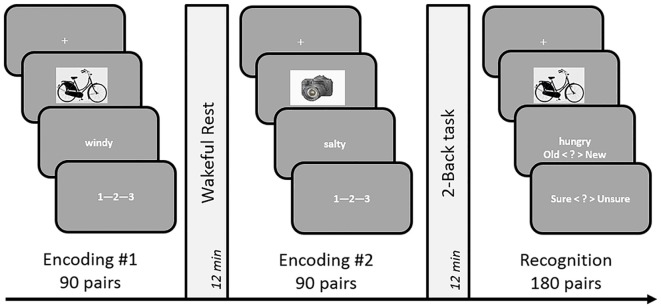
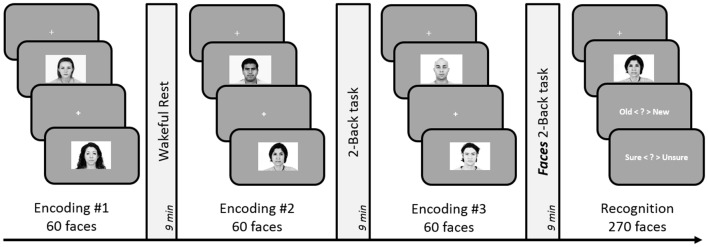
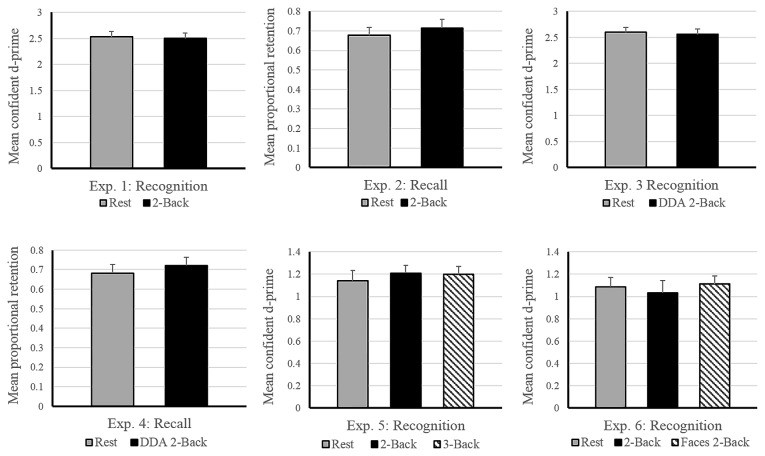
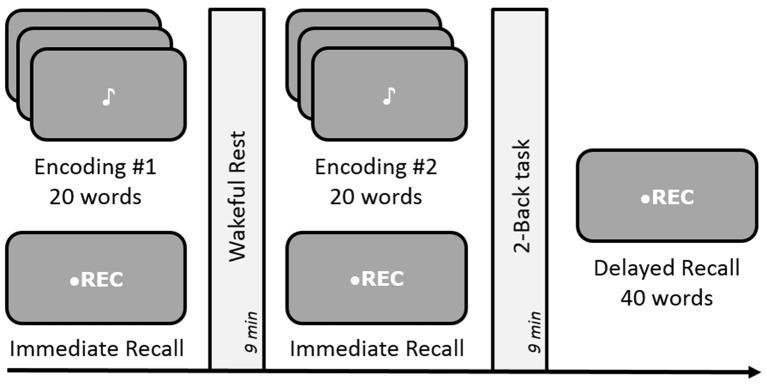
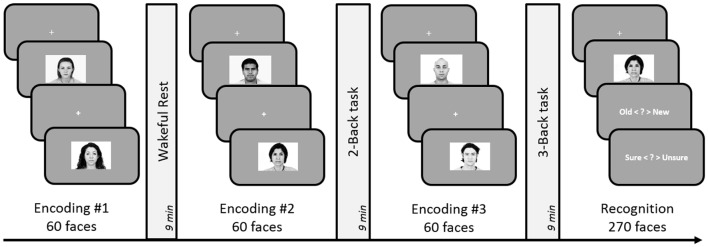
So far, studies that investigated interference effects of post-learning processes on episodic memory consolidation in humans have used tasks involving only complex and meaningful information. Such tasks require reallocation of general or encoding-specific resources away from consolidation-relevant activities. The possibility that interference can be elicited using a task that heavily taxes our limited brain resources, but has low semantic and hippocampal related long-term memory processing demands, has never been tested. We address this question by investigating whether consolidation could persist in parallel with an active, encoding-irrelevant, minimally semantic task, regardless of its high resource demands for cognitive processing. We distinguish the impact of such a task on consolidation based on whether it engages resources that are: (1) general/executive, or (2) specific/overlapping with the encoding modality. Our experiments compared subsequent memory performance across two post-encoding consolidation periods: quiet wakeful rest and a cognitively demanding n-Back task. Across six different experiments (total = 176), we carefully manipulated the design of the n-Back task to target general or specific resources engaged in the ongoing consolidation process. In contrast to previous studies that employed interference tasks involving conceptual stimuli and complex processing demands, we did not find any differences between n-Back and rest conditions on memory performance at delayed test, using both recall and recognition tests. Our results indicate that: (1) quiet, wakeful rest is not a necessary prerequisite for episodic memory consolidation; and (2) post-encoding cognitive engagement does not interfere with memory consolidation when task-performance has minimal semantic and hippocampally-based episodic memory processing demands. We discuss our findings with reference to resource and reactivation-led interference theories.
到目前为止,研究人类学习后过程对情景记忆巩固的干扰效应的研究,仅使用了涉及复杂且有意义信息的任务。此类任务需要将一般资源或编码特定资源从与巩固相关的活动中重新分配。使用一项对我们有限的大脑资源造成极大负担,但语义和海马体相关的长期记忆处理需求较低的任务来引发干扰的可能性,从未得到过测试。我们通过研究在一项活跃的、与编码无关的、语义最少的任务并行的情况下,巩固是否能够持续进行来解决这个问题,而不考虑其对认知处理的高资源需求。我们根据这样一项任务是否占用以下资源来区分其对巩固的影响:(1) 一般/执行资源,或 (2) 与编码方式特定/重叠的资源。我们的实验比较了两个编码后巩固阶段的后续记忆表现:安静清醒休息和一项认知要求较高的n-back任务。在六个不同的实验(总共 = 176)中,我们仔细操纵了n-back任务的设计,以针对正在进行的巩固过程中涉及的一般或特定资源。与之前采用涉及概念性刺激和复杂处理需求的干扰任务的研究不同,我们使用回忆和识别测试,在延迟测试中未发现n-back任务和休息条件在记忆表现上有任何差异。我们的结果表明:(1) 安静、清醒的休息不是情景记忆巩固的必要前提;(2) 当任务表现的语义和基于海马体的情景记忆处理需求最小时,编码后的认知参与不会干扰记忆巩固。我们参照资源和再激活引发的干扰理论来讨论我们的发现。