Forsberg Lars A
Science for Life Laboratory, Beijer Laboratory of Genome Research, Department of Immunology, Genetics and Pathology, Uppsala University, Uppsala, Sweden.
Hum Genet. 2017 May;136(5):657-663. doi: 10.1007/s00439-017-1799-2. Epub 2017 Apr 19.
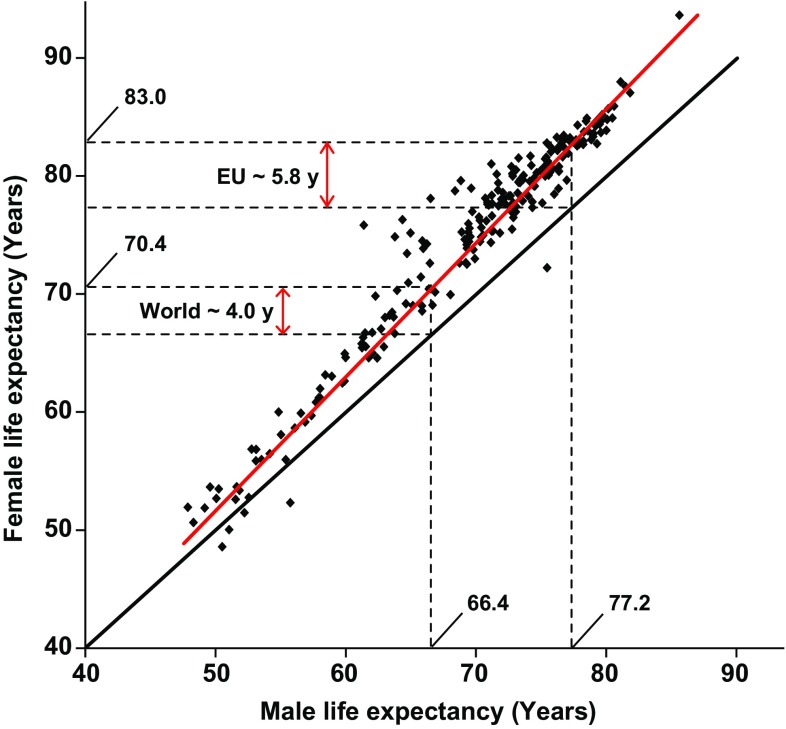
Recent discoveries have shown that harboring cells without the Y chromosome in the peripheral blood is associated with increased risk for all-cause mortality and disease such as different forms of cancer, Alzheimer's disease, as well as other conditions in aging men. In the entire world, the life expectancy of men is shorter compared to women, a sex difference that has been known for centuries, but the underlying mechanism(s) are not well understood. As a male-specific genetic risk factor, an increased risk for pathology and mortality associated with mosaic loss of chromosome Y (LOY) in blood cells could help to explain that men on average live shorter lives compared to women. This review primarily focuses on observed associations between LOY in blood and various diseases in aging men. Other topics covered are known risk factors for LOY, methods to detect LOY, and a discussion regarding mechanisms such as immunosurveillance, that could possibly explain how an acquired mutation in blood cells can be associated with disease processes in other organs.
最近的研究发现,外周血中存在不含Y染色体的细胞与全因死亡率增加以及多种疾病风险上升有关,这些疾病包括不同类型的癌症、阿尔茨海默病以及老年男性的其他病症。在全球范围内,男性的预期寿命比女性短,这种性别差异已存在数百年,但潜在机制尚不清楚。作为一种男性特有的遗传风险因素,血细胞中Y染色体镶嵌性缺失(LOY)导致的病理和死亡风险增加,可能有助于解释为何男性平均寿命比女性短。本综述主要关注血细胞中LOY与老年男性各种疾病之间的关联。还涵盖了LOY的已知风险因素、检测LOY的方法,以及关于免疫监视等机制的讨论,这些机制可能解释血细胞中的获得性突变如何与其他器官的疾病进程相关联。