Chung Pil-Wook, Cho Soo-Jin, Kim Won-Joo, Yang Kwang Ik, Yun Chang-Ho, Chu Min Kyung
Department of Neurology, Kangbuk Samsung Hospital, Sungkyunkwan University School of Medicine, Seoul, Republic of Korea.
Department of Neurology, Dongtan Sacred Heart Hospital, Hallym University College of Medicine, Hwaseong, Republic of Korea.
J Headache Pain. 2017 Dec;18(1):47. doi: 10.1186/s10194-017-0754-x. Epub 2017 Apr 19.
Recent studies have shown a significant association between restless legs syndrome (RLS) and primary headache disorders. Nevertheless, information regarding the association between tension-type headache (TTH) and RLS is limited. This study aimed to investigate the association between RLS and TTH in a population-based sample.
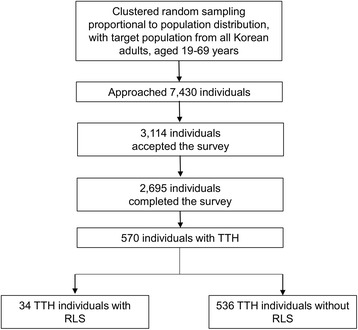
We selected a stratified random population sample of Koreans aged 19-69 years and assessed them using a semi-structured interview designed to identify RLS, headache type, and clinical characteristics of TTH. We determined the prevalence and clinical impact of RLS in participants with TTH.
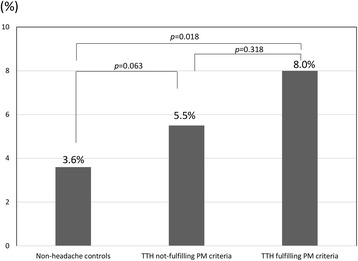
Of the 2695 participants, 570 (21.2%) and 142 (5.3%) were classified as having TTH and RLS, respectively. Among the 570 individuals with TTH, 113 (19.8%) also met the criteria for probable migraine (PM). The prevalence of RLS was significantly higher among individuals with TTH than among those with non-headache (6.0% vs 3.6%, p = 0.018). The prevalence of RLS was significantly higher in subjects with TTH who fulfilled PM criteria than in those with non-headache participants (8.0% vs. 3.6%, p = 0.018). However, RLS prevalence in individuals with TTH who did not fulfil PM criteria did not differ from that of participants with non-headache (5.5% vs. 3.6%, p = 0.063). TTH participants with RLS had higher visual analogue scale scores for headache intensity (5.1 ± 2.0 vs. 4.3 ± 1.8, p = 0.038), and higher prevalence of anxiety (20.6% vs. 8.8%, p = 0.022) and depression (14.7% vs. 3.5%, p = 0.002) than TTH participants without RLS. Multivariable analyses revealed that headache aggravation by movement (odds ratio [OR] = 2.4, 95% confidence interval [CI] = 1.1-5.2) and depression (OR = 3.5, 95% CI = 1.1-11.4) were significant indicators of RLS among individuals with TTH.
The prevalence of RLS was higher among individuals with TTH than among those with non-headache. Some clinical presentations varied in accordance with the presence of RLS among participants with TTH.
近期研究表明,不宁腿综合征(RLS)与原发性头痛疾病之间存在显著关联。然而,关于紧张型头痛(TTH)与RLS之间关联的信息有限。本研究旨在调查基于人群样本中RLS与TTH之间的关联。
我们选取了19 - 69岁韩国人的分层随机人群样本,并使用半结构化访谈对他们进行评估,该访谈旨在确定RLS、头痛类型以及TTH的临床特征。我们确定了TTH患者中RLS的患病率及其临床影响。
在2695名参与者中,分别有570人(21.2%)和142人(5.3%)被分类为患有TTH和RLS。在570名患有TTH的个体中,113人(19.8%)也符合可能偏头痛(PM)的标准。TTH患者中RLS的患病率显著高于无头痛者(6.0%对3.6%,p = 0.018)。符合PM标准的TTH患者中RLS的患病率显著高于无头痛参与者(8.0%对3.6%,p = 0.018)。然而,未符合PM标准的TTH患者中RLS的患病率与无头痛参与者的患病率无差异(5.5%对3.6%,p = 0.063)。患有RLS的TTH患者在头痛强度的视觉模拟量表评分更高(5.1±2.0对4.3±1.8,p = 0.038),焦虑患病率(20.6%对8.8%,p = 0.022)和抑郁患病率(14.7%对3.5%,p = 0.002)也高于未患RLS的TTH患者。多变量分析显示,运动可加重头痛(比值比[OR]=2.4,95%置信区间[CI]=1.1 - 5.2)和抑郁(OR = 3.5,95% CI = 1.1 - 11.4)是TTH患者中RLS的重要指标。
TTH患者中RLS的患病率高于无头痛者。在患有TTH的参与者中,一些临床表现因RLS的存在而有所不同。