Department of Neurology, BioMedical Research Institute, Pusan National University Hospital, Pusan National University School of Medicine, Busan, South Korea.
Department of Neurology, Dongtan Sacred Heart Hospital, Hallym University College of Medicine, Hwaseong, South Korea.
J Headache Pain. 2018 Sep 14;19(1):86. doi: 10.1186/s10194-018-0916-5.
Insomnia and migraine are closely related; insomnia aggravates migraine symptoms. This study was conducted to investigate the impact of migraine on the clinical presentation of insomnia symptoms.
The data of the Korean Headache-Sleep Study (KHSS) were used in the present study. The KHSS is a nation-wide cross-sectional population-based survey regarding headache and sleep in Korean adults aged 19 to 69 years. If a participant's Insomnia Severity Index (ISI) score ≥ 10, she/he was classified as having insomnia. The clinical presentation of insomnia symptoms was assessed using total and subcomponent scores of the ISI.
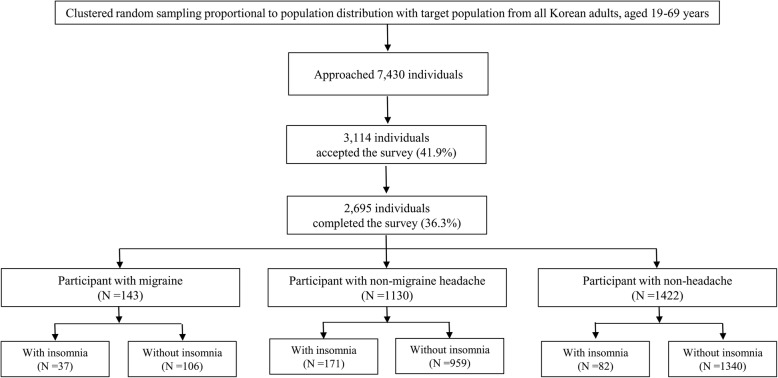
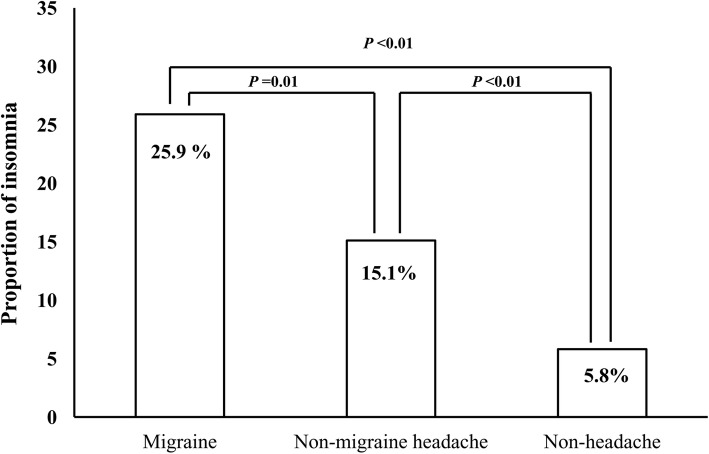
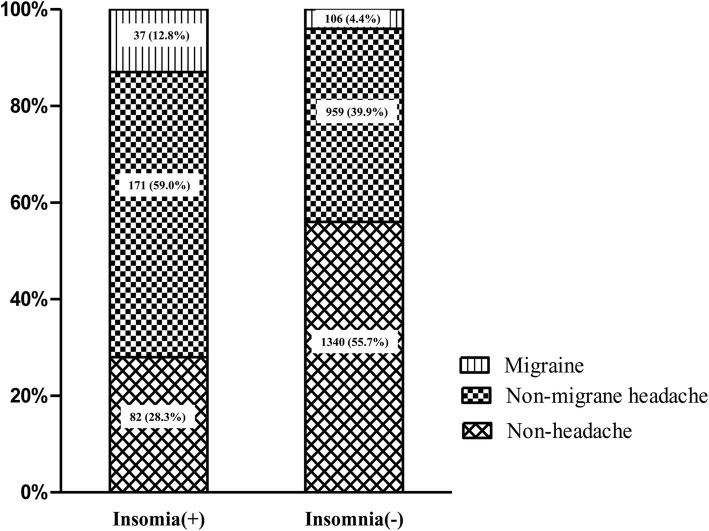
Of 2695 participants, 290 (10.8%) and 143 (5.3%) individuals were assigned as having insomnia and migraine, respectively. The proportions of migraine (12.8% vs. 4.4%, p < 0.001) and non-migraine headache (59.0% vs. 39.9%, p < 0.001) were higher among individuals with insomnia compared to those without insomnia. Among participants with insomnia, total ISI scores were not significantly different among participants with migraine, non-migraine, and non-headache [median and interquartile range: 13.0 (11.0-17.5) vs. 13.0 (11.0-17.5) vs. 12.0 (11.0-16.0), p = 0.245]. ISI scores for noticeability of sleep problems to others were significantly higher among participants with migraine [3.0 (2.0-4.0) vs. 2.0 (2.0-3.0), p = 0.011] and non-migraine headache [3.0 (2.0-4.0) vs. 2.0 (2.0-3.0), p = 0.001] compared to those without headache history. Other ISI subcomponent scores did not significantly differ between headache status groups.
Participants with insomnia had an increased risk of migraine and non-migraine headache compared to those without insomnia. Among participants with insomnia, overall insomnia severity was not significantly influenced by the headache status.
失眠和偏头痛密切相关;失眠会加重偏头痛症状。本研究旨在探讨偏头痛对失眠症状临床表现的影响。
本研究使用了韩国头痛-睡眠研究(KHSS)的数据。KHSS 是一项针对韩国 19 至 69 岁成年人头痛和睡眠的全国性横断面人群调查。如果参与者的失眠严重程度指数(ISI)得分≥10,则将其归类为患有失眠。使用 ISI 的总分和子成分得分评估失眠症状的临床表现。
在 2695 名参与者中,290 名(10.8%)和 143 名(5.3%)分别被诊断为失眠和偏头痛。与无失眠者相比,失眠者中偏头痛(12.8%比 4.4%,p<0.001)和非偏头痛性头痛(59.0%比 39.9%,p<0.001)的比例更高。在失眠者中,偏头痛、非偏头痛和无头痛患者的总 ISI 评分无显著差异[中位数和四分位距:13.0(11.0-17.5)比 13.0(11.0-17.5)比 12.0(11.0-16.0),p=0.245]。偏头痛[3.0(2.0-4.0)比 2.0(2.0-3.0),p=0.011]和非偏头痛性头痛[3.0(2.0-4.0)比 2.0(2.0-3.0),p=0.001]患者中他人对睡眠问题的察觉程度的 ISI 评分显著高于无头痛史的患者。头痛状态组间其他 ISI 子成分评分无显著差异。
与无失眠者相比,失眠者偏头痛和非偏头痛性头痛的风险增加。在失眠者中,整体失眠严重程度不受头痛状况的显著影响。