School of Life Sciences, Nanchang University, Nanchang, Jiangxi 330031, China.
State Key Laboratory of Food Science and Technology, Nanchang University, Nanchang, Jiangxi 330031, China.
Sci Rep. 2017 Apr 20;7:46579. doi: 10.1038/srep46579.
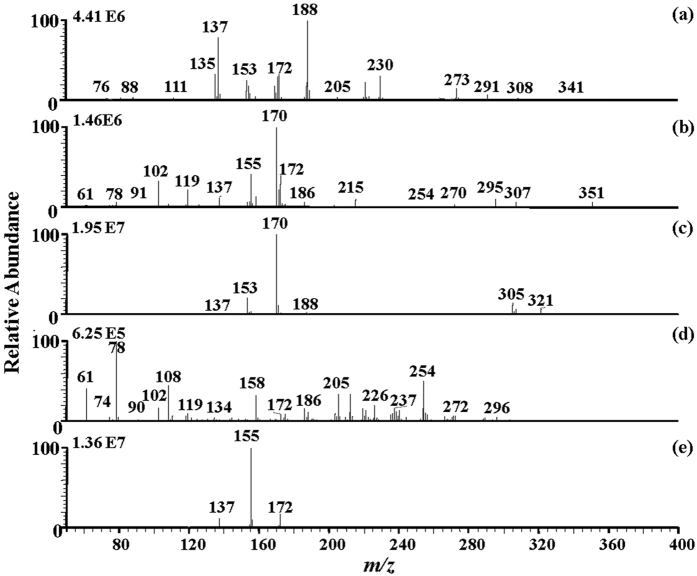
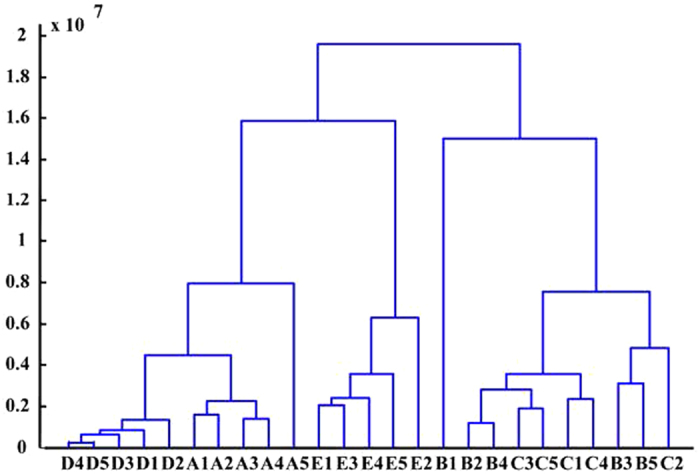
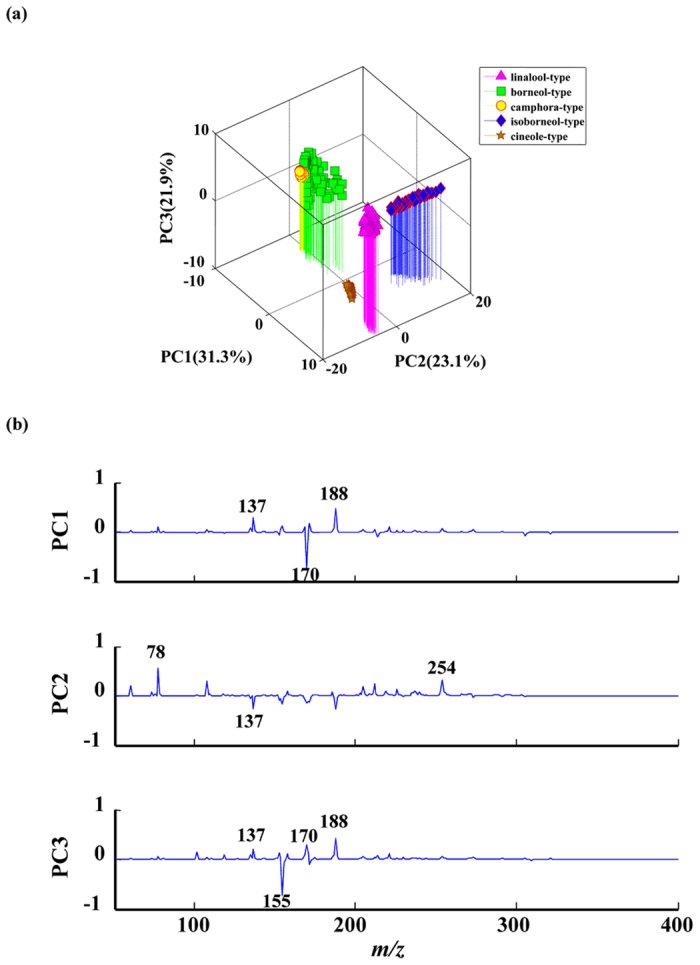
Five chemotypes, the isoborneol-type, camphora-type, cineole-type, linalool-type and borneol-type of Cinnamomum camphora (L.) Presl have been identified at the molecular level based on the multivariate analysis of mass spectral fingerprints recorded from a total of 750 raw leaf samples (i.e., 150 leaves equally collected for each chemotype) using desorption atmospheric pressure chemical ionization mass spectrometry (DAPCI-MS). Both volatile and semi-volatile metabolites of the fresh leaves of C. camphora were simultaneously detected by DAPCI-MS without any sample pretreatment, reducing the analysis time from half a day using conventional methods (e.g., GC-MS) down to 30 s. The pattern recognition results obtained using principal component analysis (PCA) was cross-checked by cluster analysis (CA), showing that the difference visualized by the DAPCI-MS spectral fingerprints was validated with 100% accuracy. The study demonstrates that DAPCI-MS meets the challenging requirements for accurate differentiation of all the five chemotypes of C. camphora leaves, motivating more advanced application of DAPCI-MS in plant science and forestry studies.
基于对总共 750 个原始叶片样本(即每个化学型各采集 150 个叶片)的质谱指纹图谱的多元分析,利用解吸常压化学电离质谱(DAPCI-MS),从分子水平上鉴定了 5 种樟属(L.)樟化学型,即异龙脑型、樟脑型、桉油醇型、芳樟醇型和龙脑型。DAPCI-MS 无需任何样品预处理,可同时检测新鲜樟叶的挥发性和半挥发性代谢物,分析时间从使用传统方法(例如 GC-MS)的半天缩短至 30s。主成分分析(PCA)得到的模式识别结果通过聚类分析(CA)进行交叉检查,表明 DAPCI-MS 光谱指纹图可视化的差异具有 100%的准确性。该研究表明,DAPCI-MS 满足准确区分所有 5 种樟属叶片化学型的苛刻要求,激励了 DAPCI-MS 在植物科学和林业研究中的更先进应用。