• 文献检索
  • 文档翻译
  • 深度研究
  • 学术资讯
  • Suppr Zotero 插件Zotero 插件
  • 邀请有礼
  • 套餐&价格
  • 历史记录
应用&插件
Suppr Zotero 插件Zotero 插件浏览器插件Mac 客户端Windows 客户端微信小程序
定价
高级版会员购买积分包购买API积分包
服务
文献检索文档翻译深度研究API 文档MCP 服务
关于我们
关于 Suppr公司介绍联系我们用户协议隐私条款
关注我们

Suppr 超能文献

核心技术专利:CN118964589B侵权必究
粤ICP备2023148730 号-1Suppr @ 2026

文献检索

告别复杂PubMed语法,用中文像聊天一样搜索,搜遍4000万医学文献。AI智能推荐,让科研检索更轻松。

立即免费搜索

文件翻译

保留排版,准确专业,支持PDF/Word/PPT等文件格式,支持 12+语言互译。

免费翻译文档

深度研究

AI帮你快速写综述,25分钟生成高质量综述,智能提取关键信息,辅助科研写作。

立即免费体验

含糖及人工甜味饮料与新发中风和痴呆症风险:一项前瞻性队列研究。

Sugar- and Artificially Sweetened Beverages and the Risks of Incident Stroke and Dementia: A Prospective Cohort Study.

作者信息

Pase Matthew P, Himali Jayandra J, Beiser Alexa S, Aparicio Hugo J, Satizabal Claudia L, Vasan Ramachandran S, Seshadri Sudha, Jacques Paul F

机构信息

From the Department of Neurology (M.P.P., J.J.H., A.S.B., H.J.A., C.L.S., S.S.) and Sections of Preventive Medicine and Epidemiology, Department of Medicine (R.S.V), Boston University School of Medicine, MA; Framingham Heart Study, MA (M.P.P., J.J.H., A.S.B., H.J.A., C.L.S., R.S.V., S.S., P.F.J.); Centre for Human Psychopharmacology, Swinburne University of Technology, Australia (M.P.P.); Department of Biostatistics (J.J.H., A.S.B.) and Department of Epidemiology (R.S.V.), Boston University School of Public Health, MA; and Jean Mayer US Department of Agriculture Human Nutrition Research Center on Aging, Tufts University, Boston, MA (P.F.J.).

出版信息

Stroke. 2017 May;48(5):1139-1146. doi: 10.1161/STROKEAHA.116.016027.

DOI:10.1161/STROKEAHA.116.016027
PMID:28428346
原文链接:https://pmc.ncbi.nlm.nih.gov/articles/PMC5405737/
Abstract

BACKGROUND AND PURPOSE

Sugar- and artificially-sweetened beverage intake have been linked to cardiometabolic risk factors, which increase the risk of cerebrovascular disease and dementia. We examined whether sugar- or artificially sweetened beverage consumption was associated with the prospective risks of incident stroke or dementia in the community-based Framingham Heart Study Offspring cohort.

METHODS

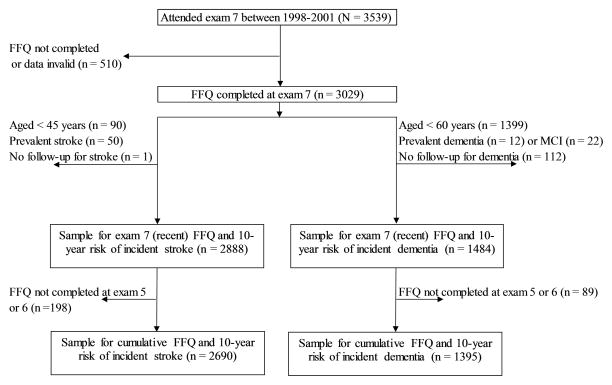
We studied 2888 participants aged >45 years for incident stroke (mean age 62 [SD, 9] years; 45% men) and 1484 participants aged >60 years for incident dementia (mean age 69 [SD, 6] years; 46% men). Beverage intake was quantified using a food-frequency questionnaire at cohort examinations 5 (1991-1995), 6 (1995-1998), and 7 (1998-2001). We quantified recent consumption at examination 7 and cumulative consumption by averaging across examinations. Surveillance for incident events commenced at examination 7 and continued for 10 years. We observed 97 cases of incident stroke (82 ischemic) and 81 cases of incident dementia (63 consistent with Alzheimer's disease).

RESULTS

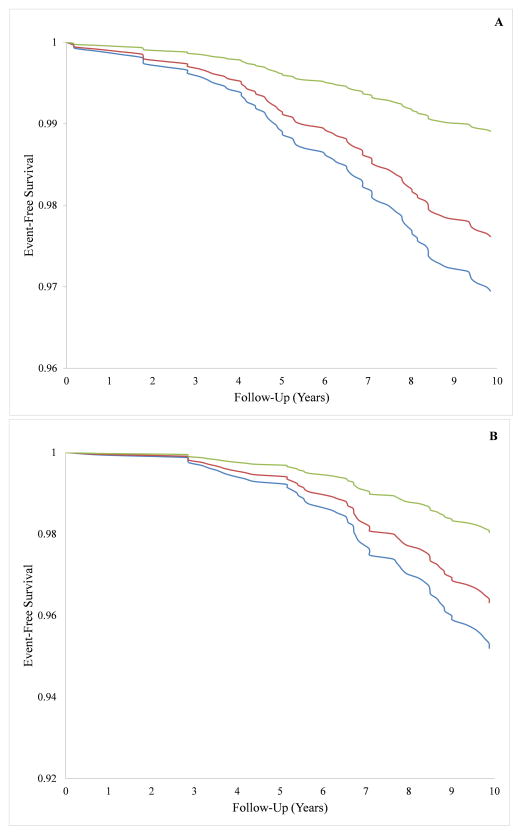
After adjustments for age, sex, education (for analysis of dementia), caloric intake, diet quality, physical activity, and smoking, higher recent and higher cumulative intake of artificially sweetened soft drinks were associated with an increased risk of ischemic stroke, all-cause dementia, and Alzheimer's disease dementia. When comparing daily cumulative intake to 0 per week (reference), the hazard ratios were 2.96 (95% confidence interval, 1.26-6.97) for ischemic stroke and 2.89 (95% confidence interval, 1.18-7.07) for Alzheimer's disease. Sugar-sweetened beverages were not associated with stroke or dementia.

CONCLUSIONS

Artificially sweetened soft drink consumption was associated with a higher risk of stroke and dementia.

摘要

背景与目的

含糖及人工甜味饮料的摄入与心血管代谢危险因素相关,而这些因素会增加脑血管疾病和痴呆的风险。在基于社区的弗雷明汉心脏研究后代队列中,我们研究了饮用含糖或人工甜味饮料是否与发生中风或痴呆的前瞻性风险相关。

方法

我们对2888名年龄大于45岁的参与者进行了中风发病情况研究(平均年龄62岁[标准差9岁];男性占45%),对1484名年龄大于60岁的参与者进行了痴呆发病情况研究(平均年龄69岁[标准差6岁];男性占46%)。在队列检查第5次(1991 - 1995年)、第6次(1995 - 1998年)和第7次(1998 - 2001年)时,使用食物频率问卷对饮料摄入量进行量化。我们在检查第7次时量化近期摄入量,并通过对各次检查结果求平均值来量化累积摄入量。对发病事件的监测从检查第7次开始,持续10年。我们观察到97例中风发病病例(82例为缺血性中风)和81例痴呆发病病例(63例符合阿尔茨海默病)。

结果

在对年龄、性别、教育程度(用于痴呆分析)、热量摄入、饮食质量、身体活动和吸烟进行调整后,人工甜味软饮料近期和累积摄入量较高与缺血性中风、全因痴呆和阿尔茨海默病痴呆风险增加相关。将每日累积摄入量与每周0份(参照值)进行比较时,缺血性中风的风险比为2.96(95%置信区间,1.26 - 6.97),阿尔茨海默病的风险比为2.89(95%置信区间,1.18 - 7.07)。含糖饮料与中风或痴呆无关。

结论

饮用人工甜味软饮料与中风和痴呆风险较高相关。

https://cdn.ncbi.nlm.nih.gov/pmc/blobs/96d5/5405737/807f97f45bae/nihms860316f2.jpg
https://cdn.ncbi.nlm.nih.gov/pmc/blobs/96d5/5405737/06056e85f885/nihms860316f1.jpg
https://cdn.ncbi.nlm.nih.gov/pmc/blobs/96d5/5405737/807f97f45bae/nihms860316f2.jpg
https://cdn.ncbi.nlm.nih.gov/pmc/blobs/96d5/5405737/06056e85f885/nihms860316f1.jpg
https://cdn.ncbi.nlm.nih.gov/pmc/blobs/96d5/5405737/807f97f45bae/nihms860316f2.jpg

相似文献

1
Sugar- and Artificially Sweetened Beverages and the Risks of Incident Stroke and Dementia: A Prospective Cohort Study.含糖及人工甜味饮料与新发中风和痴呆症风险:一项前瞻性队列研究。
Stroke. 2017 May;48(5):1139-1146. doi: 10.1161/STROKEAHA.116.016027.
2
Consumption of soft drinks and juices and risk of liver and biliary tract cancers in a European cohort.欧洲队列中软饮料和果汁的消费与肝胆道癌症风险
Eur J Nutr. 2016 Feb;55(1):7-20. doi: 10.1007/s00394-014-0818-5. Epub 2014 Dec 21.
3
Association Between Artificially Sweetened Beverage Consumption During Pregnancy and Infant Body Mass Index.孕期人工甜味饮料摄入与婴儿体重指数的关系。
JAMA Pediatr. 2016 Jul 1;170(7):662-70. doi: 10.1001/jamapediatrics.2016.0301.
4
Sugar in Beverage and the Risk of Incident Dementia, Alzheimer's Disease and Stroke: A Prospective Cohort Study.饮料中的糖分与新发痴呆症、阿尔茨海默病和中风风险:一项前瞻性队列研究
J Prev Alzheimers Dis. 2021;8(2):188-193. doi: 10.14283/jpad.2020.62.
5
Sweetened Beverage Intake and Incident Chronic Kidney Disease in the UK Biobank Study.含糖饮料摄入与英国生物库研究中的慢性肾脏病发病关系。
JAMA Netw Open. 2024 Feb 5;7(2):e2356885. doi: 10.1001/jamanetworkopen.2023.56885.
6
Consumption of sugar sweetened beverages, artificially sweetened beverages, and fruit juice and incidence of type 2 diabetes: systematic review, meta-analysis, and estimation of population attributable fraction.含糖饮料、人工甜味饮料和果汁的摄入量与2型糖尿病发病率:系统评价、荟萃分析及人群归因分数估计
Br J Sports Med. 2016 Apr;50(8):496-504. doi: 10.1136/bjsports-2016-h3576rep.
7
Sweetened beverage consumption, incident coronary heart disease, and biomarkers of risk in men.含糖饮料摄入与男性冠心病事件及风险标志物
Circulation. 2012 Apr 10;125(14):1735-41, S1. doi: 10.1161/CIRCULATIONAHA.111.067017. Epub 2012 Mar 12.
8
Consumption of caffeinated and artificially sweetened soft drinks is associated with risk of early menarche.饮用含咖啡因和人工甜味剂的软饮料与初潮过早的风险相关。
Am J Clin Nutr. 2015 Sep;102(3):648-54. doi: 10.3945/ajcn.114.100958. Epub 2015 Jul 15.
9
Frequent Consumption of Sugar- and Artificially Sweetened Beverages and Natural and Bottled Fruit Juices Is Associated with an Increased Risk of Metabolic Syndrome in a Mediterranean Population at High Cardiovascular Disease Risk.在地中海地区心血管疾病高风险人群中,经常饮用含糖饮料、人工甜味剂饮料以及天然和瓶装果汁与代谢综合征风险增加有关。
J Nutr. 2016 Aug;146(8):1528-36. doi: 10.3945/jn.116.230367. Epub 2016 Jun 29.
10
No difference in ad libitum energy intake in healthy men and women consuming beverages sweetened with fructose, glucose, or high-fructose corn syrup: a randomized trial.健康男性和女性饮用用果糖、葡萄糖或高果糖玉米糖浆调味的饮料时,随意能量摄入量无差异:一项随机试验。
Am J Clin Nutr. 2015 Dec;102(6):1373-80. doi: 10.3945/ajcn.115.116368. Epub 2015 Nov 4.

引用本文的文献

1
Aspartame and ischemic stroke: unraveling the molecular link through network toxicology and molecular docking analysis.阿斯巴甜与缺血性中风:通过网络毒理学和分子对接分析揭示分子联系
Sci Rep. 2025 Jul 4;15(1):23871. doi: 10.1038/s41598-025-08898-z.
2
Epidemiology and future trend predictions of ischemic stroke based on the global burden of disease study 1990-2021.基于1990 - 2021年全球疾病负担研究的缺血性卒中流行病学及未来趋势预测
Commun Med (Lond). 2025 Jul 3;5(1):273. doi: 10.1038/s43856-025-00939-y.
3
Sweetened Beverages and Incident All-Cause Dementia Among Older Adults.

本文引用的文献

1
Association of Ideal Cardiovascular Health With Vascular Brain Injury and Incident Dementia.理想心血管健康与血管性脑损伤及新发痴呆症的关联
Stroke. 2016 May;47(5):1201-6. doi: 10.1161/STROKEAHA.115.012608. Epub 2016 Apr 12.
2
Type 2 Diabetes as a Risk Factor for Dementia in Women Compared With Men: A Pooled Analysis of 2.3 Million People Comprising More Than 100,000 Cases of Dementia.与男性相比,2型糖尿病作为女性痴呆症的危险因素:对230万人进行的汇总分析,其中包括超过10万例痴呆症病例。
Diabetes Care. 2016 Feb;39(2):300-7. doi: 10.2337/dc15-1588. Epub 2015 Dec 17.
3
Consumption of sugar sweetened beverages, artificially sweetened beverages, and fruit juice and incidence of type 2 diabetes: systematic review, meta-analysis, and estimation of population attributable fraction.
老年人饮用含糖饮料与全因性痴呆症发病情况
JAMA Psychiatry. 2025 Jun 18. doi: 10.1001/jamapsychiatry.2025.1230.
4
Network Approach to Evaluate the Effect of Diet on Stroke or Myocardial Infarction Using Gaussian Graphical Model.使用高斯图形模型评估饮食对中风或心肌梗死影响的网络方法。
Nutrients. 2025 May 8;17(10):1605. doi: 10.3390/nu17101605.
5
Brazilian front-of-package nutrition labelling and food additives: an approach to identify ultra-processed food products.巴西包装正面营养标签与食品添加剂:一种识别超加工食品的方法。
Br J Nutr. 2025 Jun 14;133(11):1466-1472. doi: 10.1017/S000711452500090X. Epub 2025 May 19.
6
Impacts of non-nutritive sweeteners on the human microbiome.非营养性甜味剂对人体微生物群的影响。
Immunometabolism (Cobham). 2025 Apr 24;7(2):e00060. doi: 10.1097/IN9.0000000000000060. eCollection 2025 Apr.
7
Life span policies and macroeconomic transition will help the 21st-century brain health revolution in developing countries.寿命政策和宏观经济转型将助力发展中国家的21世纪脑健康革命。
Alzheimers Dement. 2025 Feb;21(2):e70006. doi: 10.1002/alz.70006.
8
Ultra-processed food consumption and risk of dementia and Alzheimer's disease: The Framingham Heart Study.超加工食品的消费与痴呆症和阿尔茨海默病的风险:弗雷明汉心脏研究
J Prev Alzheimers Dis. 2025 Feb;12(2):100042. doi: 10.1016/j.tjpad.2024.100042. Epub 2025 Jan 1.
9
Prevalence and Predictors of the Use of Low-Calorie Sweeteners Among Non-Pregnant, Non-Lactating Women of Reproductive Age in Australia.澳大利亚育龄非妊娠非哺乳期妇女使用低热量甜味剂的流行情况及其预测因素。
Nutrients. 2024 Nov 20;16(22):3963. doi: 10.3390/nu16223963.
10
Dietary patterns and cardiorespiratory fitness in midlife and subsequent all-cause dementia: findings from the cooper center longitudinal study.饮食习惯模式与中年时期的心肺功能健康状况及其与后续全因痴呆的关系:来自库珀中心纵向研究的结果。
Int J Behav Nutr Phys Act. 2024 Sep 27;21(1):109. doi: 10.1186/s12966-024-01663-x.
含糖饮料、人工甜味剂饮料和果汁的摄入与2型糖尿病发病率:系统评价、荟萃分析及人群归因分数估计
BMJ. 2015 Jul 21;351:h3576. doi: 10.1136/bmj.h3576.
4
Diet soda intake is associated with long-term increases in waist circumference in a biethnic cohort of older adults: the San Antonio Longitudinal Study of Aging.在一个老年双种族队列(圣安东尼奥衰老纵向研究)中,饮用无糖汽水与腰围的长期增加有关。
J Am Geriatr Soc. 2015 Apr;63(4):708-15. doi: 10.1111/jgs.13376. Epub 2015 Mar 17.
5
Artificial sweeteners induce glucose intolerance by altering the gut microbiota.人工甜味剂通过改变肠道微生物群诱导葡萄糖不耐受。
Nature. 2014 Oct 9;514(7521):181-6. doi: 10.1038/nature13793. Epub 2014 Sep 17.
6
The global prevalence of dementia: a systematic review and metaanalysis.全球痴呆症患病率:系统评价和荟萃分析。
Alzheimers Dement. 2013 Jan;9(1):63-75.e2. doi: 10.1016/j.jalz.2012.11.007.
7
Low-calorie sweetener consumption is increasing in the United States.美国低卡路里甜味剂的消费正在增加。
Am J Clin Nutr. 2012 Sep;96(3):640-6. doi: 10.3945/ajcn.112.034751. Epub 2012 Aug 1.
8
Nonnutritive sweeteners: current use and health perspectives: a scientific statement from the American Heart Association and the American Diabetes Association.非营养性甜味剂:当前使用情况与健康展望:美国心脏协会和美国糖尿病协会的科学声明
Circulation. 2012 Jul 24;126(4):509-19. doi: 10.1161/CIR.0b013e31825c42ee. Epub 2012 Jul 9.
9
Soda consumption and the risk of stroke in men and women.苏打水消费与男性和女性中风风险的关系。
Am J Clin Nutr. 2012 May;95(5):1190-9. doi: 10.3945/ajcn.111.030205. Epub 2012 Apr 4.
10
Diet soft drink consumption is associated with an increased risk of vascular events in the Northern Manhattan Study.在北方曼哈顿研究中,饮用低热量软饮料与血管事件风险增加相关。
J Gen Intern Med. 2012 Sep;27(9):1120-6. doi: 10.1007/s11606-011-1968-2. Epub 2012 Jan 27.