The Mind Research Network and Lovelace Biomedical and Environmental Research Institute, 1101 Yale Blvd NE, Albuquerque, NM, 87106, USA.
Department of Psychiatry, Oregon Health & Science University, 3181 SW Sam Jackson Park Rd, Mail Code: DC7P, Portland, OR, 97239, USA.
Brain Imaging Behav. 2018 Apr;12(2):564-576. doi: 10.1007/s11682-017-9723-x.
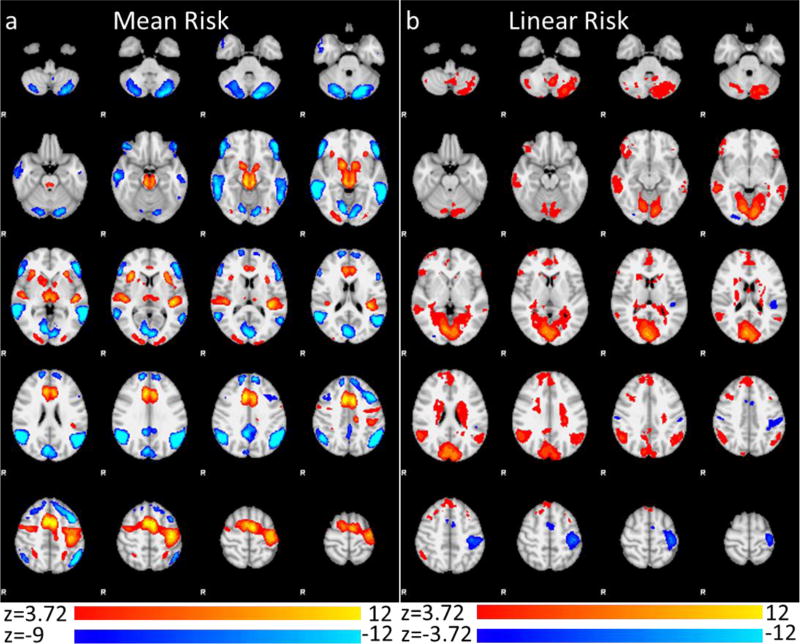
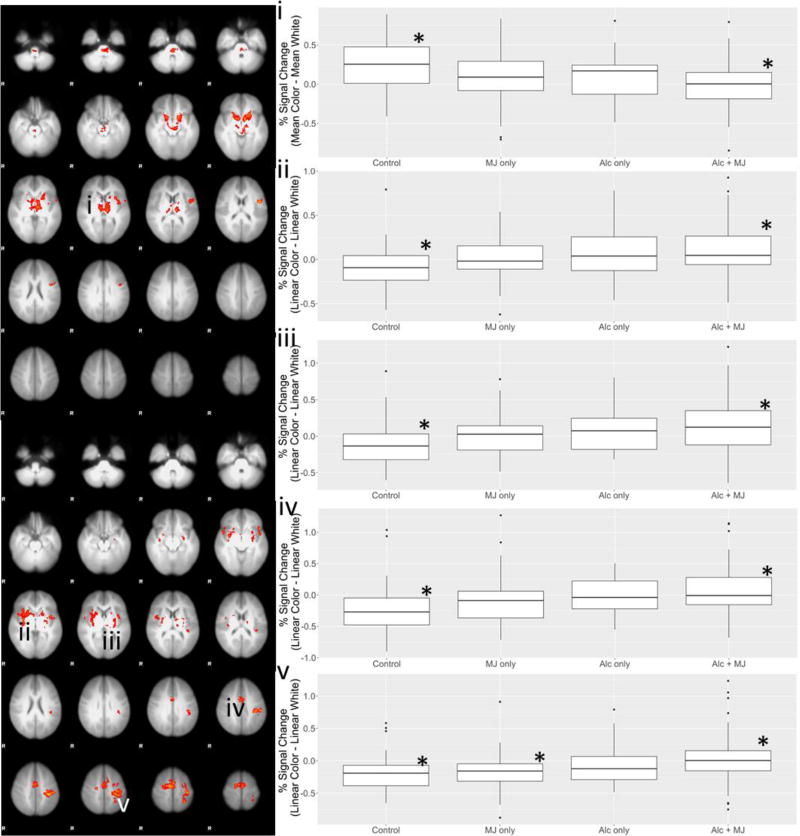
Because adolescence is a period of heightened exploration of new behaviors, there is a natural increase in risk taking including initial use of alcohol and marijuana. In order to better understand potential differences in neurocognitive functioning among adolescents who use drugs, the current study aimed to identify the neural substrates of risky decision making that differ among adolescents who are primary users of alcohol or marijuana, primary users of both alcohol and marijuana, and controls who report primary use of neither drug. Participants completed the Balloon Analogue Risk Task (BART) while undergoing functional magnetic resonance imaging. Comparison of brain activation during risky decisions versus non-risky decisions across all subjects revealed greater response to risky decisions in dorsal anterior cinguate cortex (dACC), anterior insula, ventral striatum, and lateral prefrontal cortex. Group comparisons across non-using controls, primary marijuana, primary alcohol, and alcohol and marijuana users revealed several notable differences in the recruitment of brain regions. Adolescents who use both alcohol and marijauna show decreased response during risky decision making compared to controls in insula, striatum, and thalamus, and reduced differentiation of increasing risk in dACC, insula, striatum, and superior parietal lobe compared to controls. These results provide evidence of differential engagement of risky decision making circuits among adolescents with varying levels of alcohol and marijuana use, and may provide useful targets for longitudinal studies that explicitly address causality of these differences.
由于青少年时期是探索新行为的高峰期,因此冒险行为(包括初次使用酒精和大麻)的风险自然会增加。为了更好地了解使用毒品的青少年在神经认知功能方面的潜在差异,本研究旨在确定在使用毒品的青少年中,不同的神经基础,这些青少年包括主要使用酒精或大麻的青少年、同时使用酒精和大麻的青少年,以及报告主要使用这两种药物之一的青少年。参与者在进行功能磁共振成像的同时完成了气球模拟风险任务(BART)。对所有受试者在冒险决策和非冒险决策期间的大脑激活进行比较,结果发现背侧前扣带皮层(dACC)、前岛叶、腹侧纹状体和外侧前额叶在冒险决策中反应更大。在非使用对照组、主要使用大麻组、主要使用酒精组和同时使用酒精和大麻组之间进行的组间比较显示,大脑区域的募集存在一些显著差异。与对照组相比,同时使用酒精和大麻的青少年在岛叶、纹状体和丘脑的冒险决策中反应减弱,在 dACC、岛叶、纹状体和顶叶上回的风险递增分化减少。这些结果提供了不同酒精和大麻使用水平的青少年在冒险决策回路中存在差异的证据,并且可能为明确解决这些差异因果关系的纵向研究提供有用的目标。