Hilborn Erik, Stål Olle, Jansson Agneta
Department of Clinical and Experimental Medicine and Department of Oncology, Faculty of Health Sciences, Linköping University, Linköping, Sweden.
Oncotarget. 2017 May 2;8(18):30552-30562. doi: 10.18632/oncotarget.15547.
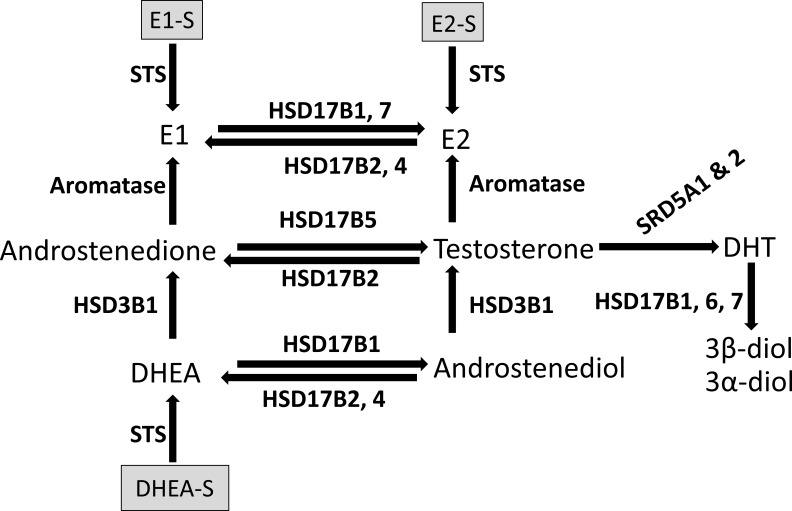
Sex steroid hormones such as estrogens and androgens are involved in the development and differentiation of the breast tissue. The activity and concentration of sex steroids is determined by the availability from the circulation, and on local conversion. This conversion is primarily mediated by aromatase, steroid sulfatase, and 17β-hydroxysteroid dehydrogenases. In postmenopausal women, this is the primary source of estrogens in the breast. Up to 70-80% of all breast cancers express the estrogen receptor-α, responsible for promoting the growth of the tissue. Further, 60-80% express the androgen receptor, which has been shown to have tissue protective effects in estrogen receptor positive breast cancer, and a more ambiguous response in estrogen receptor negative breast cancers. In this review, we summarize the function and clinical relevance in cancer for 17β-hydroxysteroid dehydrogenases 1, which facilitates the reduction of estrone to estradiol, dehydroepiandrosterone to androstendiol and dihydrotestosterone to 3α- and 3β-diol as well as 17β-hydroxysteroid dehydrogenases 2 which mediates the oxidation of estradiol to estrone, testosterone to androstenedione and androstendiol to dehydroepiandrosterone. The expression of 17β-hydroxysteroid dehydrogenases 1 and 2 alone and in combination has been shown to predict patient outcome, and inhibition of 17β-hydroxysteroid dehydrogenases 1 has been proposed to be a prime candidate for inhibition in patients who develop aromatase inhibitor resistance or in combination with aromatase inhibitors as a first line treatment. Here we review the status of inhibitors against 17β-hydroxysteroid dehydrogenases 1. In addition, we review the involvement of 17β-hydroxysteroid dehydrogenases 4, 5, 7, and 14 in breast cancer.
雌激素和雄激素等性甾体激素参与乳腺组织的发育和分化。性甾体激素的活性和浓度取决于循环中的可利用性以及局部转化。这种转化主要由芳香化酶、类固醇硫酸酯酶和17β-羟基类固醇脱氢酶介导。在绝经后女性中,这是乳腺中雌激素的主要来源。高达70 - 80%的乳腺癌表达雌激素受体-α,其负责促进组织生长。此外,60 - 80%表达雄激素受体,雄激素受体在雌激素受体阳性乳腺癌中已显示具有组织保护作用,而在雌激素受体阴性乳腺癌中的反应则更为模糊。在本综述中,我们总结了17β-羟基类固醇脱氢酶1在癌症中的功能和临床相关性,该酶促进雌酮还原为雌二醇、脱氢表雄酮还原为雄烯二醇以及双氢睾酮还原为3α-二醇和3β-二醇,同时也总结了17β-羟基类固醇脱氢酶2的功能,其介导雌二醇氧化为雌酮、睾酮氧化为雄烯二酮以及雄烯二醇氧化为脱氢表雄酮。单独或联合表达17β-羟基类固醇脱氢酶1和2已被证明可预测患者预后,并且有人提出抑制17β-羟基类固醇脱氢酶1是对芳香化酶抑制剂产生耐药性的患者或与芳香化酶抑制剂联合作为一线治疗的患者进行抑制的主要候选方法。在此我们综述针对17β-羟基类固醇脱氢酶l的抑制剂的研究现状。此外,我们还综述了17β-羟基类固醇脱氢酶4、5、7和14在乳腺癌中的作用。