Gillespie Brigid M, Hamilton Kyra, Ball Dianne, Lavin Joanne, Gardiner Therese, Withers Teresa K, Marshall Andrea P
School of Nursing & Midwifery, Griffith University, Gold Coast.
Gold Coast University Hospital and Health Service, Southport.
J Multidiscip Healthc. 2017 Apr 5;10:157-166. doi: 10.2147/JMDH.S124298. eCollection 2017.
Compliance with surgical safety checklists (SSCs) has been associated with improvements in clinical processes such as antibiotic use, correct site marking, and overall safety processes. Yet, proper execution has been difficult to achieve.
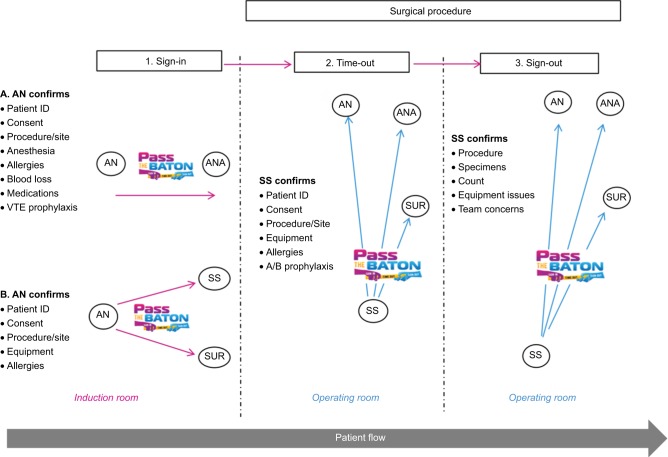
The objective of this study was to undertake a process evaluation of four knowledge translation (KT) strategies used to implement the Pass the Baton (PTB) intervention which was designed to improve utilization of the SSC.
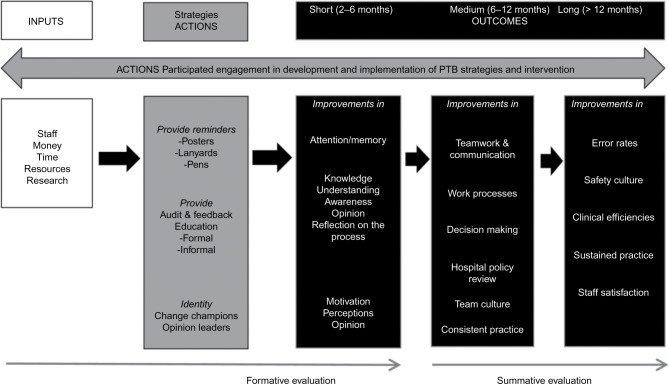
As part of the process evaluation, a logic model was generated to explain which KT strategies worked well (or less well) in the operating rooms of a tertiary referral hospital in Queensland, Australia. The KT strategies implemented included change champions/opinion leaders, education, audit and feedback, and reminders. In evaluating the implementation of these strategies, this study considered context, intervention and underpinning assumptions, implementation, and mechanism of impact. Observational and interview data were collected to assess implementation of the KT strategies relative to fidelity, feasibility, and acceptability.
Findings from 35 structured observations and 15 interviews with 96 intervention participants suggest that all of the KT strategies were consistently implemented. Of the 220 staff working in the department, that is, nurses, anesthetists, and surgeons, 160 (72.7%) knew about the PTB strategies. Qualitative analysis revealed that implementation was generally feasible and acceptable. A barrier to feasibility was physician engagement. An impediment to acceptability was participants' skepticism about the ability of the KT strategies to effect behavioral change.
Overall, results of this evaluation suggest that success of implementation was moderate. Given the probable impact of contextual factors, that is, team culture and the characteristics of participants, the KT strategies may need modification prior to widespread implementation.
遵守手术安全核对表(SSCs)与抗生素使用、正确手术部位标记及整体安全流程等临床过程的改善相关。然而,要实现正确执行却很困难。
本研究的目的是对用于实施接力棒传递(PTB)干预措施的四种知识转化(KT)策略进行过程评估,该干预措施旨在提高手术安全核对表的利用率。
作为过程评估的一部分,构建了一个逻辑模型,以解释在澳大利亚昆士兰州一家三级转诊医院的手术室中,哪些KT策略效果良好(或欠佳)。实施的KT策略包括变革推动者/意见领袖、教育、审核与反馈以及提醒。在评估这些策略的实施情况时,本研究考虑了背景、干预措施及基本假设、实施过程和影响机制。收集观察和访谈数据,以评估KT策略在保真度、可行性和可接受性方面的实施情况。
对96名干预参与者进行的35次结构化观察和15次访谈结果表明,所有KT策略均得到持续实施。在该科室工作的220名员工(即护士、麻醉师和外科医生)中,160人(72.7%)了解PTB策略。定性分析显示,实施总体上是可行且可接受的。可行性的一个障碍是医生的参与度。可接受性的一个障碍是参与者对KT策略改变行为能力的怀疑。
总体而言,该评估结果表明实施的成功率中等。鉴于背景因素(即团队文化和参与者特征)可能产生的影响,在广泛实施之前,KT策略可能需要进行修改。