State Key Laboratory for Diagnosis and Treatment of Infectious Diseases, First Affiliated Hospital, College of Medicine, Zhejiang University, Hangzhou, Zhejiang Province, 310003, China.
Collaborative Innovation Center for Diagnosis and Treatment of Infectious Diseases, Hangzhou, Zhejiang Province, 310003, China.
Sci Rep. 2017 Apr 24;7:46224. doi: 10.1038/srep46224.
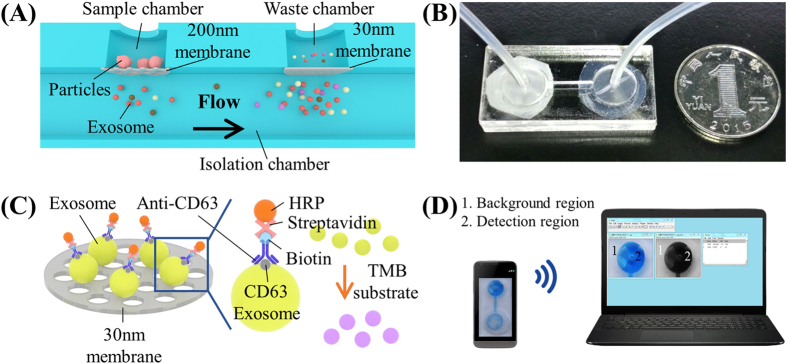
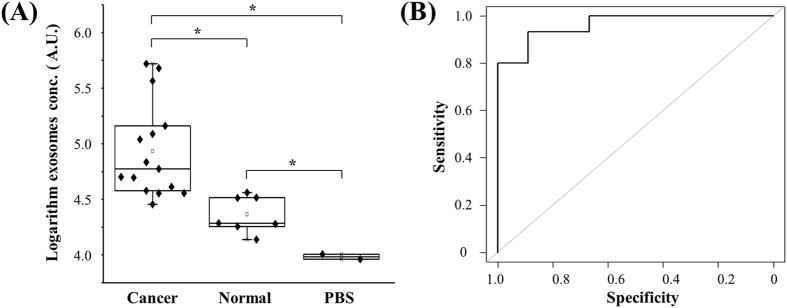
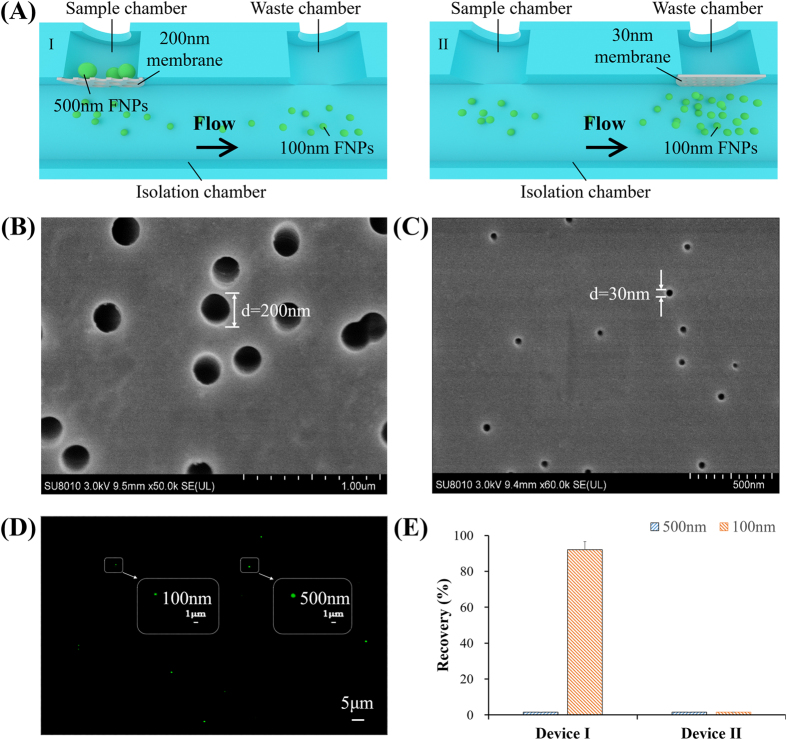
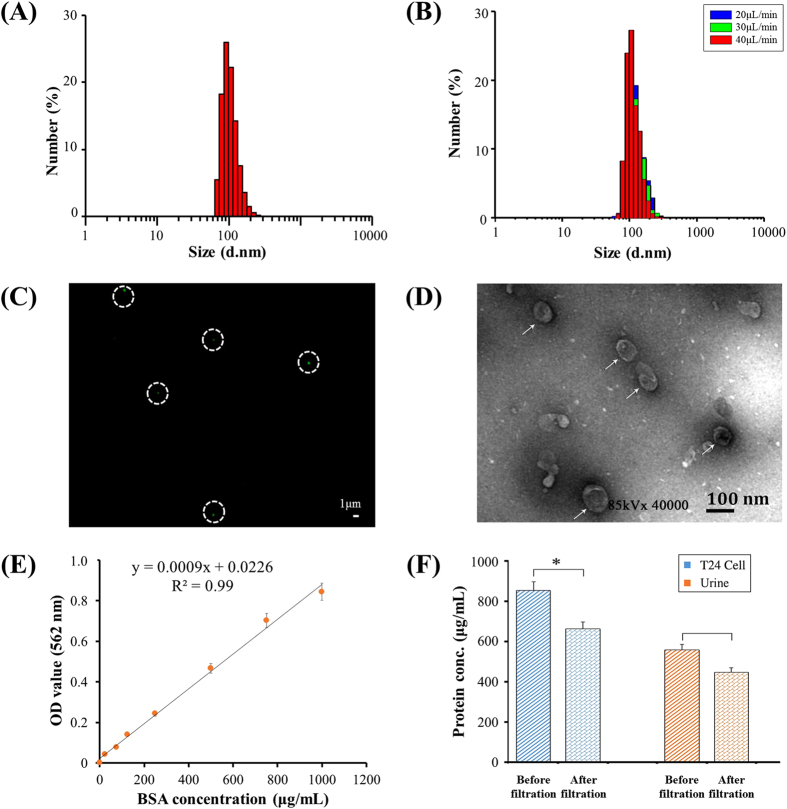
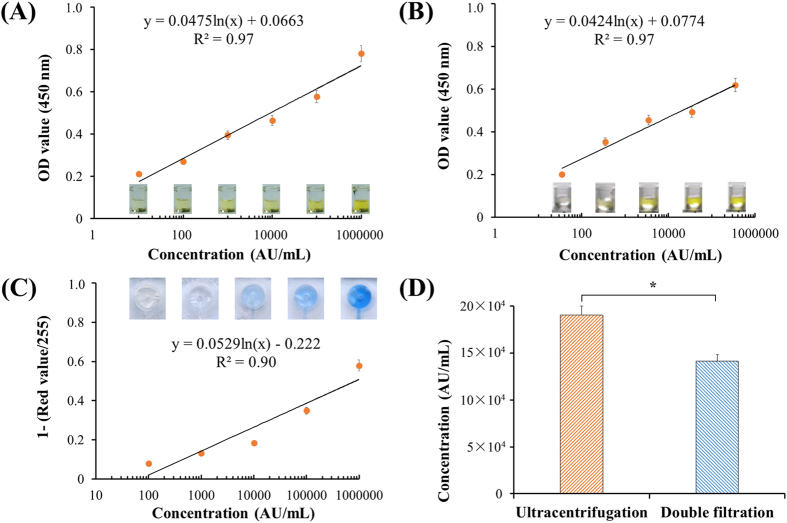
Extracellular vesicles (EVs), including exosomes and microvesicles, are present in a variety of bodily fluids, and the concentration of these sub-cellular vesicles and their associated biomarkers (proteins, nucleic acids, and lipids) can be used to aid clinical diagnosis. Although ultracentrifugation is commonly used for isolation of EVs, it is highly time-consuming, labor-intensive and instrument-dependent for both research laboratories and clinical settings. Here, we developed an integrated double-filtration microfluidic device that isolated and enriched EVs with a size range of 30-200 nm from urine, and subsequently quantified the EVs via a microchip ELISA. Our results showed that the concentration of urinary EVs was significantly elevated in bladder cancer patients (n = 16) compared to healthy controls (n = 8). Receiver operating characteristic (ROC) analysis demonstrated that this integrated EV double-filtration device had a sensitivity of 81.3% at a specificity of 90% (16 bladder cancer patients and 8 healthy controls). Thus, this integrated device has great potential to be used in conjunction with urine cytology and cystoscopy to improve clinical diagnosis of bladder cancer in clinics and at point-of-care (POC) settings.
细胞外囊泡 (EVs),包括外泌体和微泡,存在于各种体液中,这些亚细胞囊泡及其相关生物标志物(蛋白质、核酸和脂质)的浓度可用于辅助临床诊断。虽然超速离心法常用于 EV 的分离,但对于研究实验室和临床环境而言,它既耗时又费力,且依赖仪器。在这里,我们开发了一种集成的双重过滤微流控装置,可从尿液中分离和富集 30-200nm 大小范围的 EVs,然后通过微芯片 ELISA 对 EVs 进行定量。我们的结果表明,与健康对照组(n=8)相比,膀胱癌患者(n=16)尿液中的 EVs 浓度显著升高。受试者工作特征(ROC)分析表明,该集成 EV 双重过滤装置在特异性为 90%时具有 81.3%的灵敏度(16 名膀胱癌患者和 8 名健康对照者)。因此,该集成装置有望与尿液细胞学和膀胱镜检查结合使用,以改善临床诊断膀胱癌在诊所和即时护理 (POC) 环境中的应用。