Galan-Chilet Inmaculada, Grau-Perez Maria, De Marco Griselda, Guallar Eliseo, Martin-Escudero Juan Carlos, Dominguez-Lucas Alejandro, Gonzalez-Manzano Isabel, Lopez-Izquierdo Raul, Briongos-Figuero Laisa Socorro, Redon Josep, Chaves Felipe Javier, Tellez-Plaza Maria
Genomic and Genetic Diagnosis Unit, Biomedical Research Institute Hospital Clinic of Valencia (INCLIVA), Valencia, Spain.
Area of Cardiometabolic and Renal Risk, Biomedical Research Institute Hospital Clinic of Valencia (INCLIVA), Valencia, Spain; Department of Environmental Health Sciences, Columbia University, New York, NY, USA; Department of Environmental Health Sciences, Johns Hopkins Bloomberg School of Public Health, Baltimore, MD, USA.
Redox Biol. 2017 Aug;12:798-805. doi: 10.1016/j.redox.2017.04.022. Epub 2017 Apr 14.
Selenium and single-nucleotide-polymorphisms in selenoprotein genes have been associated to diabetes. However, the interaction of selenium with genetic variation in diabetes and oxidative stress-related genes has not been evaluated as a potential determinant of diabetes risk.
We evaluated the cross-sectional and prospective associations of plasma selenium concentrations with type 2 diabetes, and the interaction of selenium concentrations with genetic variation in candidate polymorphisms, in a representative sample of 1452 men and women aged 18-85 years from Spain.
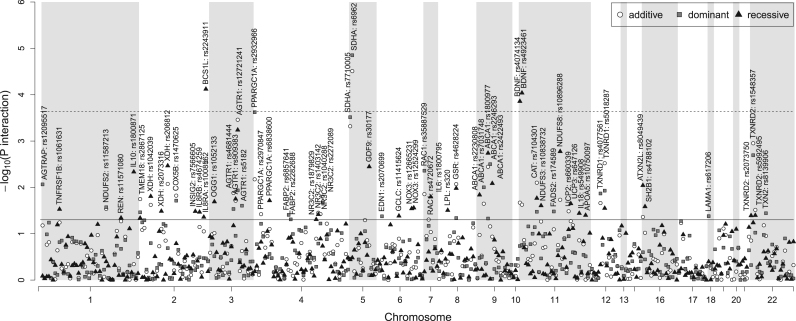
The geometric mean of plasma selenium levels in the study sample was 84.2µg/L. 120 participants had diabetes at baseline. Among diabetes-free participants who were not lost during the follow-up (N=1234), 75 developed diabetes over time. The multivariable adjusted odds ratios (95% confidence interval) for diabetes prevalence comparing the second and third to the first tertiles of plasma selenium levels were 1.80 (1.03, 3.14) and 1.97 (1.14, 3.41), respectively. The corresponding hazard ratios (95% CI) for diabetes incidence were 1.76 (0.96, 3.22) and 1.80 (0.98, 3.31), respectively. In addition, we observed significant interactions between selenium and polymorphisms in PPARGC1A, and in genes encoding mitochondrial proteins, such as BCS1L and SDHA, and suggestive interactions of selenium with other genes related to selenoproteins and redox metabolism.
Plasma selenium was positively associated with prevalent and incident diabetes. While the statistical interactions of selenium with polymorphisms involved in regulation of redox and insulin signaling pathways provide biological plausibility to the positive associations of selenium with diabetes, further research is needed to elucidate the causal pathways underlying these associations.
硒及硒蛋白基因中的单核苷酸多态性与糖尿病有关。然而,硒与糖尿病及氧化应激相关基因的遗传变异之间的相互作用尚未被评估为糖尿病风险的潜在决定因素。
我们在来自西班牙的1452名年龄在18 - 85岁的男性和女性的代表性样本中,评估了血浆硒浓度与2型糖尿病的横断面和前瞻性关联,以及硒浓度与候选多态性基因变异之间的相互作用。
研究样本中血浆硒水平的几何平均值为84.2μg/L。120名参与者在基线时患有糖尿病。在随访期间未失访的无糖尿病参与者(N = 1234)中,75人随时间发展为糖尿病。将血浆硒水平的第二和第三个三分位数与第一个三分位数相比,糖尿病患病率的多变量调整比值比(95%置信区间)分别为1.80(1.03,3.14)和1.97(1.14,3.41)。糖尿病发病率的相应风险比(95%CI)分别为1.76(0.96,3.22)和1.80(0.98,3.31)。此外,我们观察到硒与PPARGC1A中的多态性以及编码线粒体蛋白的基因(如BCS1L和SDHA)之间存在显著相互作用,并且硒与其他与硒蛋白和氧化还原代谢相关的基因之间存在提示性相互作用。
血浆硒与糖尿病的患病率和发病率呈正相关。虽然硒与参与氧化还原和胰岛素信号通路调节的多态性之间的统计学相互作用为硒与糖尿病的正相关提供了生物学合理性,但需要进一步研究以阐明这些关联背后的因果途径。