Oue Anna, Sato Kohei, Yoneya Marina, Sadamoto Tomoko
Faculty of Food and Nutritional Sciences, Toyo University, Gunma, Japan
Research Institute of Physical Fitness, Japan Women's College of Physical Education, Tokyo, Japan.
Physiol Rep. 2017 Apr;5(8). doi: 10.14814/phy2.13253.
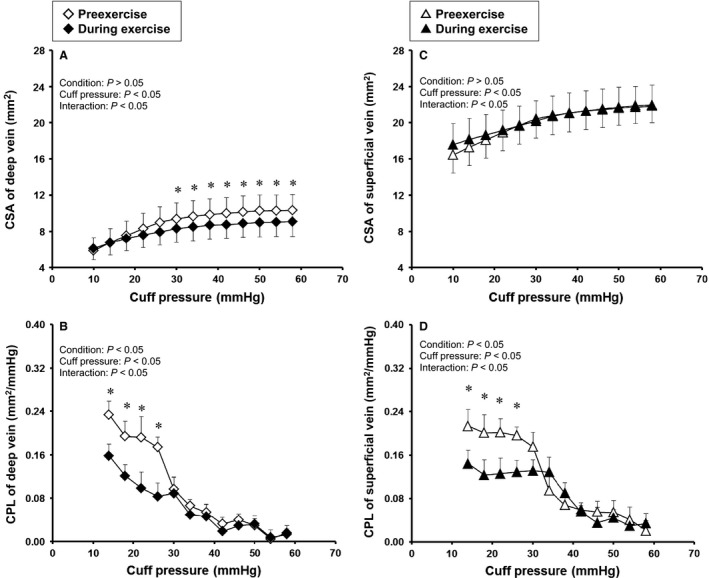
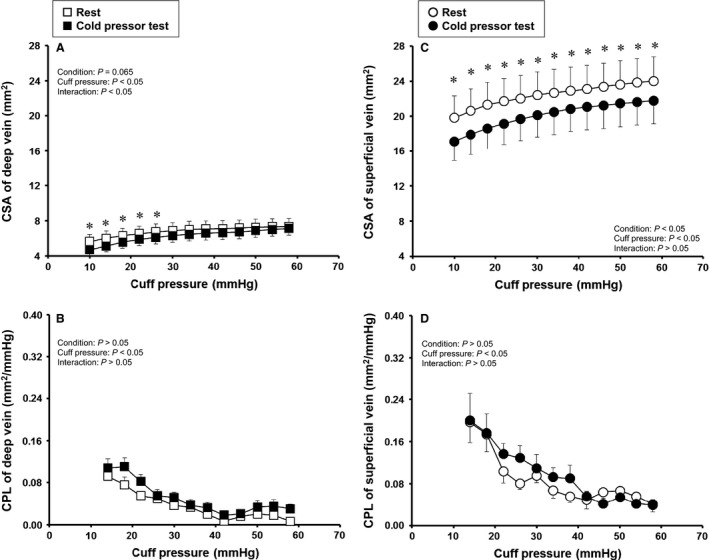
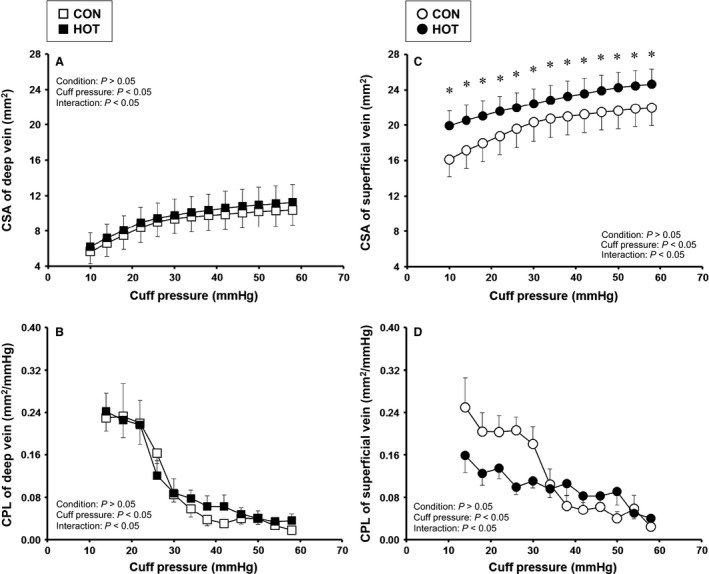
We examined whether there is a difference in compliance between the deep and superficial conduit veins of the upper arm in response to prolonged exercise. Eight young men performed cycling exercise at 60% of peak oxygen uptake until rectal temperature had been increased by 1.1°C for 38-48 min. The cross-sectional area (CSA) of the brachial (deep) and basilic (superficial) veins was assessed by ultrasound during a cuff deflation protocol. Compliance (CPL) was calculated as the numerical derivative of the cuff pressure and CSA curve. During prolonged exercise, CPL in both conduit veins was similarly decreased when compared with pre-exercise values; however, the CSA decreased in the deep vein but increased in the superficial vein. In addition, passive heating caused an analogous change in CSA and CPL of superficial vein when compared with prolonged exercise, but did not change CSA and CPL of deep vein. Cold pressor test induced the decreased CSA of deep and superficial veins without the alteration of CPL of both veins. These results suggest that CPL in the deep and superficial conduit veins adjusts to prolonged exercise via different mechanisms.
我们研究了长时间运动后上臂深静脉和浅静脉在顺应性方面是否存在差异。八名年轻男性以最大摄氧量的60%进行骑自行车运动,直至直肠温度升高1.1°C并持续38 - 48分钟。在袖带放气过程中,通过超声评估肱(深)静脉和贵要(浅)静脉的横截面积(CSA)。顺应性(CPL)计算为袖带压力和CSA曲线的数值导数。在长时间运动期间,与运动前相比,两条导管静脉的CPL均同样降低;然而,深静脉的CSA降低,而浅静脉的CSA增加。此外,与长时间运动相比,被动加热导致浅静脉的CSA和CPL发生类似变化,但未改变深静脉的CSA和CPL。冷加压试验导致深静脉和浅静脉的CSA降低,但两条静脉的CPL均未改变。这些结果表明,深静脉和浅静脉的CPL通过不同机制适应长时间运动。