Nymo S, Coutinho S R, Jørgensen J, Rehfeld J F, Truby H, Kulseng B, Martins C
Faculty of Medicine, Department of Cancer Research and Molecular Medicine, Norwegian University of Science and Technology (NTNU), Obesity Research Group,, Trondheim, Norway.
Department of Clinical Biochemistry, Rigshospitalet, University of Copenhagen, Copenhagen, Denmark.
Int J Obes (Lond). 2017 Aug;41(8):1224-1231. doi: 10.1038/ijo.2017.96. Epub 2017 Apr 25.
BACKGROUND/OBJECTIVE: Diet-induced weight loss (WL) leads to increased hunger and reduced fullness feelings, increased ghrelin and reduced satiety peptides concentration (glucagon-like peptide-1 (GLP-1), cholecystokinin (CCK) and peptide YY (PYY)). Ketogenic diets seem to minimise or supress some of these responses. The aim of this study was to determine the timeline over which changes in appetite occur during progressive WL with a ketogenic very-low-energy diet (VLED).
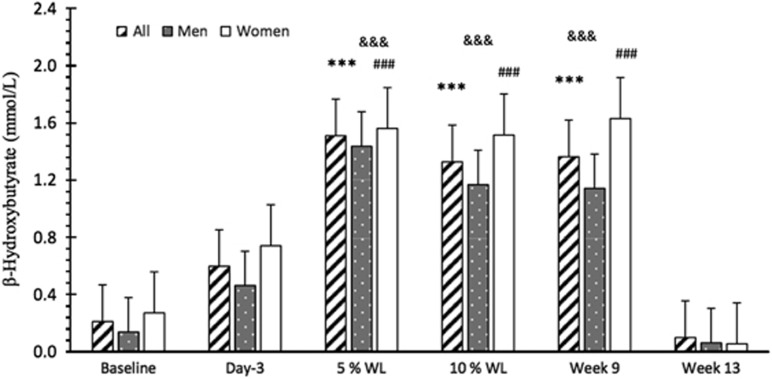
SUBJECTS/METHODS: Thirty-one sedentary adults (18 men), with obesity (body mass index: 37±4.5 kg m) underwent 8 weeks (wks) of a VLED followed by 4 wks of weight maintenance. Body weight and composition, subjective feelings of appetite and appetite-related hormones (insulin, active ghrelin (AG), active GLP-1, total PYY and CCK) were measured in fasting and postprandially, at baseline, on day 3 of the diet, 5 and 10% WL, and at wks 9 and 13. Data are shown as mean±s.d.
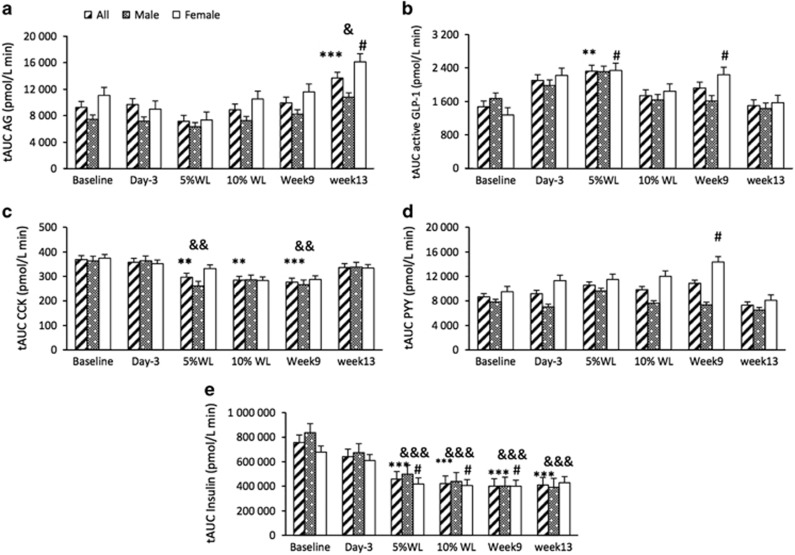
A significant increase in fasting hunger was observed by day 3 (2±1% WL), (P<0.01), 5% WL (12±8 days) (P<0.05) and wk 13 (17±2% WL) (P<0.05). Increased desire to eat was observed by day 3 (P<0.01) and 5% WL (P<0.05). Postprandial prospective food consumption was significantly reduced at wk 9 (16±2% WL) (P<0.01). Basal total PYY was significantly reduced at 10% WL (32±8 days) (P<0.05). Postprandial active GLP-1 was increased at 5% WL (P<0.01) and CCK reduced at 5 and 10% WL (P<0.01, for both) and wk 9 (P<0.001). Basal and postprandial AG were significantly increased at wk 13 (P<0.001, both).
WL with a ketogenic VLED transiently increases the drive to eat up to 3 weeks (5% WL). After that, and while participants are ketotic, a 10-17% WL is not associated with increased appetite. However, hunger feelings and AG concentrations increase significantly from baseline, once refeeding occurs.
背景/目的:饮食诱导的体重减轻(WL)会导致饥饿感增加、饱腹感降低、胃饥饿素增加以及饱腹感肽浓度降低(胰高血糖素样肽-1(GLP-1)、胆囊收缩素(CCK)和肽YY(PYY))。生酮饮食似乎能最小化或抑制其中一些反应。本研究的目的是确定采用生酮极低能量饮食(VLED)进行渐进性体重减轻期间食欲变化的时间线。
受试者/方法:31名久坐不动的成年人(18名男性),患有肥胖症(体重指数:37±4.5 kg/m²),接受了8周的VLED,随后进行4周的体重维持。在基线、饮食第3天、体重减轻5%和10%时以及第9周和第13周,测量空腹和餐后的体重和身体成分、主观食欲感受以及与食欲相关的激素(胰岛素、活性胃饥饿素(AG)、活性GLP-1、总PYY和CCK)。数据以平均值±标准差表示。
在第3天(体重减轻2±1%)(P<0.01)、体重减轻5%(12±8天)(P<0.05)和第13周(体重减轻17±2%)(P<0.05)时,空腹饥饿感显著增加。在第3天(P<0.01)和体重减轻5%时(P<0.05)观察到进食欲望增加。在第9周(体重减轻16±2%)时,餐后预期食物摄入量显著减少(P<0.01)。在体重减轻10%(32±8天)时,基础总PYY显著降低(P<0.05)。在体重减轻5%时,餐后活性GLP-1增加(P<0.01),在体重减轻5%和10%时以及第9周时CCK降低(两者均为P<0.01),在第9周时(P<0.001)。在第13周时,基础和餐后AG均显著增加(两者均为P<0.001)。
采用生酮VLED进行体重减轻会在长达3周(体重减轻5%)的时间内短暂增加进食欲望。在此之后,并且当参与者处于酮症状态时,体重减轻10 - 17%与食欲增加无关。然而,一旦重新进食,饥饿感和AG浓度会从基线显著增加。