Pudasaini Sarita, Wilson John, Ji Mukan, van Dorst Josie, Snape Ian, Palmer Anne S, Burns Brendan P, Ferrari Belinda C
School of Biotechnology and Biomolecular Sciences, University of New South WalesKensington, NSW, Australia.
Australian Antarctic Division, Department of Sustainability, Environment, Water, Population and CommunitiesKingston, TAS, Australia.
Front Microbiol. 2017 Apr 7;8:591. doi: 10.3389/fmicb.2017.00591. eCollection 2017.
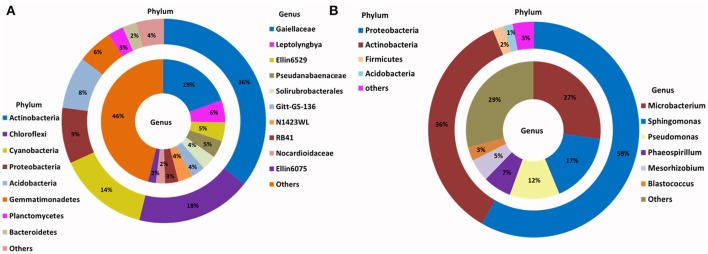
Browning Peninsula is an ice-free polar desert situated in the Windmill Islands, Eastern Antarctica. The entire site is described as a barren landscape, comprised of frost boils with soils dominated by microbial life. In this study, we explored the microbial diversity and edaphic drivers of community structure across this site using traditional cultivation methods, a novel approach the soil substrate membrane system (SSMS), and culture-independent 454-tag pyrosequencing. The measured soil environmental and microphysical factors of chlorine, phosphate, aspect and elevation were found to be significant drivers of the bacterial community, while none of the soil parameters analyzed were significantly correlated to the fungal community. Overall, Browning Peninsula soil harbored a distinctive microbial community in comparison to other Antarctic soils comprised of a unique bacterial diversity and extremely limited fungal diversity. Tag pyrosequencing data revealed the bacterial community to be dominated by Actinobacteria (36%), followed by Chloroflexi (18%), Cyanobacteria (14%), and Proteobacteria (10%). For fungi, Ascomycota (97%) dominated the soil microbiome, followed by Basidiomycota. As expected the diversity recovered from culture-based techniques was lower than that detected using tag sequencing. However, in the SSMS enrichments, that mimic the natural conditions for cultivating oligophilic "k-selected" bacteria, a larger proportion of rare bacterial taxa (15%), such as and and fungal (11%) taxa, such as , and were recovered at the genus level. At phylum level, a comparison of OTU's showed that the SSMS shared 21% of Acidobacteria, 11% of Actinobacteria and 10% of Proteobacteria OTU's with soil. For fungi, the shared OTUs was 4% (Basidiomycota) and <0.5% (Ascomycota). This was the first known attempt to culture microfungi using the SSMS which resulted in an increase in diversity from 14 to 57 microfungi OTUs compared to standard cultivation. Furthermore, the SSMS offers the opportunity to retrieve a greater diversity of bacterial and fungal taxa for future exploitation.
布朗宁半岛是位于东南极洲风车岛的无冰极地沙漠。整个区域被描述为一片荒芜的景观,由冻融泥流组成,土壤中微生物生命占主导。在本研究中,我们使用传统培养方法、一种新型的土壤基质膜系统(SSMS)以及不依赖培养的454标签焦磷酸测序技术,探索了该区域微生物多样性以及群落结构的土壤驱动因素。研究发现,所测量的土壤环境和微物理因素,如氯、磷酸盐、坡向和海拔,是细菌群落的重要驱动因素,而分析的土壤参数中没有一个与真菌群落显著相关。总体而言,与其他南极土壤相比,布朗宁半岛土壤拥有独特的微生物群落,其细菌多样性独特,真菌多样性极其有限。标签焦磷酸测序数据显示,细菌群落以放线菌为主(36%),其次是绿弯菌(18%)、蓝细菌(14%)和变形菌(10%)。对于真菌,子囊菌门(97%)在土壤微生物群落中占主导,其次是担子菌门。正如预期的那样,基于培养技术获得的多样性低于使用标签测序检测到的多样性。然而,在模拟寡营养“K选择”细菌自然培养条件的SSMS富集培养中,在属水平上回收了更大比例的稀有细菌类群(15%),如 和 ,以及真菌类群(11%),如 和 。在门水平上,对OTU的比较表明,SSMS与土壤共享21% 的酸杆菌门、11% 的放线菌门和10% 的变形菌门OTU。对于真菌,共享的OTU为4%(担子菌门)和<0.5%(子囊菌门)。这是首次使用SSMS培养微真菌的已知尝试,与标准培养相比,其多样性从14个微真菌OTU增加到57个。此外,SSMS为未来开发获取更多样化的细菌和真菌类群提供了机会。