Leclère Brice, Buckeridge David L, Boëlle Pierre-Yves, Astagneau Pascal, Lepelletier Didier
Department of Medical Evaluation and Epidemiology, Nantes University Hospital, Nantes, France.
MiHAR laboratory, Nantes University, Nantes, France.
PLoS One. 2017 Apr 25;12(4):e0176438. doi: 10.1371/journal.pone.0176438. eCollection 2017.
Several automated algorithms for epidemiological surveillance in hospitals have been proposed. However, the usefulness of these methods to detect nosocomial outbreaks remains unclear. The goal of this review was to describe outbreak detection algorithms that have been tested within hospitals, consider how they were evaluated, and synthesize their results.
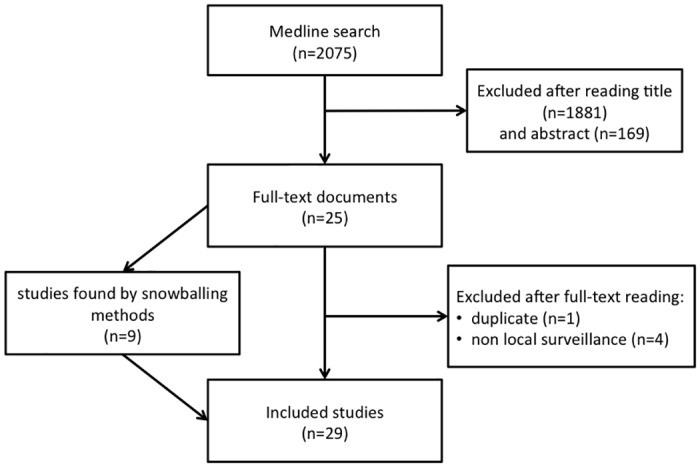
We developed a search query using keywords associated with hospital outbreak detection and searched the MEDLINE database. To ensure the highest sensitivity, no limitations were initially imposed on publication languages and dates, although we subsequently excluded studies published before 2000. Every study that described a method to detect outbreaks within hospitals was included, without any exclusion based on study design. Additional studies were identified through citations in retrieved studies.
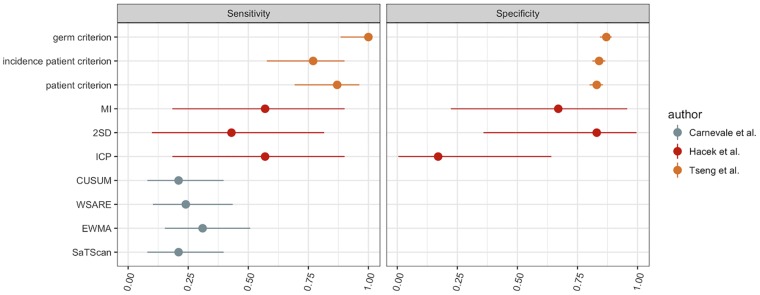
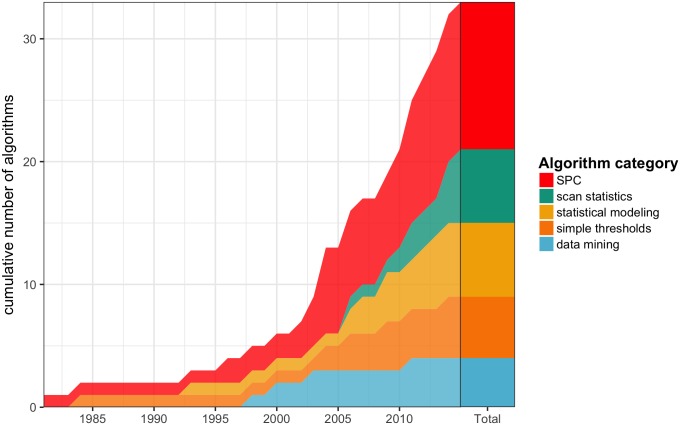
Twenty-nine studies were included. The detection algorithms were grouped into 5 categories: simple thresholds (n = 6), statistical process control (n = 12), scan statistics (n = 6), traditional statistical models (n = 6), and data mining methods (n = 4). The evaluation of the algorithms was often solely descriptive (n = 15), but more complex epidemiological criteria were also investigated (n = 10). The performance measures varied widely between studies: e.g., the sensitivity of an algorithm in a real world setting could vary between 17 and 100%.
Even if outbreak detection algorithms are useful complementary tools for traditional surveillance, the heterogeneity in results among published studies does not support quantitative synthesis of their performance. A standardized framework should be followed when evaluating outbreak detection methods to allow comparison of algorithms across studies and synthesis of results.
已经提出了几种用于医院流行病学监测的自动化算法。然而,这些方法在检测医院感染暴发方面的实用性仍不明确。本综述的目的是描述已在医院内进行测试的暴发检测算法,考虑它们是如何被评估的,并综合其结果。
我们使用与医院暴发检测相关的关键词制定了一个搜索查询,并搜索了MEDLINE数据库。为确保最高的敏感性,最初对出版语言和日期没有限制,尽管我们随后排除了2000年以前发表的研究。每项描述在医院内检测暴发方法的研究都被纳入,不基于研究设计进行任何排除。通过检索到的研究中的参考文献确定了其他研究。
纳入了29项研究。检测算法分为5类:简单阈值法(n = 6)、统计过程控制法(n = 12)、扫描统计法(n = 6)、传统统计模型法(n = 6)和数据挖掘方法(n = 4)。对算法的评估通常只是描述性的(n = 15),但也研究了更复杂的流行病学标准(n = 10)。不同研究之间的性能指标差异很大:例如,一种算法在实际环境中的敏感性可能在17%至100%之间变化。
即使暴发检测算法是传统监测的有用补充工具,但已发表研究结果的异质性不支持对其性能进行定量综合。在评估暴发检测方法时应遵循标准化框架,以便跨研究比较算法并综合结果。