Bröder Janine, Okan Orkan, Bauer Ullrich, Bruland Dirk, Schlupp Sandra, Bollweg Torsten M, Saboga-Nunes Luis, Bond Emma, Sørensen Kristine, Bitzer Eva-Maria, Jordan Susanne, Domanska Olga, Firnges Christiane, Carvalho Graça S, Bittlingmayer Uwe H, Levin-Zamir Diane, Pelikan Jürgen, Sahrai Diana, Lenz Albert, Wahl Patricia, Thomas Malcolm, Kessl Fabian, Pinheiro Paulo
Centre for Prevention and Intervention in Childhood and Adolescence CPI, Bielefeld University, Bielefeld, Germany.
National School of Public Health, Universidade NOVA de Lisboa, Lisbon, Portugal.
BMC Public Health. 2017 Apr 26;17(1):361. doi: 10.1186/s12889-017-4267-y.
Children and young people constitute a core target group for health literacy research and practice: during childhood and youth, fundamental cognitive, physical and emotional development processes take place and health-related behaviours and skills develop. However, there is limited knowledge and academic consensus regarding the abilities and knowledge a child or young person should possess for making sound health decisions. The research presented in this review addresses this gap by providing an overview and synthesis of current understandings of health literacy in childhood and youth. Furthermore, the authors aim to understand to what extent available models capture the unique needs and characteristics of children and young people.
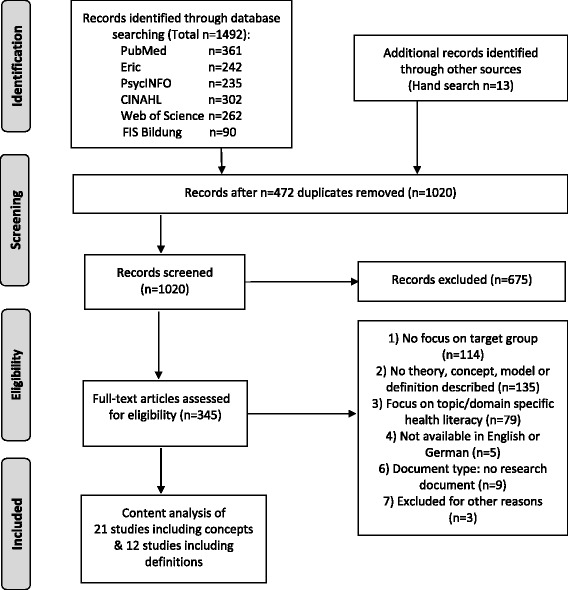
Six databases were systematically searched with relevant search terms in English and German. Of the n = 1492 publications identified, N = 1021 entered the abstract screening and N = 340 full-texts were screened for eligibility. A total of 30 articles, which defined or conceptualized generic health literacy for a target population of 18 years or younger, were selected for a four-step inductive content analysis.
The systematic review of the literature identified 12 definitions and 21 models that have been specifically developed for children and young people. In the literature, health literacy in children and young people is described as comprising variable sets of key dimensions, each appearing as a cluster of related abilities, skills, commitments, and knowledge that enable a person to approach health information competently and effectively and to derive at health-promoting decisions and actions.
Identified definitions and models are very heterogeneous, depicting health literacy as multidimensional, complex construct. Moreover, health literacy is conceptualized as an action competence, with a strong focus on personal attributes, while also recognising its interrelatedness with social and contextual determinants. Life phase specificities are mainly considered from a cognitive and developmental perspective, leaving children's and young people's specific needs, vulnerabilities, and social structures poorly incorporated within most models. While a critical number of definitions and models were identified for youth or secondary school students, similar findings are lacking for children under the age of ten or within a primary school context.
儿童和青少年是健康素养研究与实践的核心目标群体:在儿童期和青少年期,基本的认知、身体和情感发育过程发生,与健康相关的行为和技能也在发展。然而,对于儿童或青少年做出明智健康决策应具备的能力和知识,相关知识和学术共识有限。本综述中的研究通过概述和综合当前对儿童和青少年健康素养的理解来填补这一空白。此外,作者旨在了解现有模型在多大程度上能够体现儿童和青少年的独特需求和特征。
使用英语和德语的相关检索词对六个数据库进行系统检索。在识别出的n = 1492篇出版物中,N = 1021篇进入摘要筛选,N = 340篇全文被筛选以确定是否符合条件。总共选择了30篇为18岁及以下目标人群定义或概念化一般健康素养的文章,进行四步归纳内容分析。
对文献的系统综述确定了12个定义和21个专门为儿童和青少年开发的模型。在文献中,儿童和青少年的健康素养被描述为由不同的关键维度集组成,每个维度集表现为一组相关的能力、技能、承诺和知识,使一个人能够胜任且有效地处理健康信息,并做出促进健康的决策和行动。
已识别的定义和模型非常多样化,将健康素养描述为一个多维、复杂的结构。此外,健康素养被概念化为一种行动能力,强烈关注个人属性,同时也认识到其与社会和背景决定因素的相互关联性。生命阶段的特殊性主要从认知和发育的角度考虑,大多数模型很少纳入儿童和青少年的特殊需求、脆弱性和社会结构。虽然为青少年或中学生确定了相当数量的定义和模型,但对于10岁以下儿童或小学阶段的情况,缺乏类似的研究结果。