Department of Creative IT Engineering, Pohang University of Science and Technology, Pohang, Korea.
Department of Biomedical Informatics, UC San Diego, La Jolla, CA, United States.
Sci Rep. 2017 Apr 25;7(1):1114. doi: 10.1038/s41598-017-01139-y.
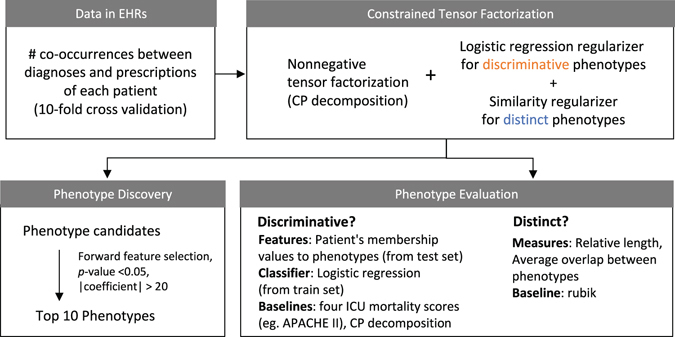
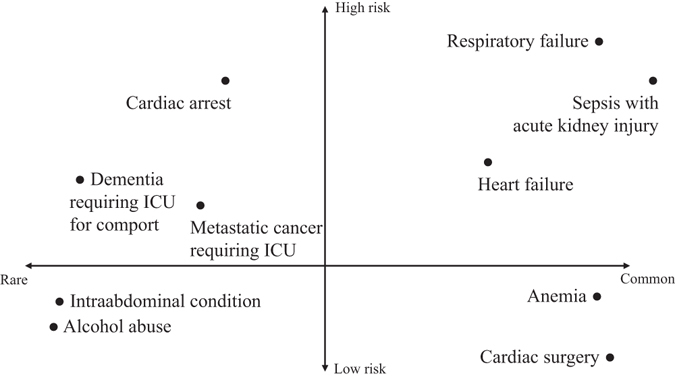
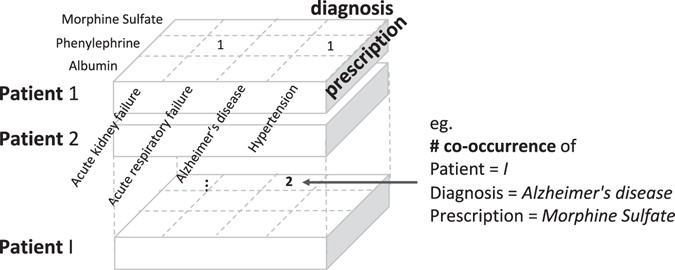
Adoption of Electronic Health Record (EHR) systems has led to collection of massive healthcare data, which creates oppor- tunities and challenges to study them. Computational phenotyping offers a promising way to convert the sparse and complex data into meaningful concepts that are interpretable to healthcare givers to make use of them. We propose a novel su- pervised nonnegative tensor factorization methodology that derives discriminative and distinct phenotypes. We represented co-occurrence of diagnoses and prescriptions in EHRs as a third-order tensor, and decomposed it using the CP algorithm. We evaluated discriminative power of our models with an Intensive Care Unit database (MIMIC-III) and demonstrated superior performance than state-of-the-art ICU mortality calculators (e.g., APACHE II, SAPS II). Example of the resulted phenotypes are sepsis with acute kidney injury, cardiac surgery, anemia, respiratory failure, heart failure, cardiac arrest, metastatic cancer (requiring ICU), end-stage dementia (requiring ICU and transitioned to comfort-care), intraabdominal conditions, and alcohol abuse/withdrawal.
电子健康记录 (EHR) 系统的采用导致了大量医疗保健数据的收集,这为研究这些数据创造了机会和挑战。计算表型分析提供了一种有前途的方法,可以将稀疏而复杂的数据转化为有意义的概念,以便医疗保健提供者利用这些概念。我们提出了一种新颖的监督非负张量分解方法,该方法可以得出有区别和独特的表型。我们将 EHR 中的诊断和处方的共现表示为一个三阶张量,并使用 CP 算法对其进行分解。我们使用重症监护病房数据库 (MIMIC-III) 评估了我们模型的判别能力,并证明了比最先进的重症监护病房死亡率计算器(例如,APACHE II、SAPS II)更好的性能。得到的表型示例包括伴有急性肾损伤的败血症、心脏手术、贫血、呼吸衰竭、心力衰竭、心脏骤停、转移性癌症(需要重症监护病房)、终末期痴呆(需要重症监护病房和过渡到舒适护理)、腹腔疾病和酒精滥用/戒断。