Zaidi Syed Shan-E-Ali, Mansoor Shahid
Molecular Virology and Gene Silencing Laboratory, Agricultural Biotechnology Division, National Institute for Biotechnology and Genetic EngineeringFaisalabad, Pakistan.
Front Plant Sci. 2017 Apr 11;8:539. doi: 10.3389/fpls.2017.00539. eCollection 2017.
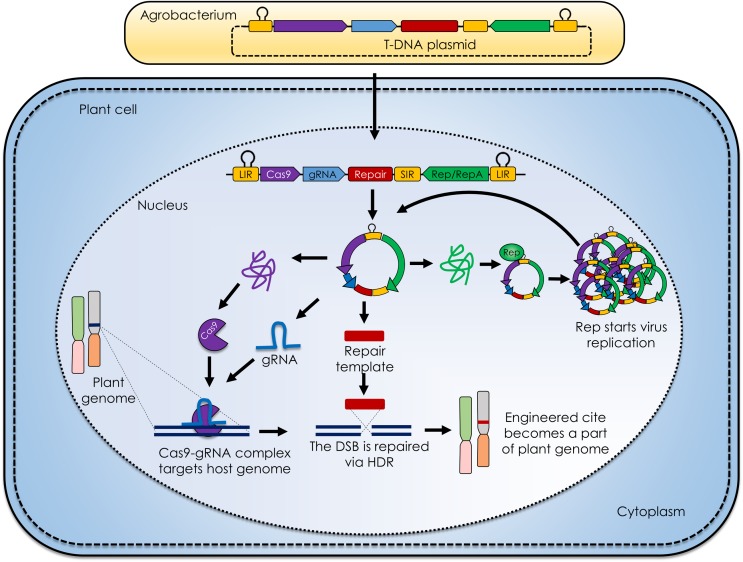
Recent advances in genome engineering (GE) has made it possible to precisely alter DNA sequences in plant cells, providing specifically engineered plants with traits of interest. Gene targeting efficiency depends on the delivery-method of both sequence-specific nucleases and repair templates, to plant cells. Typically, this is achieved using mediated transformation or particle bombardment, both of which transform only a subset of cells in treated tissues. The alternate approaches, stably integrating nuclease-encoding cassettes and repair templates into the plant genome, are time consuming, expensive and require extra regulations. More efficient GE reagents delivery methods are clearly needed if GE is to become routine, especially in economically important crops that are difficult to transform. Recently, autonomously replicating virus-based vectors have been demonstrated as efficient means of delivering GE reagents in plants. Both DNA viruses ( and ) and RNA virus () have demonstrated efficient gene targeting frequencies in model plants () and crops (potato, tomato, rice, and wheat). Here we discuss the recent advances using viral vectors for plant genome engineering, the current limitations and future directions.
基因组工程(GE)的最新进展使得精确改变植物细胞中的DNA序列成为可能,从而为特定工程植物赋予所需性状。基因靶向效率取决于序列特异性核酸酶和修复模板向植物细胞的递送方法。通常,这是通过介导转化或粒子轰击来实现的,这两种方法都只能转化处理组织中的一部分细胞。另一种方法是将编码核酸酶的盒式结构和修复模板稳定整合到植物基因组中,这种方法既耗时又昂贵,还需要额外的监管。如果要使基因组工程成为常规操作,显然需要更有效的基因组工程试剂递送方法,尤其是在难以转化的经济作物中。最近,自主复制的病毒载体已被证明是在植物中递送基因组工程试剂的有效手段。DNA病毒(和)和RNA病毒()在模式植物()和作物(马铃薯、番茄、水稻和小麦)中都展示了高效的基因靶向频率。在此,我们讨论了使用病毒载体进行植物基因组工程的最新进展、当前的局限性和未来的发展方向。