Inage Kazuhide, Orita Sumihisa, Yamauchi Kazuyo, Suzuki Miyako, Sakuma Yoshihiro, Kubota Go, Oikawa Yasuhiro, Sainoh Takeshi, Sato Jun, Fujimoto Kazuki, Shiga Yasuhiro, Abe Koki, Kanamoto Hirohito, Inoue Masahiro, Kinoshita Hideyuki, Norimoto Masaki, Umimura Tomotaka, Takahashi Kazuhisa, Ohtori Seiji
Department of Orthopaedic Surgery, Graduate School of Medicine, Chiba University, Chiba, Japan.
Department of Bioenvironmental Medicine, Graduate School of Medicine, Chiba University, Chiba, Japan.
Asian Spine J. 2017 Apr;11(2):213-218. doi: 10.4184/asj.2017.11.2.213. Epub 2017 Apr 12.
Retrospective, observational, single-center study.
To investigate the long-term outcomes of fusion procedures for treating dysplastic spondylolisthesis.
fusion performed in patients with dysplastic spondylolisthesis avoids the development of nerve complications.
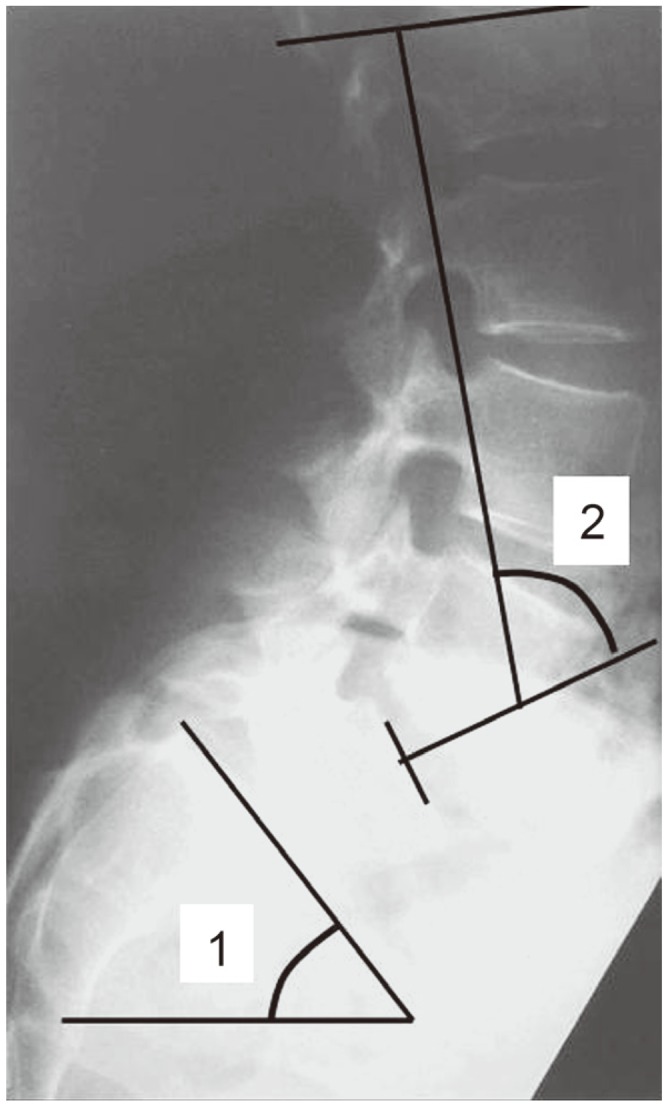
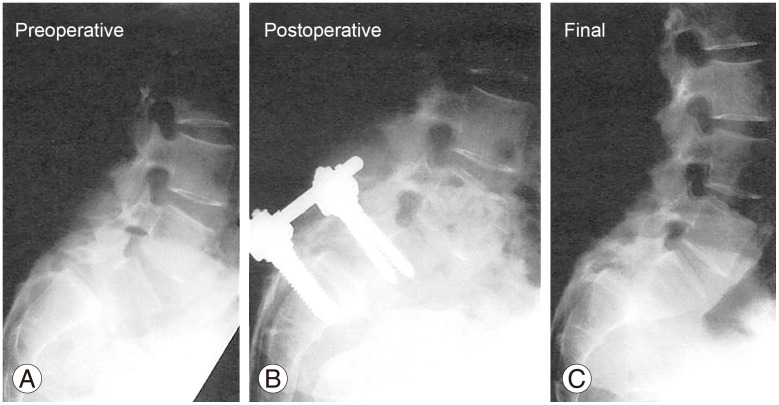
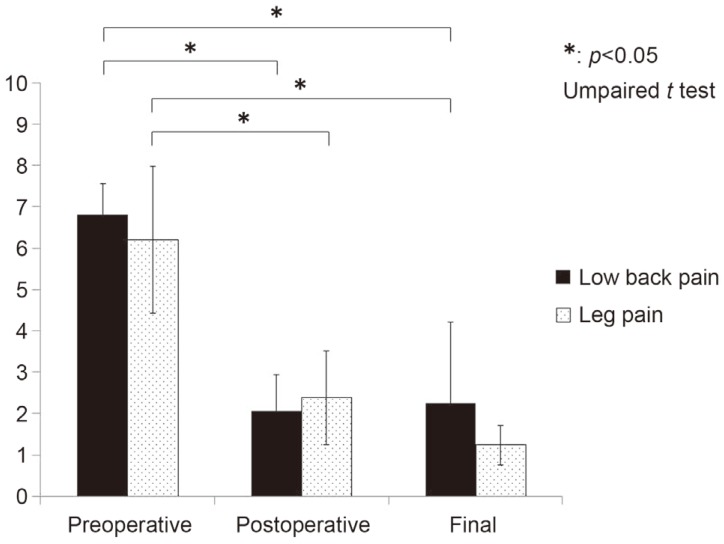
In total, 12 of 28 patients who underwent fusion for treating dysplastic spondylolisthesis at Chiba University Hospital from 1974 to 2004 were followed up in August 2013. Surgical complications were evaluated. Low back pain and leg pain were assessed using a visual analog scale (VAS). Vertebral alignment, including the lumbosacral angle and lumbar lordosis angle measurement on radiographic images (profile view in the neutral standing position), was evaluated during preoperative, postoperative, and final examinations.
The mean follow-up duration, patient age at the final examination, and patient age at operation were 20.0±7.2, 42.3±13.3, and 22.3±11.4 years, respectively. No complications were reported. Mean VAS scores for low back pain and leg pain were significantly lower at the final examination than at the preoperative examination (<0.05). At the preoperative, postoperative, and final examinations, the mean lumbosacral angle was 32.3°±14.2°, 33.7°±11.8°, and 36.5°±16.4°, while the mean lumbar lordosis angle was 51.0°±14.8°, 48.6°±18.8°, and 49.6°±15.5°, respectively. No significant differences were noted among these values across the different time periods (<0.05).
fusion performed in patients with dysplastic spondylolisthesis avoids the development of nerve complications such as nerve paralysis that may occur after repositioning operation and maintains appropriate long-term sagittal alignment, even 20 years after operation.
回顾性、观察性、单中心研究。
探讨融合手术治疗发育异常性腰椎滑脱的长期疗效。
对发育异常性腰椎滑脱患者进行融合手术可避免神经并发症的发生。
2013年8月,对1974年至2004年在千叶大学医院接受融合手术治疗发育异常性腰椎滑脱的28例患者中的12例进行了随访。评估手术并发症。使用视觉模拟量表(VAS)评估腰背痛和腿痛情况。在术前、术后及末次检查时,通过X线片(中立位站立位侧位像)测量腰骶角和腰椎前凸角,评估椎体排列情况。
平均随访时间、末次检查时患者年龄及手术时患者年龄分别为20.0±7.2年、42.3±13.3岁和22.3±11.4岁。未报告并发症。末次检查时腰背痛和腿痛的平均VAS评分显著低于术前检查(<0.05)。术前、术后及末次检查时,平均腰骶角分别为32.3°±14.2°、33.7°±11.8°和36.5°±16.4°,平均腰椎前凸角分别为51.0°±14.8°、48.6°±18.8°和49.6°±15.5°。不同时间段这些值之间无显著差异(<0.05)。
对发育异常性腰椎滑脱患者进行融合手术可避免复位手术后可能发生的神经麻痹等神经并发症,并能维持适当的长期矢状位排列,即使在术后20年也是如此。