Planells-Palop Vicente, Hazazi Ali, Feichtinger Julia, Jezkova Jana, Thallinger Gerhard, Alsiwiehri Naif O, Almutairi Mikhlid, Parry Lee, Wakeman Jane A, McFarlane Ramsay J
North West Cancer Research Institute, School of Medical Sciences, Bangor University, Brambell Building, Deiniol Road, Bangor, Gwynedd, LL57 2UW, UK.
Computational Biotechnology and Bioinformatics Group, Institute of Molecular Biotechnology, Graz University of Technology, Graz, Austria.
Mol Cancer. 2017 Apr 26;16(1):84. doi: 10.1186/s12943-017-0653-4.
Cancer/testis (CT) genes have expression normally restricted to the testis, but become activated during oncogenesis, so they have excellent potential as cancer-specific biomarkers. Evidence is starting to emerge to indicate that they also provide function(s) in the oncogenic programme. Human TEX19 is a recently identified CT gene, but a functional role for TEX19 in cancer has not yet been defined.
siRNA was used to deplete TEX19 levels in various cancer cell lines. This was extended using shRNA to deplete TEX19 in vivo. Western blotting, fluorescence activated cell sorting and immunofluorescence were used to study the effect of TEX19 depletion in cancer cells and to localize TEX19 in normal testis and cancer cells/tissues. RT-qPCR and RNA sequencing were employed to determine the changes to the transcriptome of cancer cells depleted for TEX19 and Kaplan-Meier plots were generated to explore the relationship between TEX19 expression and prognosis for a range of cancer types.
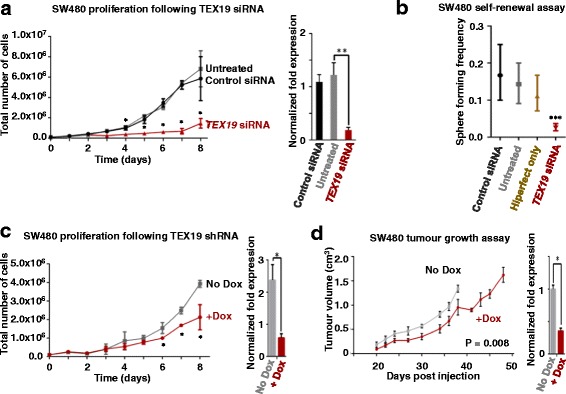
Depletion of TEX19 levels in a range of cancer cell lines in vitro and in vivo restricts cellular proliferation/self-renewal/reduces tumour volume, indicating TEX19 is required for cancer cell proliferative/self-renewal potential. Analysis of cells depleted for TEX19 indicates they enter a quiescent-like state and have subtle defects in S-phase progression. TEX19 is present in both the nucleus and cytoplasm in both cancerous cells and normal testis. In cancer cells, localization switches in a context-dependent fashion. Transcriptome analysis of TEX19 depleted cells reveals altered transcript levels of a number of cancer-/proliferation-associated genes, suggesting that TEX19 could control oncogenic proliferation via a transcript/transcription regulation pathway. Finally, overall survival analysis of high verses low TEX19 expressing tumours indicates that TEX19 expression is linked to prognostic outcomes in different tumour types.
TEX19 is required to drive cell proliferation in a range of cancer cell types, possibly mediated via an oncogenic transcript regulation mechanism. TEX19 expression is linked to a poor prognosis for some cancers and collectively these findings indicate that not only can TEX19 expression serve as a novel cancer biomarker, but may also offer a cancer-specific therapeutic target with broad spectrum potential.
癌/睾丸(CT)基因的表达通常局限于睾丸,但在肿瘤发生过程中被激活,因此它们作为癌症特异性生物标志物具有巨大潜力。越来越多的证据表明,它们在致癌程序中也发挥着作用。人类TEX19是最近发现的一种CT基因,但TEX19在癌症中的功能作用尚未明确。
使用小干扰RNA(siRNA)降低多种癌细胞系中TEX19的水平。通过短发夹RNA(shRNA)在体内进一步降低TEX19水平。采用蛋白质免疫印迹法、荧光激活细胞分选术和免疫荧光法研究TEX19缺失对癌细胞的影响,并确定TEX19在正常睾丸以及癌细胞/组织中的定位。运用逆转录定量聚合酶链反应(RT-qPCR)和RNA测序来确定TEX19缺失的癌细胞转录组的变化,并生成Kaplan-Meier曲线以探究TEX19表达与一系列癌症类型预后之间的关系。
在体外和体内降低多种癌细胞系中TEX19的水平会限制细胞增殖/自我更新/减小肿瘤体积,表明TEX19是癌细胞增殖/自我更新潜能所必需的。对TEX19缺失的细胞分析表明,它们进入一种静止样状态,并且在S期进程中存在细微缺陷。TEX19在癌细胞和正常睾丸的细胞核和细胞质中均有存在。在癌细胞中,定位以依赖于背景的方式发生转换。对TEX19缺失细胞的转录组分析揭示了许多与癌症/增殖相关基因的转录水平发生改变,这表明TEX19可能通过转录/转录调控途径控制致癌增殖。最后,对高表达与低表达TEX19的肿瘤进行总体生存分析表明,TEX19表达与不同肿瘤类型的预后结果相关。
TEX19是多种癌细胞类型中驱动细胞增殖所必需的,可能是通过致癌转录调控机制介导的。TEX19表达与某些癌症的不良预后相关,总体而言,这些发现表明TEX19表达不仅可作为一种新型癌症生物标志物,还可能提供一个具有广谱潜力的癌症特异性治疗靶点。