Alma Mater Studiorum, University of Bologna, Department of Agricultural Sciences, Viale Fanin 42, 40127, Bologna, Italy.
Council for Agricultural Research and Economics, Honey Bee and Silkworm Research Unit, Via di Saliceto 80, 40128, Bologna, Italy.
Sci Rep. 2017 Apr 26;7(1):1201. doi: 10.1038/s41598-017-01361-8.
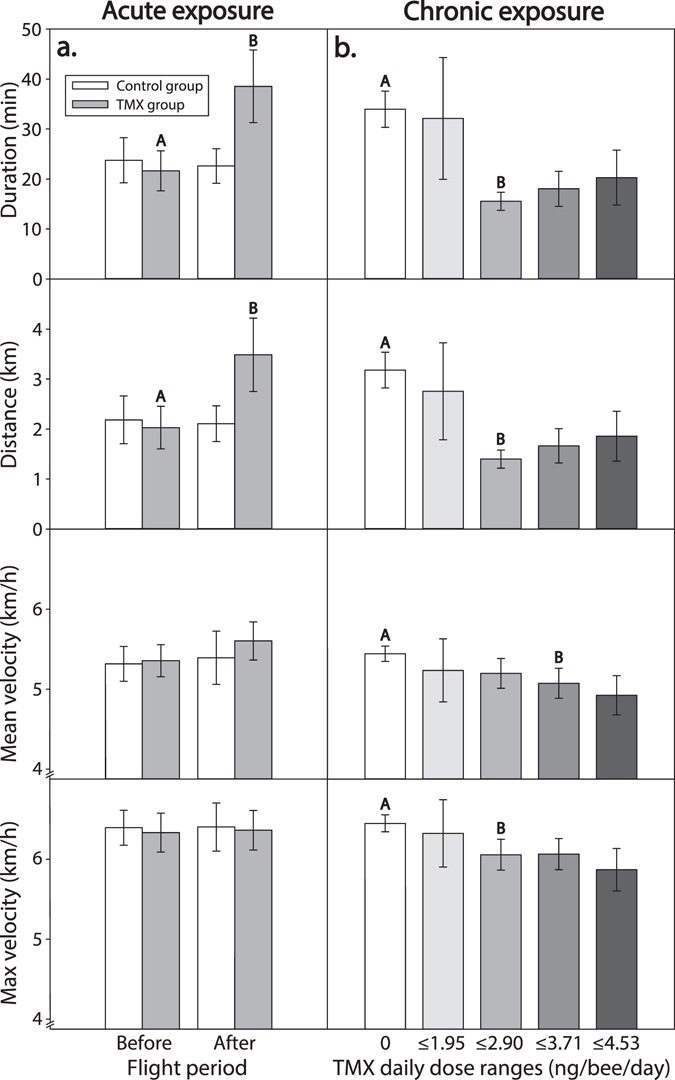
Pesticides can pose environmental risks, and a common neonicotinoid pesticide, thiamethoxam, decreases homing success in honey bees. Neonicotinoids can alter bee navigation, but we present the first evidence that neonicotinoid exposure alone can impair the physical ability of bees to fly. We tested the effects of acute or chronic exposure to thiamethoxam on the flight ability of foragers in flight mills. Within 1 h of consuming a single sublethal dose (1.34 ng/bee), foragers showed excitation and significantly increased flight duration (+78%) and distance (+72%). Chronic exposure significantly decreased flight duration (-54%), distance (-56%), and average velocity (-7%) after either one or two days of continuous exposure that resulted in bees ingesting field-relevant thiamethoxam doses of 1.96-2.90 ng/bee/day. These results provide the first demonstration that acute or chronic exposure to a neonicotinoid alone can significantly alter bee flight. Such exposure may impair foraging and homing, which are vital to normal colony function and ecosystem services.
农药会对环境造成风险,一种常见的新烟碱类农药噻虫嗪会降低蜜蜂归巢的成功率。新烟碱类农药会改变蜜蜂的导航能力,但我们首次证明,仅暴露于新烟碱类农药就会损害蜜蜂飞行的身体能力。我们在飞行测功仪中测试了急性或慢性接触噻虫嗪对觅食者飞行能力的影响。在摄入单一亚致死剂量(1.34ng/只)后的 1 小时内,觅食者表现出兴奋,并显著增加了飞行持续时间(增加 78%)和距离(增加 72%)。在连续接触 1 天或 2 天后,蜜蜂摄入了与田间相关的噻虫嗪剂量为 1.96-2.90ng/bee/天,慢性暴露会显著降低飞行持续时间(减少 54%)、距离(减少 56%)和平均速度(减少 7%)。这些结果首次证明,单独急性或慢性接触新烟碱类农药就可以显著改变蜜蜂的飞行。这种接触可能会损害觅食和归巢能力,这对正常的蜂群功能和生态系统服务至关重要。