Kiessling Silke, Ucar Ahmet, Chowdhury Kamal, Oster Henrik, Eichele Gregor
Department of Genes and Behavior, Max Planck Institute for Biophysical Chemistry, Göttingen, Germany.
Nutrition and Immunology, Technical University of Munich, Freising, Germany.
PLoS One. 2017 Apr 27;12(4):e0176547. doi: 10.1371/journal.pone.0176547. eCollection 2017.
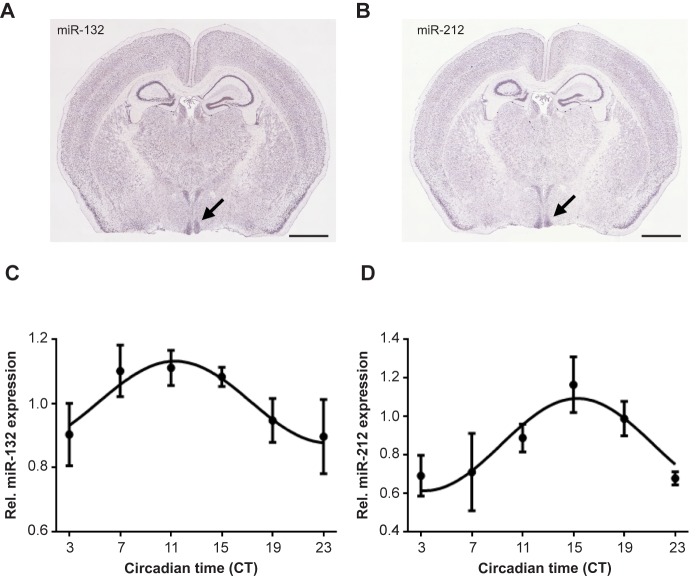
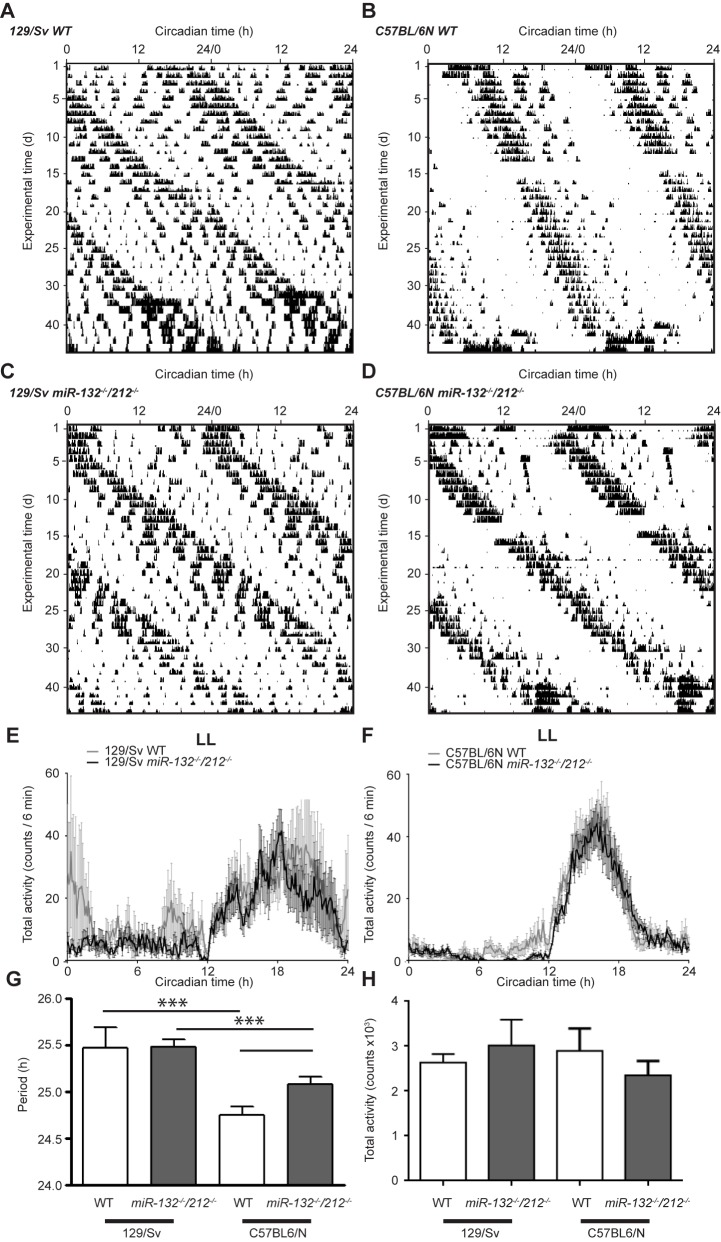
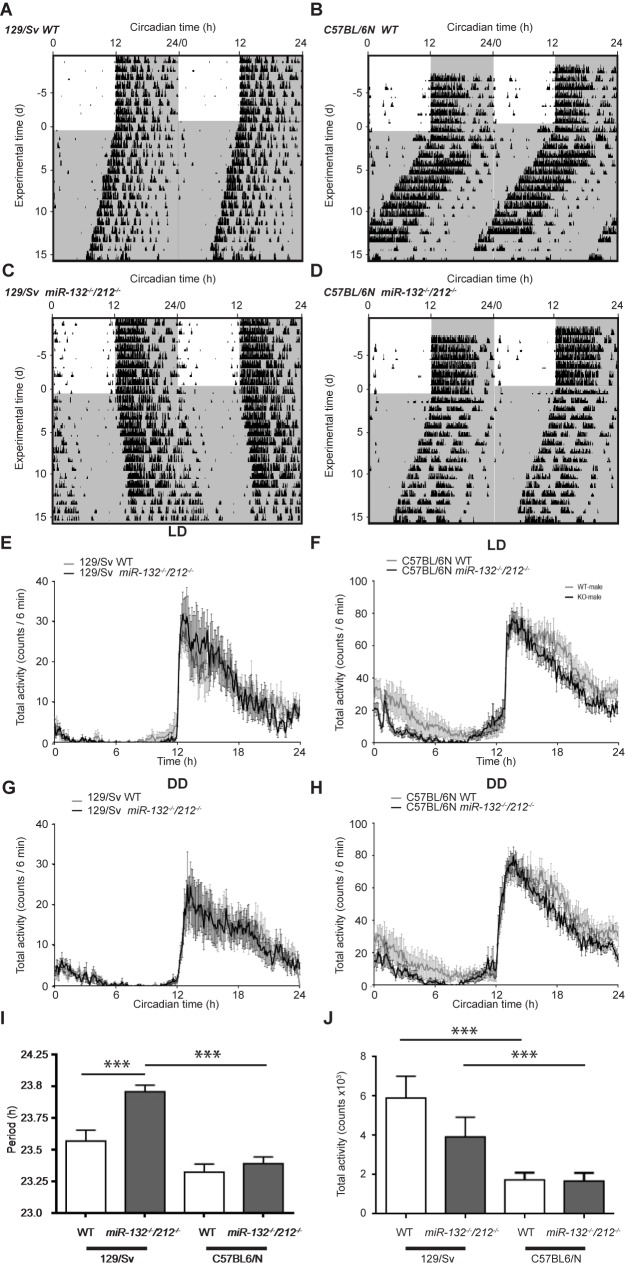
MicroRNAs (miRs) are important regulators of a wide range of biological processes. Antagomir studies suggest an implication of miR-132 in the functionality of the mammalian circadian clock. miR-212 and miR-132 are tandemly processed from the same transcript and share the same seed region. We found the clock modulator miR-132 and miR-212 to be expressed rhythmically in the central circadian clock. Consequently, mRNAs implicated in circadian functions may likely be targeted by both miRs. To further characterize the circadian role we generated mice with stable deletion of the miR-132/212 locus and compared the circadian behavior of mutant and wild-type control animals on two genetic backgrounds frequently used in chronobiological research, C57BL/6N and 129/Sv. Surprisingly, the wheel-running activity phenotype of miR mutant mice was highly background specific. A prolonged circadian free-running period in constant darkness was found in 129/Sv, but not in C57BL/6N miR-132/212 knockout mice. In contrast, in C57BL/6N, but not in 129/Sv miRNA-132/212 knockout mice a lengthened free-running period was observed in constant light conditions. Furthermore, miR-132/212 knockout mice on 129/Sv background exhibited enhanced photic phase shifts of locomotor activity accompanied by reduced light induction of Period gene transcription in the SCN. This phenotype was absent in miRNA-132/212 knockout mice on a C57BL/6N background. Together, our results reveal a strain and light regimen-specific function of miR-132/212 in the circadian clock machinery suggesting that miR-132 and miR-212 act as background-dependent circadian rhythm modulators.
微小RNA(miR)是多种生物过程的重要调节因子。反义寡核苷酸研究表明,miR-132参与哺乳动物生物钟的功能。miR-212和miR-132由同一转录本串联加工而成,并共享相同的种子区域。我们发现生物钟调节因子miR-132和miR-212在中枢生物钟中有节律地表达。因此,参与昼夜节律功能的mRNA可能同时受到这两种miR的靶向作用。为了进一步表征其在昼夜节律中的作用,我们构建了稳定缺失miR-132/212基因座的小鼠,并在时间生物学研究中常用的两种遗传背景C57BL/6N和129/Sv上比较了突变体和野生型对照动物的昼夜行为。令人惊讶的是,miR突变小鼠的转轮活动表型具有高度的背景特异性。在129/Sv小鼠中发现,在持续黑暗中昼夜节律的自由运行周期延长,但在C57BL/6N miR-132/212基因敲除小鼠中未发现。相反,在C57BL/6N小鼠中,但不在129/Sv miRNA-132/212基因敲除小鼠中,在持续光照条件下观察到自由运行周期延长。此外,129/Sv背景的miR-132/212基因敲除小鼠表现出运动活动的光诱导相移增强,同时视交叉上核中周期基因转录的光诱导减少。这种表型在C57BL/6N背景的miRNA-132/212基因敲除小鼠中不存在。总之,我们的结果揭示了miR-132/212在生物钟机制中的品系和光照方案特异性功能,表明miR-132和miR-212作为背景依赖性昼夜节律调节因子发挥作用。