Gleicher Norbert, Metzger Jacob, Croft Gist, Kushnir Vitaly A, Albertini David F, Barad David H
The Center for Human Reproduction, 21 East 69th Street, New York, NY, 10021, USA.
Foundation for Reproductive Medicine, New York, NY, 10022, USA.
Reprod Biol Endocrinol. 2017 Apr 27;15(1):33. doi: 10.1186/s12958-017-0251-8.
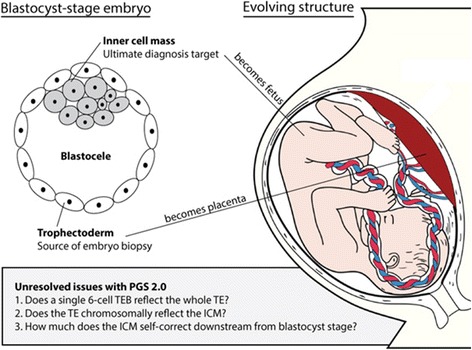
It has become increasingly apparent that the trophectoderm (TE) at blastocyst stage is much more mosaic than has been appreciated. Whether preimplantation genetic screening (PGS), utilizing a single TE biopsy (TEB), can reliably determine embryo ploidy has, therefore, increasingly been questioned in parallel.
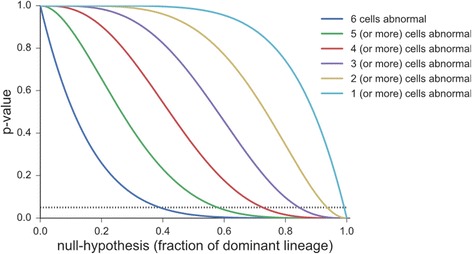
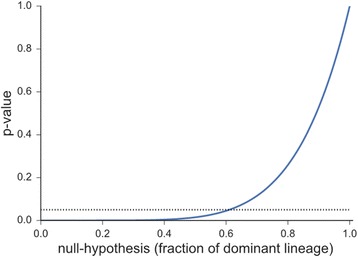
We for that reason here established 2 mathematical models to assess probabilities of false-negative and false-positive results of an on average 6-cell biopsy from an approximately 300-cell TE. This study was a collaborative effort between investigators at The Center for Human Reproduction in New York City and the Center for Studies in Physics and Biology and the Brivanlou Laboratory of Stem Cell Biology and Molecular Embryology, the latter two both at Rockefeller University in New York City.
Both models revealed that even under best case scenario, assuming even distribution of mosaicism in TE (since mosaicism is usually clonal, a highly unlikely scenario), a biopsy of at least 27 TE cells would be required to reach minimal diagnostic predictability from a single TEB.
As currently performed, a single TEB is, therefore, mathematically incapable of reliably determining whether an embryo can be transferred or should be discarded. Since a single TEB, as currently performed, apparently is not representative of the complete TE, this study, thus, raises additional concern about the clinical utilization of PGS.
越来越明显的是,囊胚期的滋养外胚层(TE)比人们以往认识到的更加具有嵌合性。因此,利用单个TE活检(TEB)进行的植入前基因筛查(PGS)能否可靠地确定胚胎倍性也越来越受到质疑。
因此,我们在此建立了2个数学模型,以评估从大约300个细胞的TE中平均进行6个细胞活检时出现假阴性和假阳性结果的概率。这项研究是纽约市人类生殖中心的研究人员与物理与生物学研究中心以及干细胞生物学与分子胚胎学的布里瓦诺实验室共同合作完成的,后两个机构均位于纽约市的洛克菲勒大学。
两个模型均显示,即使在最佳情况下,假设TE中的嵌合性呈均匀分布(由于嵌合性通常是克隆性的,这是极不可能的情况),从单个TEB中获得最小诊断可预测性也需要至少活检27个TE细胞。
因此,按照目前的操作方式,单个TEB在数学上无法可靠地确定一个胚胎是否可以移植或应该丢弃。由于目前进行的单个TEB显然不能代表完整的TE,因此这项研究对PGS的临床应用提出了更多担忧。