Lahrouchi Najim, Raju Hariharan, Lodder Elisabeth M, Papatheodorou Efstathios, Ware James S, Papadakis Michael, Tadros Rafik, Cole Della, Skinner Jonathan R, Crawford Jackie, Love Donald R, Pua Chee J, Soh Bee Y, Bhalshankar Jaydutt D, Govind Risha, Tfelt-Hansen Jacob, Winkel Bo G, van der Werf Christian, Wijeyeratne Yanushi D, Mellor Greg, Till Jan, Cohen Marta C, Tome-Esteban Maria, Sharma Sanjay, Wilde Arthur A M, Cook Stuart A, Bezzina Connie R, Sheppard Mary N, Behr Elijah R
Heart Centre, Department of Clinical and Experimental Cardiology, Academic Medical Center, Amsterdam, the Netherlands.
Molecular and Clinical Sciences Research Institute, St. George's, University of London, London, United Kingdom; Cardiology Clinical Academic Group, St. George's University Hospitals NHS Foundation Trust, London, United Kingdom.
J Am Coll Cardiol. 2017 May 2;69(17):2134-2145. doi: 10.1016/j.jacc.2017.02.046.
Sudden arrhythmic death syndrome (SADS) describes a sudden death with negative autopsy and toxicological analysis. Cardiac genetic disease is a likely etiology.
This study investigated the clinical utility and combined yield of post-mortem genetic testing (molecular autopsy) in cases of SADS and comprehensive clinical evaluation of surviving relatives.
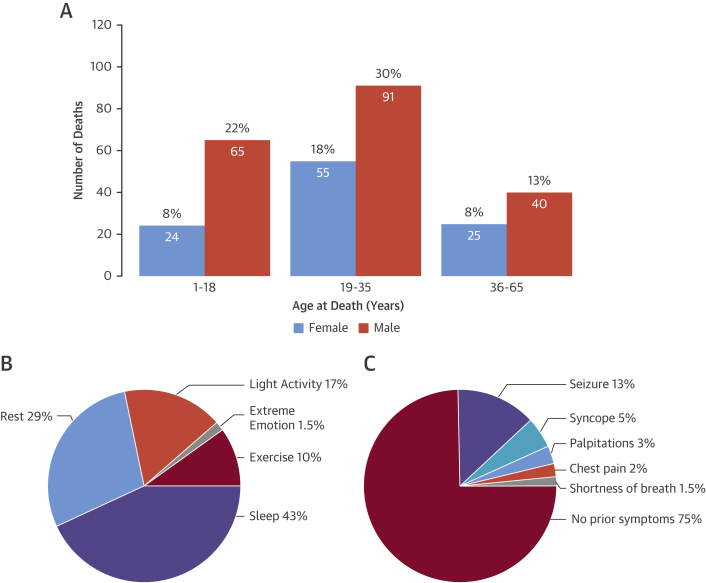
We evaluated 302 expertly validated SADS cases with suitable DNA (median age: 24 years; 65% males) who underwent next-generation sequencing using an extended panel of 77 primary electrical disorder and cardiomyopathy genes. Pathogenic and likely pathogenic variants were classified using American College of Medical Genetics (ACMG) consensus guidelines. The yield of combined molecular autopsy and clinical evaluation in 82 surviving families was evaluated. A gene-level rare variant association analysis was conducted in SADS cases versus controls.
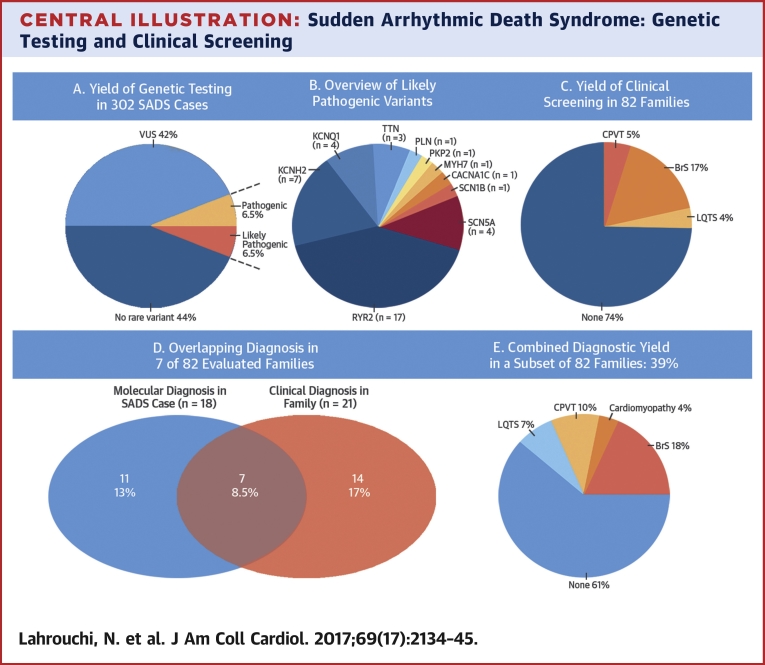
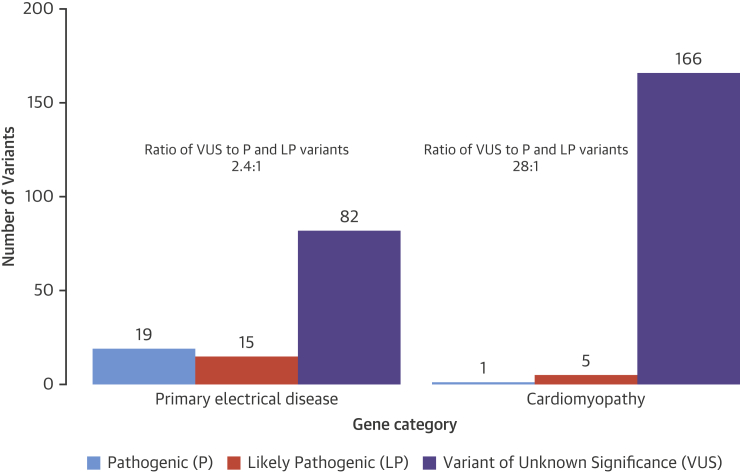
A clinically actionable pathogenic or likely pathogenic variant was identified in 40 of 302 cases (13%). The main etiologies established were catecholaminergic polymorphic ventricular tachycardia and long QT syndrome (17 [6%] and 11 [4%], respectively). Gene-based rare variants association analysis showed enrichment of rare predicted deleterious variants in RYR2 (p = 5 × 10). Combining molecular autopsy with clinical evaluation in surviving families increased diagnostic yield from 26% to 39%.
Molecular autopsy for electrical disorder and cardiomyopathy genes, using ACMG guidelines for variant classification, identified a modest but realistic yield in SADS. Our data highlighted the predominant role of catecholaminergic polymorphic ventricular tachycardia and long QT syndrome, especially the RYR2 gene, as well as the minimal yield from other genes. Furthermore, we showed the enhanced utility of combined clinical and genetic evaluation.
心律失常性猝死综合征(SADS)指尸检及毒理学分析均为阴性的猝死。心脏遗传疾病可能是其病因。
本研究调查了SADS病例死后基因检测(分子尸检)的临床实用性及综合检出率,以及对存活亲属的全面临床评估。
我们评估了302例经专业验证且有合适DNA的SADS病例(中位年龄:24岁;65%为男性),这些病例使用包含77个原发性电紊乱和心肌病基因的扩展检测板进行了二代测序。采用美国医学遗传学学会(ACMG)共识指南对致病和可能致病的变异进行分类。评估了82个存活家庭中分子尸检与临床评估相结合的检出率。对SADS病例与对照进行了基因水平的罕见变异关联分析。
302例病例中有40例(13%)鉴定出具有临床可操作性的致病或可能致病变异。确定的主要病因是儿茶酚胺能多形性室性心动过速和长QT综合征(分别为17例[6%]和11例[4%])。基于基因的罕见变异关联分析显示RYR2基因中罕见的预测有害变异富集(p = 5×10)。在存活家庭中将分子尸检与临床评估相结合,使诊断检出率从26%提高到39%。
使用ACMG变异分类指南对电紊乱和心肌病基因进行分子尸检,在SADS中鉴定出了适度但实际的检出率。我们的数据突出了儿茶酚胺能多形性室性心动过速和长QT综合征,尤其是RYR2基因的主要作用,以及其他基因的低检出率。此外,我们展示了临床和基因评估相结合的增强效用。