Latulippe Karine, Hamel Christine, Giroux Dominique
Department of Studies of Teaching and Learning, Laval University, Québec, QC, Canada.
Faculté de médecine, Département de réadaptation, Laval University, Québec, QC, Canada.
J Med Internet Res. 2017 Apr 27;19(4):e136. doi: 10.2196/jmir.6731.
eHealth is developing rapidly and brings with it a promise to reduce social health inequalities (SHIs). Yet, it appears that it also has the potential to increase them.
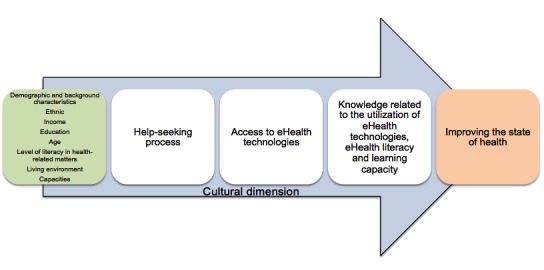
The general objective of this review was to set out how to ensure that eHealth contributes to reducing SHIs rather than exacerbating them. This review has three objectives: (1) identifying characteristics of people at risk of experiencing social inequality in health; (2) determining the possibilities of developing eHealth tools that avoid increasing SHI; and (3) modeling the process of using an eHealth tool by people vulnerable to SHI.
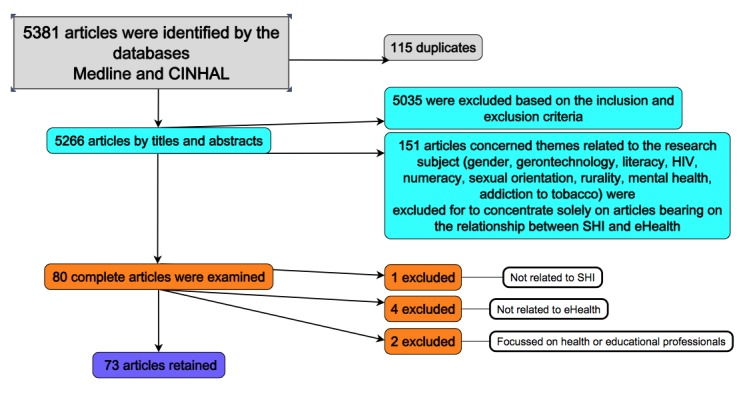
Following the EPPI approach (Evidence for Policy and Practice of Information of the Institute of Education at the University of London), two databases were searched for the terms SHIs and eHealth and their derivatives in titles and abstracts. Qualitative, quantitative, and mixed articles were included and evaluated. The software NVivo (QSR International) was employed to extract the data and allow for a metasynthesis of the data.
Of the 73 articles retained, 10 were theoretical, 7 were from reviews, and 56 were based on empirical studies. Of the latter, 40 used a quantitative approach, 8 used a qualitative approach, 4 used mixed methods approach, and only 4 were based on participatory research-action approach. The digital divide in eHealth is a serious barrier and contributes greatly to SHI. Ethnicity and low income are the most commonly used characteristics to identify people at risk of SHI. The most promising actions for reducing SHI via eHealth are to aim for universal access to the tool of eHealth, become aware of users' literacy level, create eHealth tools that respect the cultural attributes of future users, and encourage the participation of people at risk of SHI.
eHealth has the potential to widen the gulf between those at risk of SHI and the rest of the population. The widespread expansion of eHealth technologies calls for rigorous consideration of interventions, which are not likely to exacerbate SHI.
电子健康正在迅速发展,并带来了减少社会健康不平等现象(SHIs)的希望。然而,它似乎也有可能加剧这些不平等。
本综述的总体目标是阐述如何确保电子健康有助于减少而非加剧社会健康不平等现象。本综述有三个目标:(1)识别有健康方面社会不平等风险的人群特征;(2)确定开发避免加剧社会健康不平等的电子健康工具的可能性;(3)模拟易受社会健康不平等影响的人群使用电子健康工具的过程。
按照伦敦大学教育学院政策与实践信息证据(EPPI)方法,在两个数据库中搜索标题和摘要中包含社会健康不平等现象(SHIs)、电子健康及其衍生词的文献。纳入并评估定性、定量和混合研究文章。使用NVivo软件(QSR国际公司)提取数据并进行数据的元综合分析。
在保留的73篇文章中,10篇是理论性的,7篇来自综述,56篇基于实证研究。在后者中,40篇采用定量方法,8篇采用定性方法,4篇采用混合方法,只有4篇基于参与式研究 - 行动方法。电子健康中的数字鸿沟是一个严重障碍,对社会健康不平等有很大影响。种族和低收入是识别有社会健康不平等风险人群最常用的特征。通过电子健康减少社会健康不平等最有前景的行动是致力于实现电子健康工具的普遍可及性,了解用户的识字水平,创建尊重未来用户文化属性的电子健康工具,并鼓励易受社会健康不平等影响的人群参与。
电子健康有可能扩大易受社会健康不平等影响的人群与其他人群之间的差距。电子健康技术的广泛普及需要对干预措施进行严格考量,这些干预措施不应加剧社会健康不平等。