Yaginuma Yu, Abe Takashi, Thiebaud Robert S, Kitamura Takahiro, Kawanishi Masashi, Fukunaga Tetsuo
Department of Sports and Life Sciences, National Institute of Fitness and Sports in Kanoya, Kagoshima, Japan.
Department of Kinesiology, Texas Wesleyan University, Fort Worth, Texas.
Biores Open Access. 2017 Mar 1;6(1):19-27. doi: 10.1089/biores.2017.0008. eCollection 2017.
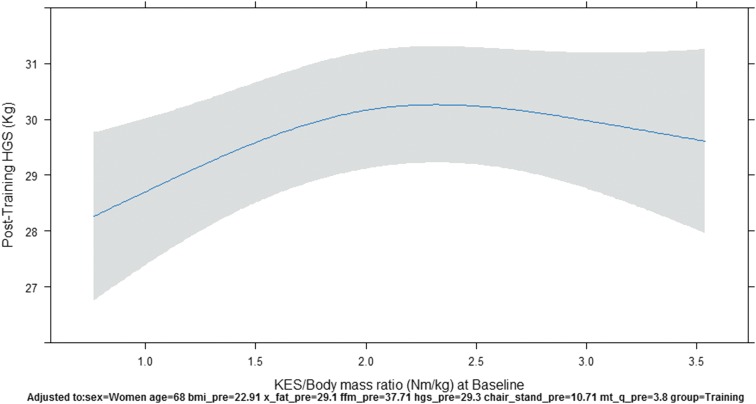
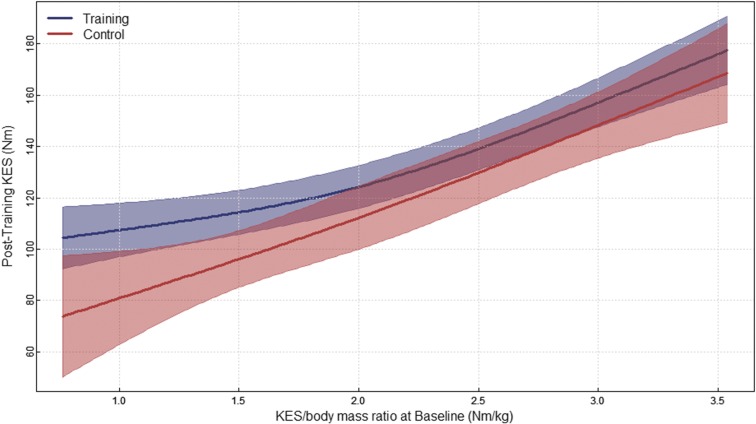
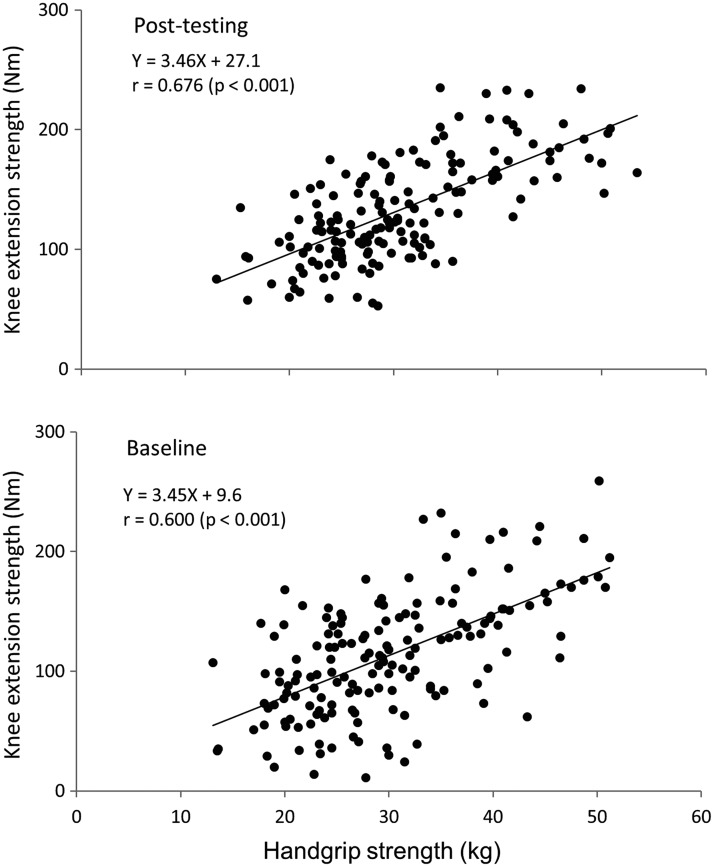
Knee extension strength (KES) improves following body mass-based lower body exercise training; however, it is unknown whether this type of exercise increases handgrip strength (HGS) as a result of a cross-education effect in older individuals. Our aim was to investigate the effect of a body mass-based exercise intervention on HGS and KES in older adults. At baseline, 166 subjects started a 12-week intervention program, and 160 (108 women and 52 men) subjects completed the study. A self-selected group of 37 older adults (21 women and 16 men) served as a control group. HGS, KES, and ultrasound-derived anterior thigh muscle thickness (anterior thigh MT) were measured at baseline and post-testing, and relative strength of the knee extensor (KES/anterior thigh MT) was calculated. A linear regression model controlling for baseline values of body-mass index, % body fat, fat-free mass, HGS, chair stand time, anterior thigh MT, and KES/body mass ratio found a significant difference between control and training groups for KES post-testing values ( = 0.001) and anterior thigh MT post-testing values ( = 0.012), but not for HGS post-testing values ( = 0.287). Our results suggest that increases in lower body strength and muscle size following a 12-week lower body mass-based exercise intervention fail to translate into improvements in HGS.
基于体重的下肢运动训练后,膝关节伸展力量(KES)会有所改善;然而,在老年人中,这种类型的运动是否会因交叉教育效应而增加握力(HGS)尚不清楚。我们的目的是研究基于体重的运动干预对老年人HGS和KES的影响。在基线时,166名受试者开始了为期12周的干预计划,160名(108名女性和52名男性)受试者完成了研究。37名老年人(21名女性和16名男性)的自我选择组作为对照组。在基线和测试后测量HGS、KES和超声测量的大腿前侧肌肉厚度(大腿前侧MT),并计算膝关节伸肌的相对力量(KES/大腿前侧MT)。一个控制体重指数、体脂百分比、去脂体重、HGS、从椅子上站起的时间、大腿前侧MT和KES/体重比基线值的线性回归模型发现,对照组和训练组在测试后KES值(=0.001)和大腿前侧MT测试后值(=0.012)上存在显著差异,但在测试后HGS值上不存在显著差异(=0.287)。我们的结果表明,为期12周的基于体重的下肢运动干预后,下肢力量和肌肉大小的增加未能转化为HGS的改善。