Leung Tiffany, Davis Stephen A
School of Science, RMIT University, Melbourne, VIC, Australia.
School of Mathematics and Statistics, University of Melbourne, Parkville, VIC, Australia.
Front Vet Sci. 2017 Apr 13;4:52. doi: 10.3389/fvets.2017.00052. eCollection 2017.
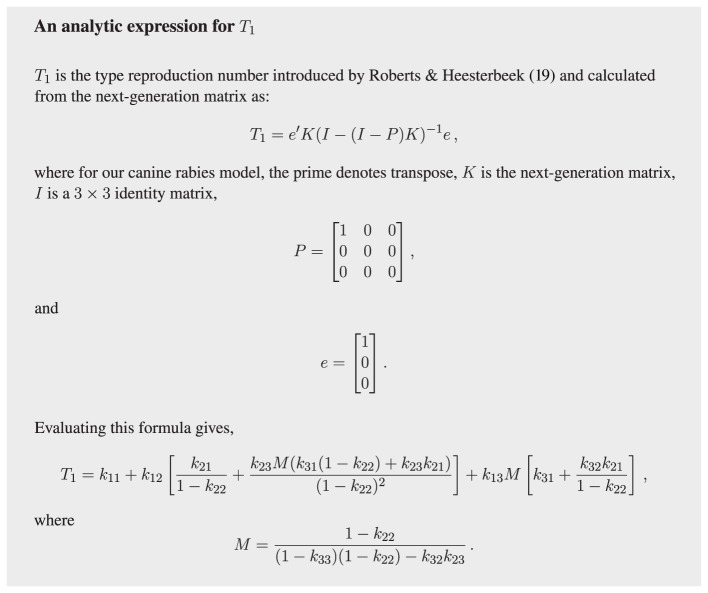
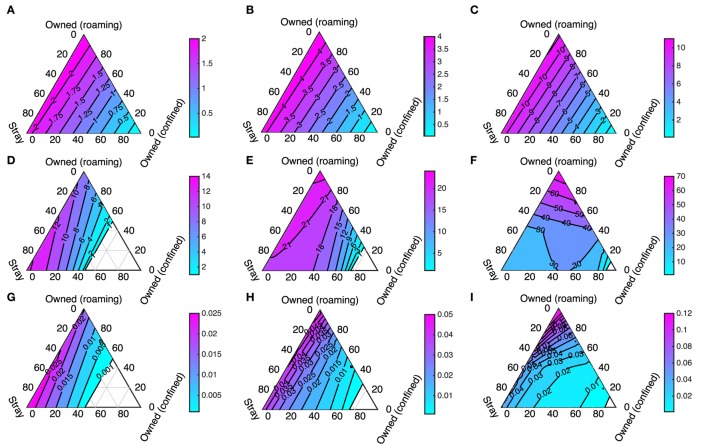
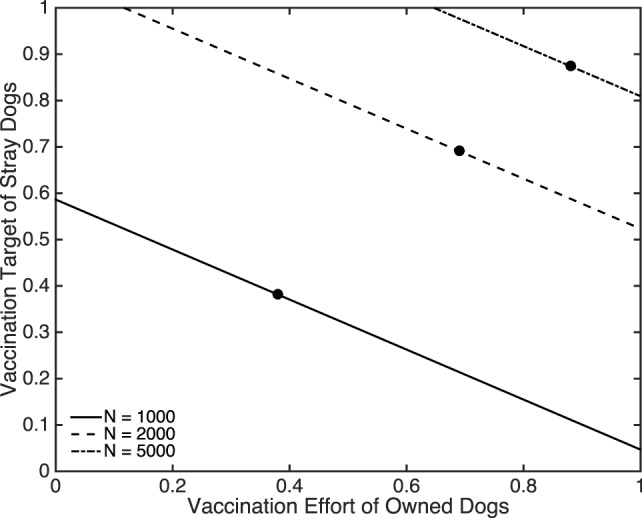
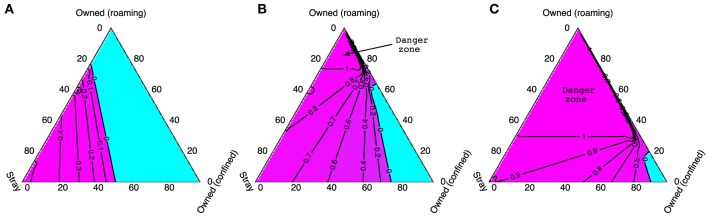
The role of stray dogs in the persistence of domestic dog rabies, and whether removal of such dogs is beneficial, remains contentious issues for control programs seeking to eliminate rabies. While a community might reach the WHO vaccination target of 70% for dogs that can be handled, the stray or neighborhood dogs that are too wary of humans to be held are a more problematic population to vaccinate. Here, we present a method to estimate vaccination targets for stray dogs when the dog population is made up of stray, free-roaming, and confined dogs, where the latter two types are considered to have an identifiable owner. The control effort required for stray dogs is determined by the , the number of stray dogs infected by one rabid stray dog either directly or via chain of infection involving owned dogs. Like the basic reproduction number for single host populations, determines the vaccination effort required to control the spread of disease when control is targeted at one host type, and there is a mix of host types. The application of to rabies in mixed populations of stray and owned dogs is novel. We show that the outcome is sensitive to the vaccination coverage in the owned dog population, such that if vaccination rates of owned dogs were too low then no control effort targeting stray dogs is able to control or eliminate rabies. The required vaccination level also depends on the composition of the dog population, where a high proportion of either stray or free-roaming dogs implies unrealistically high vaccination levels are required to prevent rabies. We find that the required control effort is less sensitive to continuous culling that increases the death rate of stray dogs than to changes in the carrying capacity of the stray dog population.
流浪狗在家犬狂犬病持续存在中所起的作用,以及清除这些狗是否有益,对于寻求消除狂犬病的防控项目来说仍是有争议的问题。虽然一个社区可能达到世界卫生组织针对可管控犬只70%的疫苗接种目标,但那些对人类过于警惕而无法捕捉的流浪狗或邻里间的狗,是更难进行疫苗接种的群体。在此,我们提出一种方法,当犬只群体由流浪狗、自由放养的狗和圈养的狗组成时(后两种类型被认为有可识别的主人),用于估计流浪狗的疫苗接种目标。流浪狗所需的防控力度由 决定,即一只狂犬病流浪狗直接或通过涉及有主犬只的感染链感染的流浪狗数量。与单一宿主群体的基本繁殖数 一样,当防控针对一种宿主类型且存在多种宿主类型混合时, 决定了控制疾病传播所需的疫苗接种力度。 将 应用于流浪狗和有主犬只的混合群体中的狂犬病是新颖的。我们表明,结果对有主犬只群体的疫苗接种覆盖率敏感,以至于如果有主犬只的疫苗接种率过低,那么针对流浪狗的任何防控措施都无法控制或消除狂犬病。所需的疫苗接种水平还取决于犬只群体的构成,流浪狗或自由放养的狗比例高意味着需要不切实际的高疫苗接种水平来预防狂犬病。我们发现,所需的防控力度对增加流浪狗死亡率的持续扑杀不如对流浪狗群体承载能力变化敏感。