Asif Irfan M, Harmon Kimberly G
Department of Family Medicine, Greenville Health System, University of South Carolina-Greenville School of Medicine, Greenville, South Carolina.
Department of Family Medicine, University of Washington, Seattle, Washington.
Sports Health. 2017 May/Jun;9(3):268-279. doi: 10.1177/1941738117694153. Epub 2017 Feb 1.
Sudden cardiac death (SCD) in a young athlete is a tragic event and is the leading medical cause of death in this population. The precise incidence of SCD in young athletes has been subject of debate, with studies reporting drastically different rates (1:917,000 athlete-years (AYs) to 1:3000 AYs) depending on the methodological design of the investigation or the targeted population.
A literature search was performed in PubMed using the terms: incidence, sudden cardiac death, sudden death, sudden cardiac arrest, etiology, pathology, registry, athlete, young, children, and adolescents. Articles were reviewed for relevance and included if they contained information on the incidence of SCD in athletes or young persons up to the age of 35 years.
Clinical review.
Level 5.
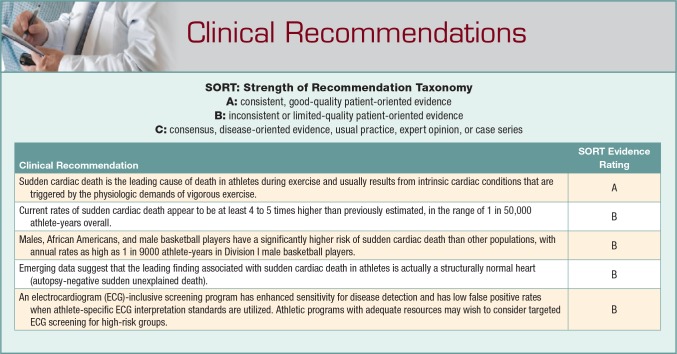
Studies of high quality and rigor consistently yield an incidence of 1:50,000 AYs in college athletes and between 1:50,000 and 1:80,000 AYs for high school athletes, with certain subgroups that appear to be at particularly high risk, including the following: men, basketball players, and African Americans. Initial reports suggest that the most common cause of SCD is hypertrophic cardiomyopathy (HCM). However, more comprehensive investigations in the United States and international populations-athletes, nonathletes, and military-support that the most common finding on autopsy in young individuals with SCD is actually a structurally normal heart (autopsy-negative sudden unexplained death).
SCD is the leading cause of death in athletes during exercise and usually results from intrinsic cardiac conditions that are triggered by the physiologic demands of vigorous exercise. Current rates of SCD appear to be at least 4 to 5 times higher than previously estimated, with men, African Americans, and male basketball players being at greatest risk. Emerging data suggest that the leading finding associated with SCD in athletes is actually a structurally normal heart (autopsy-negative sudden unexplained death).
年轻运动员心源性猝死(SCD)是一个悲剧性事件,是该人群死亡的主要医学原因。年轻运动员SCD的确切发病率一直存在争议,根据调查的方法设计或目标人群不同,研究报告的发病率差异很大(从1:917,000运动员年(AYs)到1:3000 AYs)。
在PubMed上进行文献检索,使用的关键词为:发病率、心源性猝死、猝死、心脏骤停、病因、病理、登记、运动员、年轻人、儿童和青少年。对文章进行相关性审查,如果文章包含有关运动员或35岁以下年轻人SCD发病率的信息,则将其纳入。
临床综述。
5级。
高质量和严谨的研究一致得出,大学运动员的发病率为1:50,000 AYs,高中运动员的发病率在1:50,000至1:80,000 AYs之间,某些亚组似乎风险特别高,包括男性、篮球运动员和非裔美国人。初步报告表明,SCD最常见的原因是肥厚型心肌病(HCM)。然而,在美国和国际人群(运动员、非运动员和军人)中进行的更全面调查表明,SCD年轻个体尸检时最常见的发现实际上是心脏结构正常(尸检阴性的不明原因猝死)。
SCD是运动员运动期间死亡的主要原因,通常由剧烈运动的生理需求引发的内在心脏疾病导致。目前SCD的发病率似乎至少比先前估计的高4至5倍,男性、非裔美国人和男性篮球运动员风险最大。新出现的数据表明,与运动员SCD相关的主要发现实际上是心脏结构正常(尸检阴性的不明原因猝死)。