Vats Mukti, Mishra Sumit Kumar, Baghini Mahdieh Shojaei, Chauhan Deepak S, Srivastava Rohit, De Abhijit
Department of Biosciences and Bioengineering, Indian Institute of Technology Bombay, Powai, Mumbai 410210, India.
Molecular Functional Imaging Laboratory, Advanced Centre for Treatment, Research and Education in Cancer (ACTREC), Tata Memorial Centre, Kharghar, Mumbai 410210, India.
Int J Mol Sci. 2017 Apr 28;18(5):924. doi: 10.3390/ijms18050924.
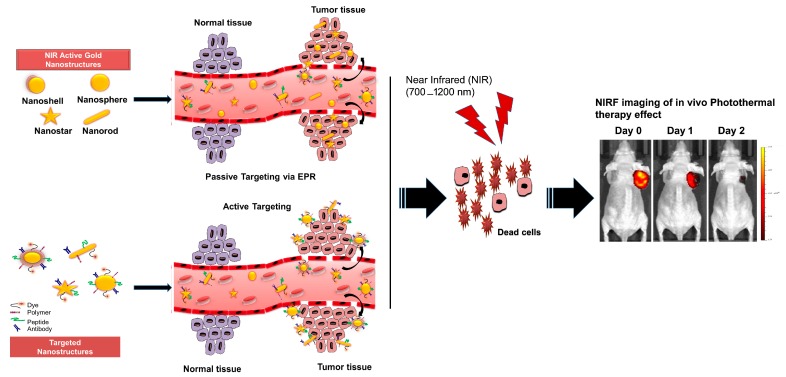
The unresolved and paramount challenge in bio-imaging and targeted therapy is to clearly define and demarcate the physical margins of tumor tissue. The ability to outline the healthy vital tissues to be carefully navigated with transection while an intraoperative surgery procedure is performed sets up a necessary and under-researched goal. To achieve the aforementioned objectives, there is a need to optimize design considerations in order to not only obtain an effective imaging agent but to also achieve attributes like favorable water solubility, biocompatibility, high molecular brightness, and a tissue specific targeting approach. The emergence of near infra-red fluorescence (NIRF) light for tissue scale imaging owes to the provision of highly specific images of the target organ. The special characteristics of near infra-red window such as minimal auto-fluorescence, low light scattering, and absorption of biomolecules in tissue converge to form an attractive modality for cancer imaging. Imparting molecular fluorescence as an exogenous contrast agent is the most beneficial attribute of NIRF light as a clinical imaging technology. Additionally, many such agents also display therapeutic potentials as photo-thermal agents, thus meeting the dual purpose of imaging and therapy. Here, we primarily discuss molecular imaging and therapeutic potentials of two such classes of materials, i.e., inorganic NIR dyes and metallic gold nanoparticle based materials.
生物成像和靶向治疗中尚未解决且至关重要的挑战是清晰界定和划分肿瘤组织的物理边界。在进行术中手术时,能够勾勒出在横切时需小心避开的健康重要组织,这是一个必要且研究不足的目标。为实现上述目标,需要优化设计考量,以便不仅获得有效的成像剂,还能实现诸如良好的水溶性、生物相容性、高分子亮度以及组织特异性靶向方法等特性。用于组织尺度成像的近红外荧光(NIRF)光的出现得益于提供了目标器官的高度特异性图像。近红外窗口的特殊特性,如最小的自发荧光、低光散射以及组织中生物分子的吸收,共同构成了一种有吸引力的癌症成像方式。赋予分子荧光作为外源性造影剂是NIRF光作为临床成像技术最有益的特性。此外,许多此类试剂还作为光热剂显示出治疗潜力,从而满足成像和治疗的双重目的。在此,我们主要讨论两类此类材料的分子成像和治疗潜力,即无机近红外染料和基于金属金纳米颗粒的材料。