Echeverría Francisca, Ortiz Macarena, Valenzuela Rodrigo, Videla Luis A
Nutrition Department, Faculty of Medicine, University of Chile, Independencia 1027, Independencia, Santiago 8380453, Chile.
Nutrition and Dietetics School, Faculty of Health Sciences, Catholic University of Maule, Merced 333, Curicó 3340000, Chile.
Int J Mol Sci. 2017 Apr 28;18(5):930. doi: 10.3390/ijms18050930.
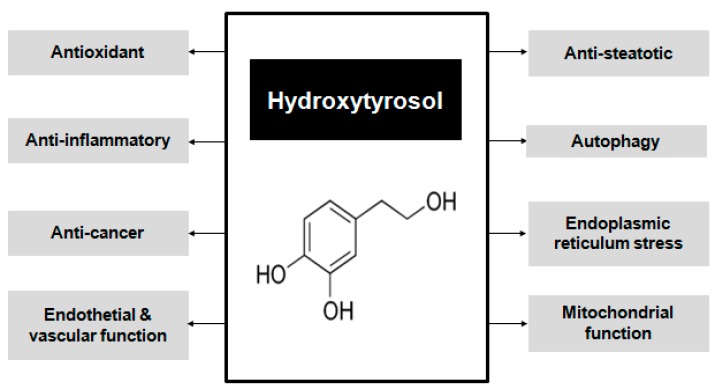
Hydroxytyrosol (HT) ((3,4-Dihydroxyphenyl)ethanol) is a polyphenol mainly present in extra virgin olive oil (EVOO) but also in red wine. It has a potent antioxidant effect related to hydrogen donation, and the ability to improve radical stability. The phenolic content of olive oil varies between 100 and 600 mg/kg, due to multiple factors (place of cultivation, climate, variety of the olive and level of ripening at the time of harvest), with HT and its derivatives providing half of that content. When consumed, EVOO's phenolic compounds are hydrolyzed in the stomach and intestine, increasing levels of free HT which is then absorbed in the small intestine, forming phase II metabolites. It has been demonstrated that HT consumption is safe even at high doses, and that is not genotoxic or mutagenic in vitro. The beneficial effects of HT have been studied in humans, as well as cellular and animal models, mostly in relation to consumption of EVOO. Many properties, besides its antioxidant capacity, have been attributed to this polyphenol. The aim of this review was to assess the main properties of HT for human health with emphasis on those related to the possible prevention and/or treatment of non-communicable diseases.
羟基酪醇(HT)((3,4-二羟基苯基)乙醇)是一种主要存在于特级初榨橄榄油(EVOO)中但也存在于红酒中的多酚。它具有与氢供体相关的强大抗氧化作用,以及提高自由基稳定性的能力。由于多种因素(种植地点、气候、橄榄品种和收获时的成熟度),橄榄油中的酚类含量在100至600毫克/千克之间变化,其中HT及其衍生物占该含量的一半。食用时,EVOO中的酚类化合物在胃和肠道中水解,增加游离HT的水平,然后在小肠中被吸收,形成II期代谢产物。已经证明,即使高剂量食用HT也是安全的,并且在体外它没有遗传毒性或致突变性。HT的有益作用已在人体以及细胞和动物模型中进行了研究,主要与EVOO的消费有关。除了其抗氧化能力外,这种多酚还具有许多特性。本综述的目的是评估HT对人类健康的主要特性,重点是那些与非传染性疾病的可能预防和/或治疗相关的特性。