a Centre for Interventions in Infection, Inflammation & Immunity (4i) and Graduate Entry Medical School , University of Limerick , Limerick , Ireland.
b Satakunta University of Applied Sciences , Rauma , Finland.
Bioengineered. 2017 Nov 2;8(6):679-685. doi: 10.1080/21655979.2017.1323593. Epub 2017 May 19.
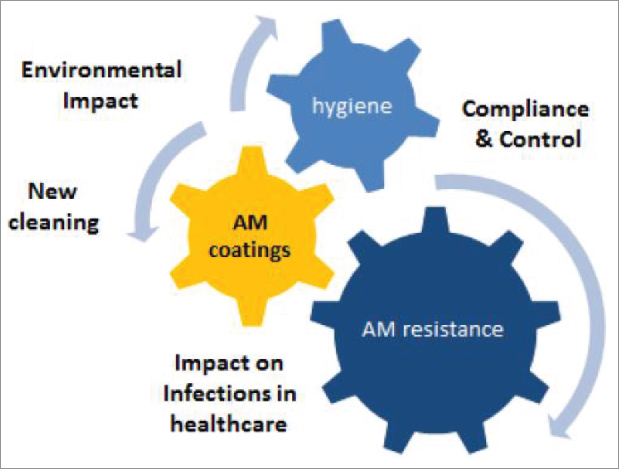
Worldwide, millions of patients are affected annually by healthcare-associated infection (HCAI), impacting up to 80,000 patients in European Hospitals on any given day. This represents not only public health risk, but also an economic burden. Complementing routine hand hygiene practices, cleaning and disinfection, antimicrobial coatings hold promise based, in essence, on the application of materials and chemicals with persistent bactericidal or -static properties onto surfaces or in textiles used in healthcare environments. The focus of considerable commercial investment and academic research energies, such antimicrobial coating-based approaches are widely believed to have potential in reduction of microbial numbers on surfaces in clinical settings. This belief exists despite definitive evidence as to their efficacy and is based somewhat on positive studies involving, for example, copper, silver or gold ions, titanium or organosilane, albeit under laboratory conditions. The literature describes successful delay and/or prevention of recontamination following conventional cleaning and disinfection by problematic microbes such as methicillin-resistant Staphylococcus aureus (MRSA) and vancomycin resistant enterococci (VRE), among others. However, there is a scarcity of studies assessing antimicrobial surfaces other than copper in the clinical environment, and a complete lack of published data regarding the successful implementation of these materials on clinically significant outcomes (including HCAI). Through its Cooperation in Science and Technology program (COST), the European Commission has funded a 4-year initiative to establish a network of stakeholders involved in development, regulation and use of novel anti-microbial coatings for prevention of HCAI. The network (AMiCI) comprises participants of more than 60 universities, research institutes and companies across 29 European countries and, to-date, represents the most comprehensive consortium targeting use of these emergent technologies in healthcare settings. More specifically, the network will prioritise coordinated research on the effects (both positive and negative) of antimicrobial coatings in healthcare sectors; know-how regarding availability and mechanisms of action of (nano)-coatings; possible adverse effects of such materials (e.g., potential emergence of microbial resistance or emission of toxic agents into the environment); standardised performance assessments for antimicrobial coatings; identification and dissemination of best practices by hospitals, other clinical facilities, regulators and manufacturers.
全球范围内,每年有数百万人受到医疗保健相关感染(HAI)的影响,在任何一天,欧洲医院都有多达 8 万名患者受到影响。这不仅是公共卫生风险,也是经济负担。除了常规的手部卫生实践、清洁和消毒外,抗菌涂层具有一定的前景,其本质上是将具有持久杀菌或抑菌特性的材料和化学物质应用于医疗环境中使用的表面或纺织品上。这些抗菌涂层基于的方法得到了大量商业投资和学术研究的关注,人们普遍认为它们具有减少临床环境中表面微生物数量的潜力。尽管没有明确的证据证明其疗效,但人们仍然相信这一点,这在一定程度上是基于涉及铜、银或金离子、钛或有机硅烷等的积极研究,尽管这些研究是在实验室条件下进行的。文献描述了成功延迟和/或预防经常规清洁和消毒后,耐甲氧西林金黄色葡萄球菌(MRSA)和万古霉素耐药肠球菌(VRE)等问题微生物的再次污染。然而,在临床环境中,除了铜之外,评估抗菌表面的研究很少,并且关于这些材料在临床上重要结果(包括 HAI)方面成功实施的公开数据完全缺乏。通过其科学与技术合作计划(COST),欧盟委员会资助了一个为期 4 年的倡议,旨在建立一个涉及新型抗菌涂层开发、监管和使用的利益相关者网络,以预防 HAI。该网络(AMiCI)由来自 29 个欧洲国家的 60 多所大学、研究所和公司的参与者组成,迄今为止,这是针对这些新兴技术在医疗保健环境中应用的最全面的联盟。更具体地说,该网络将优先协调研究抗菌涂层在医疗保健部门的影响(包括积极和消极影响);关于(纳米)涂层的可用性和作用机制的专业知识;这些材料可能产生的不利影响(例如,微生物耐药性的出现或有毒剂排放到环境中);抗菌涂层的标准化性能评估;由医院、其他临床设施、监管机构和制造商确定和传播最佳实践。