Sadeghi Mahsa, Barlow-Krelina Emily, Gibbons Clare, Shaikh Komal T, Fung Wai Lun Alan, Meschino Wendy S, Till Christine
Department of Psychology, York University, Toronto, Ontario, Canada.
Genetics Program, North York General Hospital, Toronto, Ontario, Canada.
PLoS One. 2017 Apr 28;12(4):e0176429. doi: 10.1371/journal.pone.0176429. eCollection 2017.
Huntington disease (HD) is associated with a variety of cognitive deficits, with prominent difficulties in working memory (WM). WM deficits are notably compromised in early-onset and prodromal HD patients. This study aimed to determine the feasibility of a computerized WM training program (Cogmed QM), novel to the HD population.
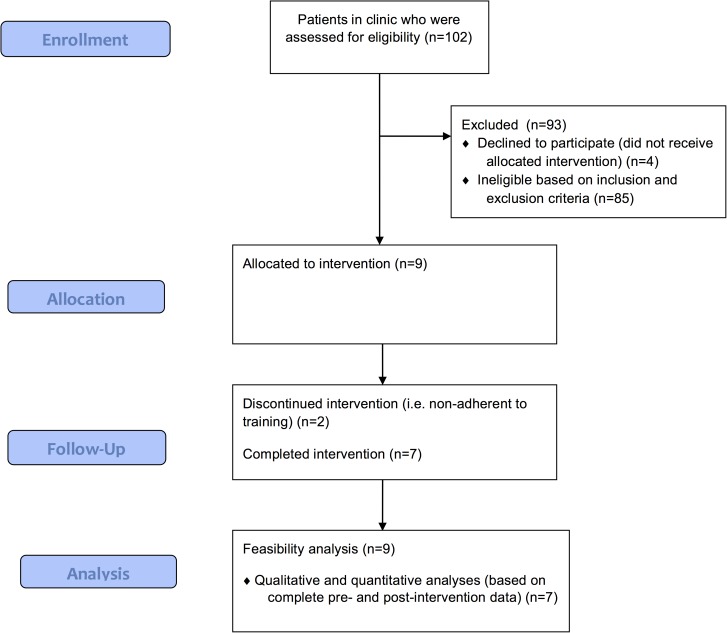
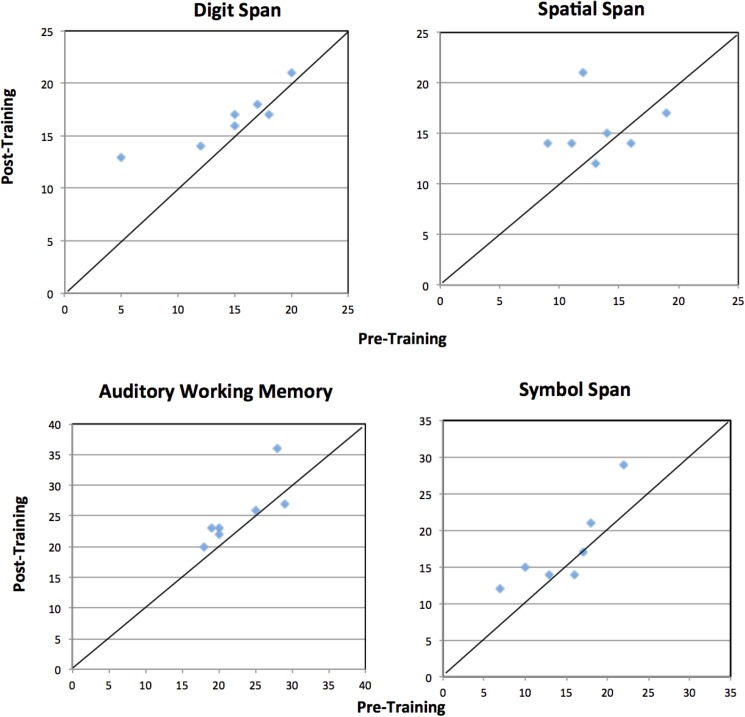
Nine patients, aged 26-62, with early stage HD underwent a 25-session (5 days/week for 5 weeks) WM training program (Cogmed QM). Training exercises involved the manipulation and storage of verbal and visuospatial information, with difficulty adapted as a function of individual performance. Neuropsychological testing was conducted before and after training, and performance on criterion WM measures (Digit Span and Spatial Span), near-transfer WM measures (Symbol Span and Auditory WM), and control measures were evaluated. Post-training interviews about patient experience were thematically analyzed using NVivo software.
Seven of nine patients demonstrated adherence to the training and completed all sessions within the recommended timeframe of 5 weeks. All adherent patients showed improvement on the Cogmed tasks as defined by the Improvement Index (M = 22.17, SD = 8.84, range = 13-36). All adherent patients reported that they found training helpful (n = 7), and almost all felt that their memory improved (n = 6). Participants also expressed that the training was difficult, sometimes frustrating, and time consuming.
This pilot study provides support for feasibility of computerized WM training in early-stage patients with HD. Results suggest that HD patients perceive benefits of intensive WM training, though a full-scale and controlled intervention project is needed to understand the size of the effect and reliability of changes over time.
ClinicalTrials.gov, Registry number NCT02926820.
亨廷顿舞蹈症(HD)与多种认知缺陷相关,其中工作记忆(WM)存在显著困难。在早发性和前驱期HD患者中,WM缺陷尤为明显。本研究旨在确定一种针对HD人群的新型计算机化WM训练程序(Cogmed QM)的可行性。
9名年龄在26 - 62岁的早期HD患者接受了为期25节(每周5天,共5周)的WM训练程序(Cogmed QM)。训练练习涉及言语和视觉空间信息的操作与存储,难度根据个体表现进行调整。在训练前后进行神经心理学测试,并评估标准WM测量(数字广度和空间广度)、近迁移WM测量(符号广度和听觉WM)以及对照测量的表现。使用NVivo软件对训练后关于患者体验的访谈进行主题分析。
9名患者中有7名坚持训练并在推荐的5周时间内完成了所有课程。所有坚持训练的患者在改善指数定义的Cogmed任务上均有改善(M = 22.17,SD = 8.84,范围 = 13 - 36)。所有坚持训练的患者均报告他们认为训练有帮助(n = 7),并且几乎所有人都感觉自己的记忆力有所改善(n = 6)。参与者还表示训练困难,有时令人沮丧且耗时。
这项初步研究为早期HD患者进行计算机化WM训练的可行性提供了支持。结果表明,HD患者认为强化WM训练有益,不过需要一个全面且受控的干预项目来了解效果大小以及随时间变化的可靠性。
ClinicalTrials.gov,注册号NCT02926820。