Lamptey Peter, Laar Amos, Adler Alma J, Dirks Rebecca, Caldwell Aya, Prieto-Merino David, Aerts Ann, Pearce Neil, Perel Pablo
Department of Non-communicable Disease Epidemiology, London School of Hygiene & Tropical Medicine, Keppel St, London, WC1E 7HT, UK.
Family Health International 360, Washington DC, WA, USA.
BMC Public Health. 2017 Apr 28;17(1):368. doi: 10.1186/s12889-017-4260-5.
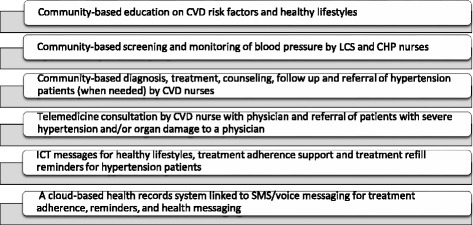
Ghana faces an increasing burden of non-communicable disease with rates of hypertension estimated as high as 36% in adults. Despite these high rates, hypertension control remains very poor in Ghana (4%). The current project aims to implement and evaluate a community-based programme to raise awareness, and to improve treatment and control of hypertension in the Eastern Region of Ghana. In this paper, we present the findings of the baseline cross-sectional survey focusing on hypertension prevalence, awareness, treatment, and control.
To evaluate the ComHIP project, a quasi-experimental design consisted of a before and after evaluations are being implemented in the intervention and comparison districts. A cohort study component is being implemented in the intervention district to assess hypertension control. Background anthropometric and clinical data collected as part of the baseline survey were analyzed in STATA Version 11. We examined the characteristics of individuals, associated with the baseline study outcomes using logistic regression models.
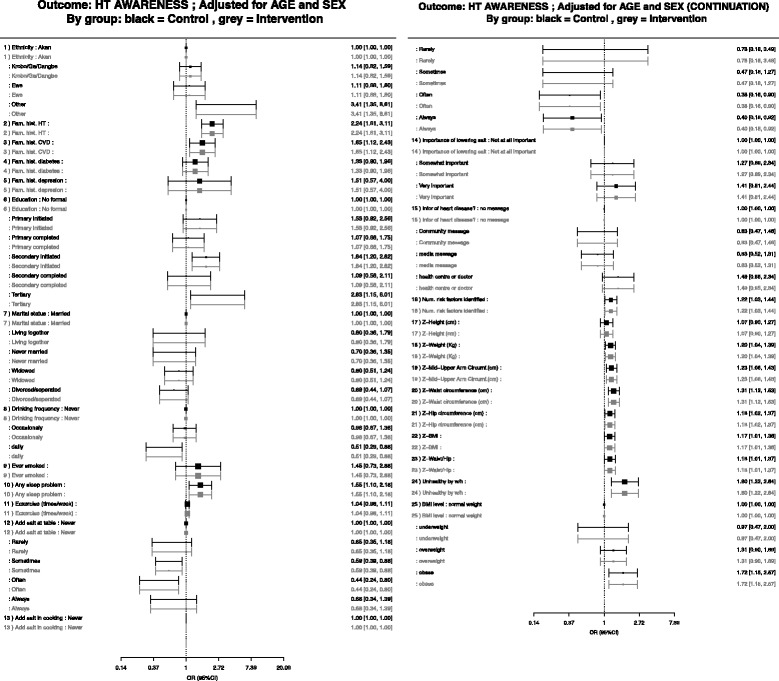
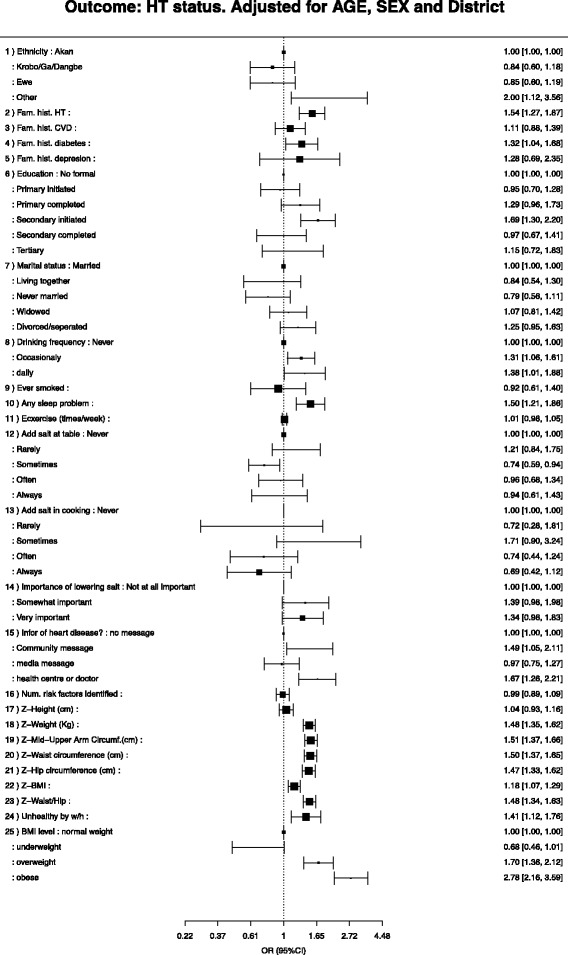
We interviewed 2400 respondents (1200 each from the comparison and intervention districts), although final sample sizes after data cleaning were 1170 participants in the comparison district and 1167 in the intervention district. With the exception of ethnicity, the control and intervention districts compare favorably. Overall 32.4% of the study respondents were hypertensive (31.4% in the control site; and 33.4% in the intervention site); 46.2% of hypertensive individuals were aware of a previous diagnosis of hypertension (44.7% in the control site, and 47.7% in the intervention site), and only around 9% of these were being treated in either arm. Hypertension control was 1.3% overall (0.5% in the comparison site, and 2.1% in the intervention site). Age was a predictor of having hypertension, and so was increasing body mass index (BMI), waist, and hip circumferences. After adjusting for age, the risk factors with the greatest association with hypertension were being overweight (aOR = 2.30; 95% CI 1.53-3.46) or obese (aOR = 3.61; 95% CI 2.37-5.51). Older individuals were more likely to be aware of their hypertension status than younger people. After adjusting for age people with a family history of hypertension or CVD, or having an unhealthy waist hip ratio, were more likely to be aware of their hypertension status.
The high burden of hypertension among the studied population, coupled with high awareness, yet very low level of hypertension treatment and control requires in-depth investigation of the bottlenecks to treatment and control. The low hypertension treatment and control rates despite current and previous general educational programs particularly in the intervention district, may suggest that such programs are not necessarily impactful on the health of the population.
加纳面临着日益加重的非传染性疾病负担,据估计成年人高血压患病率高达36%。尽管患病率如此之高,但加纳的高血压控制情况仍然很差(仅4%)。当前项目旨在实施并评估一项基于社区的项目,以提高加纳东部地区对高血压的认识,并改善高血压的治疗与控制情况。在本文中,我们呈现了基线横断面调查的结果,该调查聚焦于高血压患病率、知晓率、治疗情况及控制情况。
为评估ComHIP项目,采用了准实验设计,在干预区和对照区实施前后评估。在干预区开展一项队列研究以评估高血压控制情况。作为基线调查一部分收集的背景人体测量和临床数据在STATA 11版本中进行分析。我们使用逻辑回归模型研究了与基线研究结果相关的个体特征。
我们采访了2400名受访者(对照区和干预区各1200名),不过数据清理后的最终样本量在对照区为1170名参与者,干预区为1167名。除了种族外,对照区和干预区情况良好。总体而言,32.4%的研究受访者患有高血压(对照区为31.4%;干预区为33.4%);46.2%的高血压患者知晓自己之前被诊断为高血压(对照区为44.7%,干预区为47.7%),而其中只有约9%在任何一组中接受治疗。总体高血压控制率为1.3%(对照区为0.5%,干预区为2.1%)。年龄是患高血压的一个预测因素,体重指数(BMI)、腰围和臀围增加也是如此。在调整年龄后,与高血压关联最大的危险因素是超重(调整后比值比[aOR]=2.30;95%置信区间[CI]为1.53 - 3.46)或肥胖(aOR = 3.61;95% CI为2.37 - 5.51)。老年人比年轻人更有可能知晓自己的高血压状况。在调整年龄后,有高血压或心血管疾病家族史、或腰臀比不健康的人更有可能知晓自己的高血压状况。
研究人群中高血压负担沉重,知晓率高,但高血压治疗和控制水平极低,这需要深入调查治疗和控制的瓶颈。尽管当前及以往开展了一般教育项目,特别是在干预区,但高血压治疗和控制率较低,这可能表明此类项目对人群健康不一定有影响。