Pharmacy Department, Korle Bu Teaching Hospital, Accra, Ghana.
Department of Pharmacy Practice, Faculty of Pharmacy and Pharmaceutical Sciences, College of Health Sciences, Kwame Nkrumah University of Science and Technology, Kumasi, Ghana.
Pan Afr Med J. 2021 Jul 8;39:184. doi: 10.11604/pamj.2021.39.184.27977. eCollection 2021.
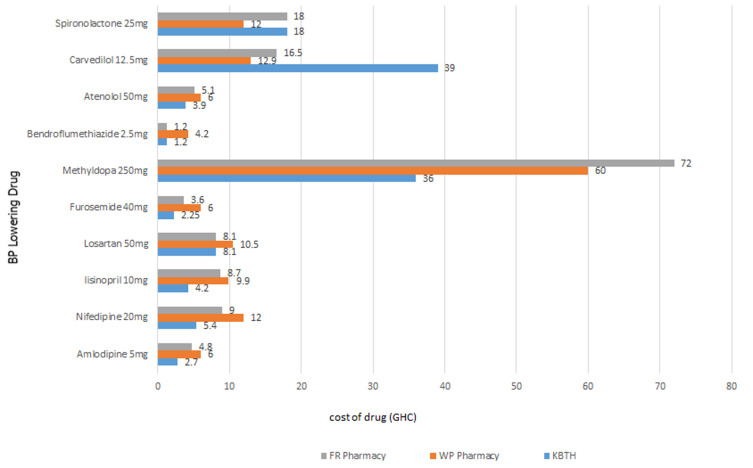
many hypertensive patients require two or more anti-hypertensive drugs, but in low- and middle-income countries there may be challenges with medication access or affordability. The objective of this study was to determine accessibility and affordability of anti-hypertensive medicines and their association with blood pressure (BP) control among hypertensive patients attending the Korle-Bu teaching hospital (KBTH) polyclinic.
a cross-sectional study was conducted among 310 systematically sampled hypertensive patients attending the KBTH Polyclinic in Ghana. A structured questionnaire was used to obtain data on patient demographics and clinical characteristics, prices, availability and mode of payment of generic anti-hypertensive medicines.
fifty-nine patients (19.4%) made out-of-pocket payments. At the private pharmacy and hospital, 123 (40.5%) and 77 patients (25.3%) respectively could not afford four anti-hypertensive medicines. Medicines availability at KBTH was 60%. Continuous access to BP drugs at KBTH was 14.8%. Overall access was 74.9% (SD ± 41.3). Out-of-pocket affordability of the medicines was positively correlated with BP control (R=0.12, p=0.037). Obtaining medicines via health insurance only was more likely to result in BP control than making any out-of-pocket payments (OR= 2.185; 95% CI, 1.215 - 3.927). Access at KBTH was more likely to result in BP control (OR=1.642; 95% C.I, 0.843 - 3.201).
there were access challenges although most patients obtained BP medication free. Out-of-pocket affordability is a challenge for some hypertensive patients. Access to affordable BP medication can improve BP control. These findings provide an impetus for urgently evaluating access to affordable anti-hypertensive medicines in other hospitals in Ghana.
许多高血压患者需要两种或更多种降压药,但在中低收入国家,可能存在药物获取或负担能力方面的挑战。本研究的目的是确定高血压患者在科勒布教学医院(KBTH)门诊部接受治疗时,降压药物的可及性和可负担性及其与血压(BP)控制的关系。
对加纳 KBTH 门诊部 310 名系统抽样的高血压患者进行了横断面研究。使用结构化问卷获取患者人口统计学和临床特征、价格、通用降压药的供应情况和支付方式的数据。
59 名患者(19.4%)自掏腰包支付费用。在私人药房和医院,分别有 123 名(40.5%)和 77 名患者(25.3%)无法负担四种降压药。KBTH 的药物供应率为 60%。KBTH 连续获得 BP 药物的比例为 14.8%。总体可及性为 74.9%(SD ± 41.3)。药物的自付能力与 BP 控制呈正相关(R=0.12,p=0.037)。仅通过健康保险获得药物比任何自付费用更有可能控制 BP(OR=2.185;95% CI,1.215 - 3.927)。在 KBTH 获得药物更有可能控制 BP(OR=1.642;95% CI,0.843 - 3.201)。
尽管大多数患者可以免费获得 BP 药物,但仍存在可及性挑战。一些高血压患者面临自付能力的挑战。获得负担得起的 BP 药物可以改善 BP 控制。这些发现为迫切评估加纳其他医院负担得起的降压药物的可及性提供了动力。