Orlandini Lucia Clara, Coppola Marianna, Fulcheri Christian, Cernusco Luna, Wang Pei, Cionini Luca
Centro Oncologico Fiorentino, Radiation Oncology Department, Via A. Ragionieri 101, 50023, Florence, Italy.
Department of Radiation Oncology, Sichuan Cancer Hospital, No.55, the 4th Section, Renmin South Road, Chengdu, China.
Radiat Oncol. 2017 Apr 28;12(1):78. doi: 10.1186/s13014-017-0815-y.
The cumulative dose was compared with the planned dose among fourteen patients undergoing image-guided, intensity-modulated radiotherapy of the prostate bed. Moreover, we investigated the feasibility of adding dose tracking to the routine workflow for radiotherapy.
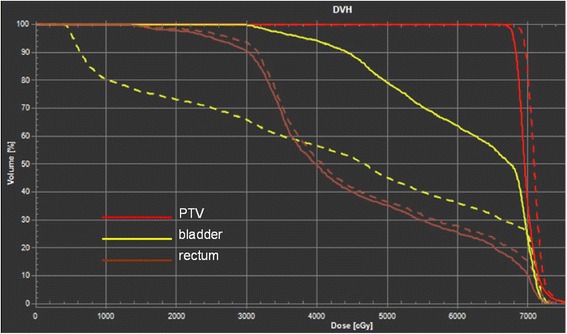
Daily cone beam computed tomography was conducted for image-guided radiotherapy, and weekly cumulative delivered doses were calculated for dose tracking. Deformable image registration was applied to map weekly dose distributions to the original treatment plan and to create a cumulative dose distribution. The dose-volume histogram (DVH) cut-off points for the rectum and bladder and the planning target volume (PTV), were used to compare the planned and cumulative delivered doses. The additional time required by the departmental staff to complete these duties was recorded.
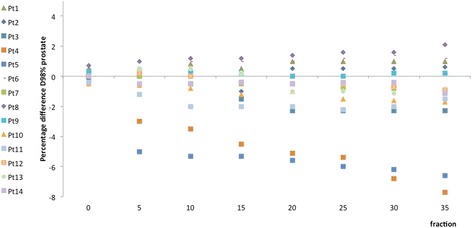
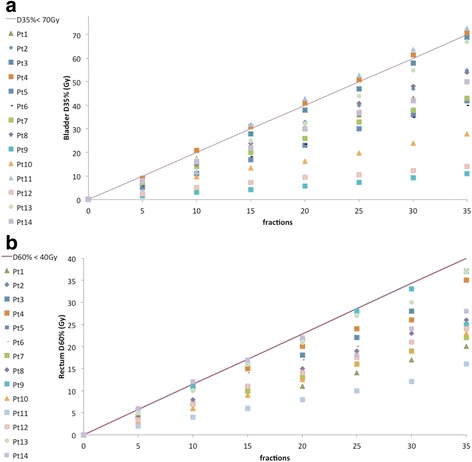
The PTV coverage of the delivered treatment did not satisfy the expected goal for three patients (V98% >98%). In another three patients, the DVH cut-off point for the bladder was higher than the limits, while for the rectum, treatment was as expected in all cases (two patients failed both their bladder constraints and the PTV coverage). Overall, four patients did not satisfy one or more criteria at the end of their treatment.
A well-defined strategy for dose tracking assessment is feasible, would have minimal impact on the workload of a radiotherapy department, and may offer objective information to support radiation oncologists in making decisions about adaptive procedures.
在14例接受前列腺床图像引导调强放疗的患者中,比较了累积剂量与计划剂量。此外,我们研究了在放射治疗的常规工作流程中增加剂量跟踪的可行性。
进行每日锥形束计算机断层扫描以进行图像引导放射治疗,并计算每周累积输送剂量以进行剂量跟踪。应用可变形图像配准将每周剂量分布映射到原始治疗计划,并创建累积剂量分布。直肠、膀胱和计划靶区(PTV)的剂量体积直方图(DVH)截止点用于比较计划剂量和累积输送剂量。记录部门工作人员完成这些职责所需的额外时间。
三名患者的实际治疗PTV覆盖率未达到预期目标(V98%>98%)。另外三名患者中,膀胱的DVH截止点高于限值,而直肠在所有病例中治疗均符合预期(两名患者膀胱限制和PTV覆盖率均未达标)。总体而言,四名患者在治疗结束时未满足一项或多项标准。
明确的剂量跟踪评估策略是可行的,对放射治疗科工作量的影响最小,并且可以提供客观信息以支持放射肿瘤学家做出关于适应性程序的决策。