Limpawattana Panita, Putraveephong Siraphong, Inthasuwan Pratchaya, Boonsawat Watchara, Theerakulpisut Daris, Chindaprasirt Jarin
Division of Geriatric Medicine.
Department of Internal Medicine.
Int J Chron Obstruct Pulmon Dis. 2017 Apr 18;12:1193-1198. doi: 10.2147/COPD.S134233. eCollection 2017.
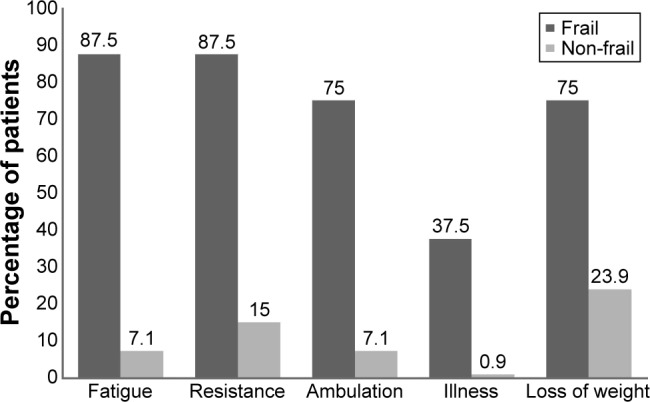
Frailty is a state of increased risk of unfavorable outcomes when exposed to stressors, and COPD is one of the several chronic illnesses associated with the condition. However, few studies have been conducted regarding the prevalence of COPD and its related factors in Southeast Asia. The objectives of this study were to determine the prevalence of frailty in COPD patients and to identify the associated factors in these populations. A cross-sectional study of COPD patients who attended a COPD clinic was conducted from May 2015 to December 2016. Baseline characteristics were collected, and the diagnosis of frailty was based on the FRAIL (fatigue, resistance, ambulation, illnesses, and loss of weight) scale. Descriptive statistics were used to analyze baseline data. Factors associated with frailty were analyzed using univariate and multivariate regression analyses. The results showed that the prevalence rates of frailty and pre-frailty were 6.6% (eight out of 121 cases) and 41.3% (50 out of 121 cases), respectively, among COPD patients. Fatigue was the most common component of the FRAIL scale that was found more frequently in frail patients than in non-frail patients (odds ratio [OR] 91.9). Factors associated with frailty according to multivariate analyses were comorbid cancer (adjusted OR [AOR] 45.8), at least two instances of nonelective admission over the past 12 months (AOR 112.5), high waist circumference (WC) (AOR 1.3), and presence of sarcopenia (AOR 29.5). In conclusion, frailty affected 6.6% of stable COPD patients. Cancer, two or more instances of nonelective hospitalization over the past 12 months, high WC, and presence of sarcopenia were associated with frailty. Early identification and intervention in high-risk patients is recommended to prevent or delay the adverse outcomes of frailty.
衰弱是指个体在面对应激源时出现不良后果风险增加的一种状态,慢性阻塞性肺疾病(COPD)是与该状态相关的几种慢性疾病之一。然而,关于东南亚地区COPD的患病率及其相关因素的研究较少。本研究的目的是确定COPD患者中衰弱的患病率,并识别这些人群中的相关因素。2015年5月至2016年12月,对就诊于COPD门诊的患者进行了一项横断面研究。收集了基线特征,衰弱的诊断基于FRAIL(疲劳、耐力、行走能力、疾病和体重减轻)量表。采用描述性统计分析基线数据。使用单因素和多因素回归分析来分析与衰弱相关的因素。结果显示,COPD患者中衰弱和衰弱前期的患病率分别为6.6%(121例中的8例)和41.3%(121例中的50例)。疲劳是FRAIL量表中最常见的组成部分,在衰弱患者中比非衰弱患者更常见(优势比[OR]为91.9)。多因素分析显示,与衰弱相关的因素包括合并癌症(校正OR[AOR]为45.8)、过去12个月内至少两次非选择性住院(AOR为112.5)、高腰围(WC)(AOR为1.3)和存在肌肉减少症(AOR为29.5)。总之,6.6%的稳定期COPD患者存在衰弱。癌症、过去12个月内两次或更多次非选择性住院、高腰围和存在肌肉减少症与衰弱相关。建议对高危患者进行早期识别和干预,以预防或延缓衰弱的不良后果。