Chen Shuang-Qing, Huang Min, Shen Yu-Ying, Liu Chen-Lu, Xu Chuan-Xiao
Department of Radiology, The Affiliated Suzhou Hospital, Nanjing Medical University, Suzhou 215001, China.
Breast Imaging Screening Center, The Affiliated Suzhou Hospital, Nanjing Medical University, Suzhou 215001, China.
Korean J Radiol. 2017 May-Jun;18(3):470-475. doi: 10.3348/kjr.2017.18.3.470. Epub 2017 Apr 3.
To evaluate the validity of two abbreviated protocols (AP) of MRI in breast cancer screening of dense breast tissue.
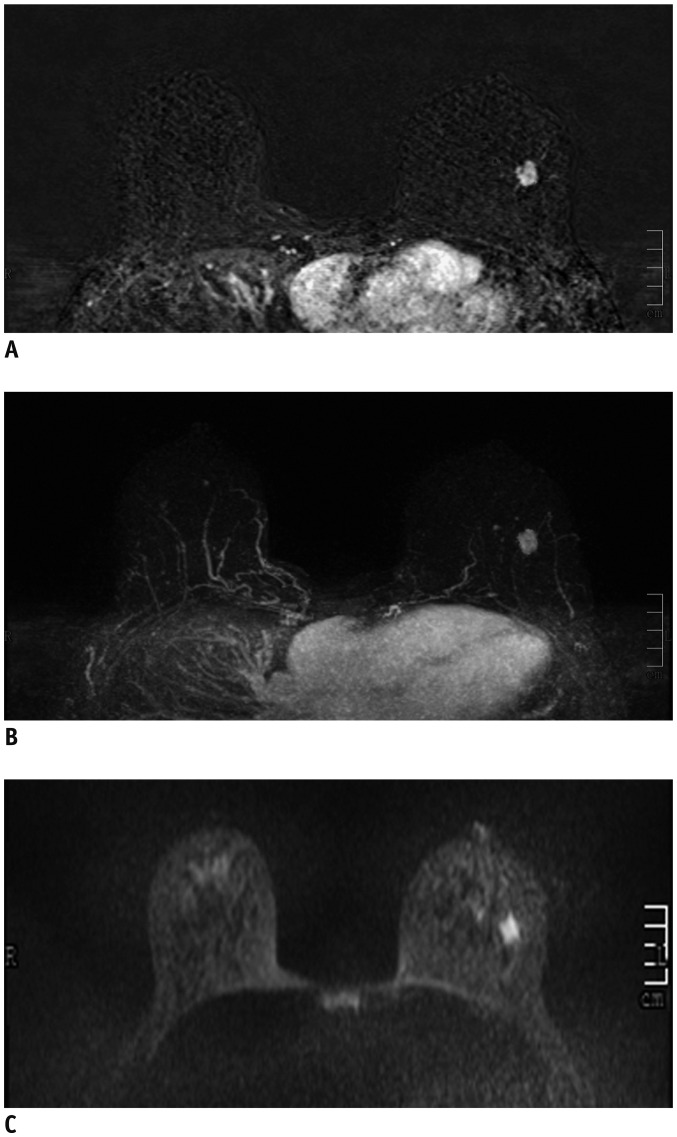
This was a retrospective study in 356 participants with dense breast tissue and negative mammography results. The study was approved by the Nanjing Medical University Ethics Committee. Patients were imaged with a full diagnostic protocol (FDP) of MRI. Two APs (AP-1 consisting of the first post-contrast subtracted [FAST] and maximum-intensity projection [MIP] images, and AP-2 consisting of AP-1 combined with diffusion-weighted imaging [DWI]) and FDP images were analyzed separately, and the sensitivities and specificities of breast cancer detection were calculated.
Of the 356 women, 67 lesions were detected in 67 women (18.8%) by standard MR protocol, and histological examination revealed 14 malignant lesions and 53 benign lesions. The average interpretation time of AP-1 and AP-2 were 37 seconds and 54 seconds, respectively, while the average interpretation time of the FDP was 3 minutes and 25 seconds. The sensitivities of the AP-1, AP-2, and FDP were 92.9, 100, and 100%, respectively, and the specificities of the three MR protocols were 86.5, 95.0, and 96.8%, respectively. There was no significant difference among the three MR protocols in the diagnosis of breast cancer ( > 0.05). However, the specificity of AP-1 was significantly lower than that of AP-2 ( = 0.031) and FDP ( = 0.035), while there was no difference between AP-2 and FDP ( > 0.05).
The AP may be efficient in the breast cancer screening of dense breast tissue. FAST and MIP images combined with DWI of MRI are helpful to improve the specificity of breast cancer detection.
评估两种简化的MRI方案(AP)在致密乳腺组织乳腺癌筛查中的有效性。
这是一项对356名乳腺组织致密且乳腺X线摄影结果为阴性的参与者进行的回顾性研究。该研究经南京医科大学伦理委员会批准。患者接受了MRI的全诊断方案(FDP)成像。分别分析两种AP(AP-1由首次对比剂注射后减影[FAST]和最大强度投影[MIP]图像组成,AP-2由AP-1结合扩散加权成像[DWI]组成)和FDP图像,并计算乳腺癌检测的敏感性和特异性。
在356名女性中,标准MR方案在67名女性(18.8%)中检测到67个病灶,组织学检查显示14个恶性病灶和53个良性病灶。AP-1和AP-2的平均解读时间分别为37秒和54秒,而FDP的平均解读时间为3分25秒。AP-1、AP-2和FDP的敏感性分别为92.9%、100%和100%,三种MR方案的特异性分别为86.5%、95.0%和96.8%。三种MR方案在乳腺癌诊断方面无显著差异(>0.05)。然而,AP-1的特异性显著低于AP-2(=0.031)和FDP(=0.035),而AP-2和FDP之间无差异(>0.05)。
AP在致密乳腺组织的乳腺癌筛查中可能有效。MRI的FAST和MIP图像结合DWI有助于提高乳腺癌检测的特异性。