Audagnotto Martina, Dal Peraro Matteo
Institute of Bioengineering, School of Life Sciences, École Polytechnique Fédérale de Lausanne (EPFL), Lausanne, Switzerland.
Comput Struct Biotechnol J. 2017 Mar 31;15:307-319. doi: 10.1016/j.csbj.2017.03.004. eCollection 2017.
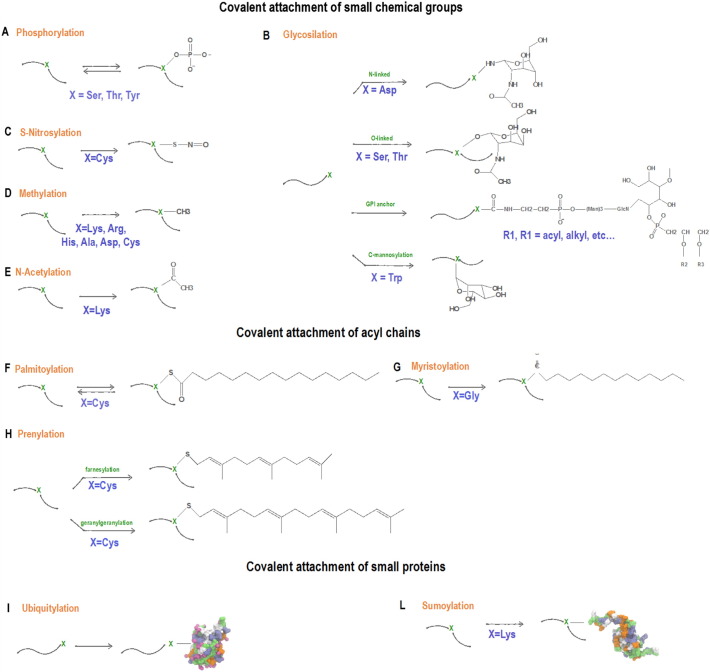
Post-translational modifications (PTMs) occur in almost all proteins and play an important role in numerous biological processes by significantly affecting proteins' structure and dynamics. Several computational approaches have been developed to study PTMs (, phosphorylation, sumoylation or palmitoylation) showing the importance of these techniques in predicting modified sites that can be further investigated with experimental approaches. In this review, we summarize some of the available online platforms and their contribution in the study of PTMs. Moreover, we discuss the emerging capabilities of molecular modeling and simulation that are able to complement these bioinformatics methods, providing deeper molecular insights into the biological function of post-translational modified proteins.
翻译后修饰(PTMs)几乎发生在所有蛋白质中,通过显著影响蛋白质的结构和动力学,在众多生物学过程中发挥重要作用。已经开发了几种计算方法来研究PTMs(如磷酸化、SUMO化或棕榈酰化),这表明这些技术在预测可通过实验方法进一步研究的修饰位点方面的重要性。在本综述中,我们总结了一些现有的在线平台及其在PTM研究中的贡献。此外,我们还讨论了分子建模和模拟的新兴能力,这些能力能够补充这些生物信息学方法,为翻译后修饰蛋白质的生物学功能提供更深入的分子见解。