Asif-Laidin Amna, Delmarre Valérie, Laurentie Jeanne, Miller Wolfgang J, Ronsseray Stéphane, Teysset Laure
Sorbonne Universités, UPMC University of Paris 06, CNRS, Biologie du Développement Paris-Seine, Institut de Biologie Paris-Seine (LBD-IBPS), 75005 Paris, France.
Lab Genome Dynamics, Department for Cell & Developmental Biology, Center of Anatomy and Cell Biology, Medical University of Vienna, A-1090 Vienna, Austria.
DNA Res. 2017 Oct 1;24(5):459-472. doi: 10.1093/dnares/dsx017.
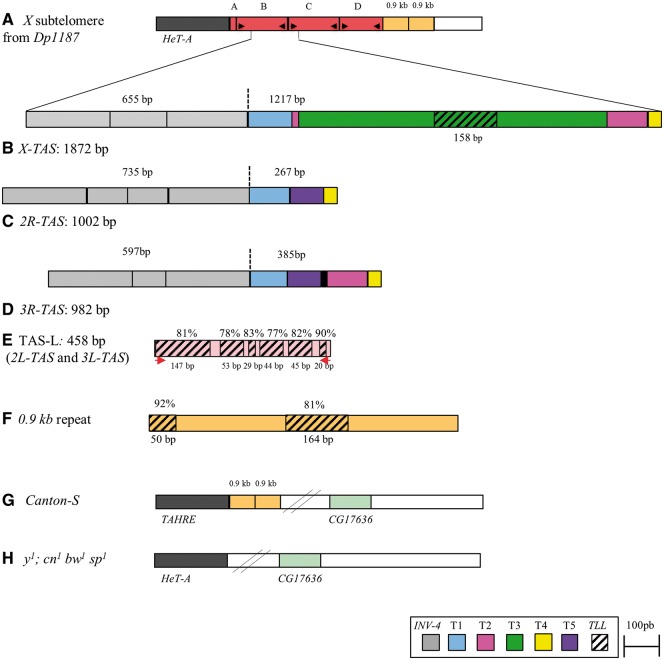
Two Telomeric Associated Sequences, TAS-R and TAS-L, form the principal subtelomeric repeat families identified in Drosophila melanogaster. They are PIWI-interacting RNA (piRNA) clusters involved in repression of Transposable Elements. In this study, we revisited TAS structural and functional dynamics in D. melanogaster and in related species. In silico analysis revealed that TAS-R family members are composed of previously uncharacterized domains. This analysis also showed that TAS-L repeats are composed of arrays of a region we have named "TAS-L like" (TLL) identified specifically in one TAS-R family member, X-TAS. TLL were also present in other species of the melanogaster subgroup. Therefore, it is possible that TLL represents an ancestral subtelomeric piRNA core-cluster. Furthermore, all D. melanogaster genomes tested possessed at least one TAS-R locus, whereas TAS-L can be absent. A screen of 110 D. melanogaster lines showed that X-TAS is always present in flies living in the wild, but often absent in long-term laboratory stocks and that natural populations frequently lost their X-TAS within 2 years upon lab conditioning. Therefore, the unexpected structural and temporal dynamics of subtelomeric piRNA clusters demonstrated here suggests that genome organization is subjected to distinct selective pressures in the wild and upon domestication in the laboratory.
两个端粒相关序列,TAS-R和TAS-L,构成了在黑腹果蝇中鉴定出的主要亚端粒重复序列家族。它们是与PIWI相互作用的RNA(piRNA)簇,参与转座元件的抑制。在本研究中,我们重新审视了黑腹果蝇及相关物种中TAS的结构和功能动态。计算机分析表明,TAS-R家族成员由以前未表征的结构域组成。该分析还表明,TAS-L重复序列由我们命名为“类TAS-L”(TLL)的区域阵列组成,该区域在一个TAS-R家族成员X-TAS中被特异性鉴定。TLL也存在于黑腹果蝇亚组的其他物种中。因此,TLL有可能代表一个祖先亚端粒piRNA核心簇。此外,所有测试的黑腹果蝇基因组都至少拥有一个TAS-R位点,而TAS-L可能不存在。对110个黑腹果蝇品系的筛选表明,X-TAS在野生果蝇中总是存在,但在长期实验室种群中经常缺失,并且自然种群在实验室驯化2年内经常失去其X-TAS。因此,这里展示的亚端粒piRNA簇意外的结构和时间动态表明,基因组组织在野外和实验室驯化过程中受到不同的选择压力。