Mu Hong, Geacintov Nicholas E, Min Jung-Hyun, Zhang Yingkai, Broyde Suse
Department of Chemistry, University of Illinois at Chicago , Chicago, Illinois 60607, United States.
NYU-ECNU Center for Computational Chemistry at NYU Shanghai , Shanghai 200062, China.
Chem Res Toxicol. 2017 Jun 19;30(6):1344-1354. doi: 10.1021/acs.chemrestox.7b00074. Epub 2017 May 15.
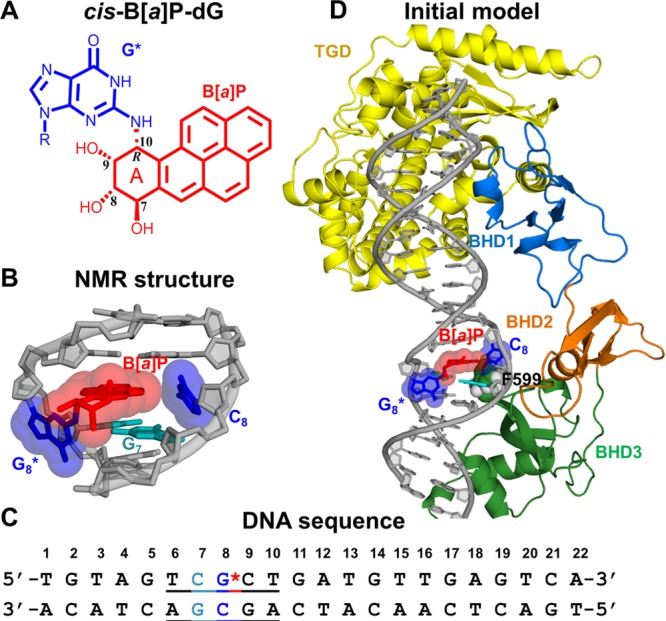
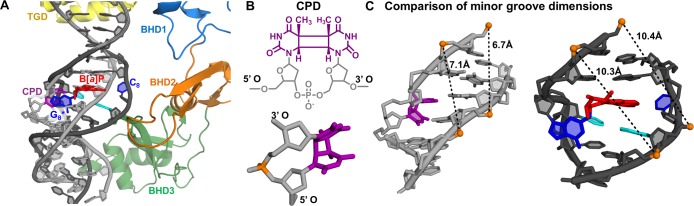
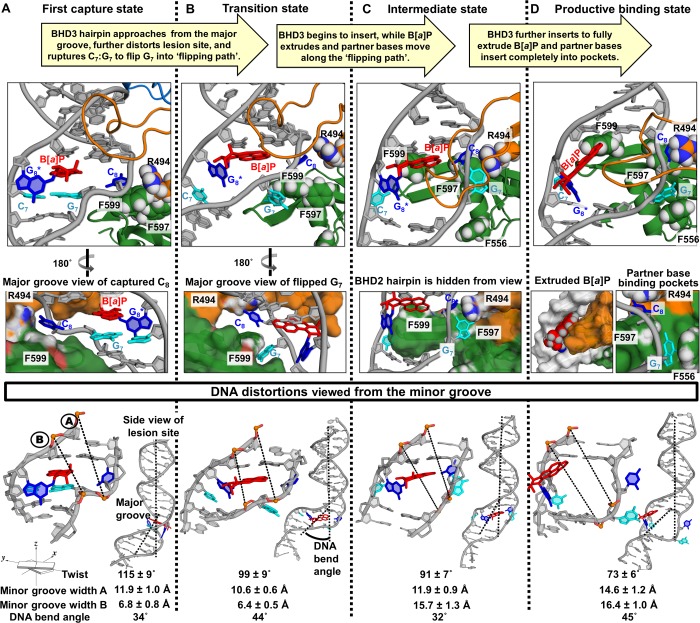
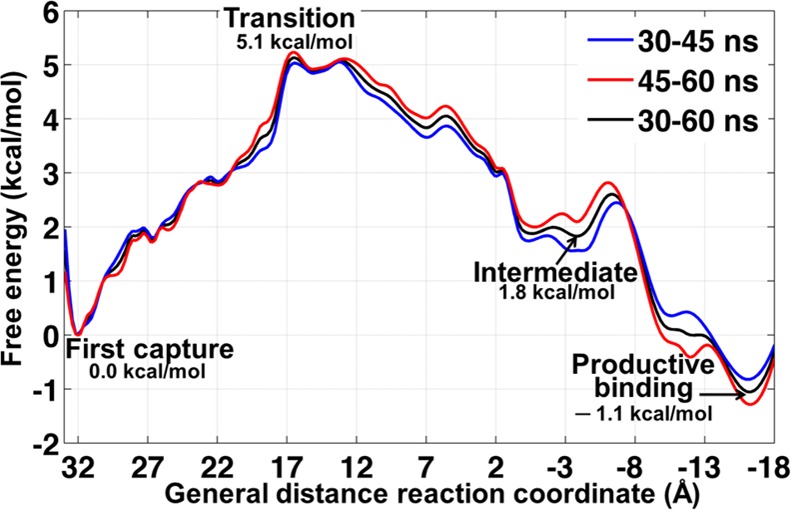
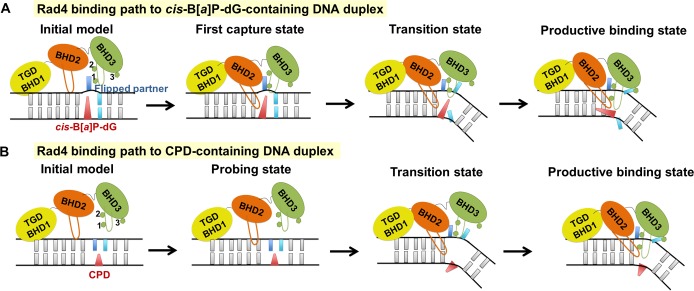
The xeroderma pigmentosum C protein complex (XPC) recognizes a variety of environmentally induced DNA lesions and is the key in initiating their repair by the nucleotide excision repair (NER) pathway. When bound to a lesion, XPC flips two nucleotide pairs that include the lesion out of the DNA duplex, yielding a productively bound complex that can lead to successful lesion excision. Interestingly, the efficiencies of NER vary greatly among different lesions, influencing their toxicity and mutagenicity in cells. Though differences in XPC binding may influence NER efficiency, it is not understood whether XPC utilizes different mechanisms to achieve productive binding with different lesions. Here, we investigated the well-repaired 10R-(+)-cis-anti-benzo[a]pyrene-N-dG (cis-B[a]P-dG) DNA adduct in a duplex containing normal partner C opposite the lesion. This adduct is derived from the environmental pro-carcinogen benzo[a]pyrene and is likely to be encountered by NER in the cell. We have extensively investigated its binding to the yeast XPC orthologue, Rad4, using umbrella sampling with restrained molecular dynamics simulations and free energy calculations. The NMR solution structure of this lesion in duplex DNA has shown that the dC complementary to the adducted dG is flipped out of the DNA duplex in the absence of XPC. However, it is not known whether the "pre-flipped" base would play a role in its recognition by XPC. Our results show that Rad4 first captures the displaced dC, which is followed by a tightly coupled lesion-extruding pathway for productive binding. This binding path differs significantly from the one deduced for the small cis-syn cyclobutane pyrimidine dimer lesion opposite mismatched thymines [ Mu , H. , ( 2015 ) Biochemistry , 54 ( 34 ), 5263 - 7 ]. The possibility of multiple paths that lead to productive binding to XPC is consistent with the versatile lesion recognition by XPC that is required for successful NER.
着色性干皮病C蛋白复合物(XPC)可识别多种环境诱导的DNA损伤,是通过核苷酸切除修复(NER)途径启动损伤修复的关键。当与损伤部位结合时,XPC会将包括损伤部位在内的两个核苷酸对从DNA双链中翻转出来,产生一个能有效结合的复合物,从而成功切除损伤部位。有趣的是,不同损伤的NER效率差异很大,这会影响它们在细胞中的毒性和致突变性。虽然XPC结合的差异可能会影响NER效率,但尚不清楚XPC是否利用不同机制与不同损伤实现有效结合。在此,我们研究了在含有与损伤部位相对的正常配对胞嘧啶(C)的双链体中修复良好的10R-(+)-顺式-反式苯并[a]芘-N-脱氧鸟苷(顺式-B[a]P-dG)DNA加合物。这种加合物源自环境致癌物苯并[a]芘,细胞中的NER很可能会遇到它。我们使用带约束的分子动力学模拟和自由能计算的伞形抽样方法,广泛研究了它与酵母XPC同源物Rad4的结合。该损伤在双链DNA中的核磁共振溶液结构表明,在没有XPC的情况下,与加合的脱氧鸟苷互补的胞嘧啶(dC)会从DNA双链中翻转出来。然而,尚不清楚这个“预翻转”的碱基是否会在XPC对其的识别中发挥作用。我们的结果表明,Rad4首先捕获被置换的dC,随后是一条紧密耦合的损伤挤出途径以实现有效结合。这条结合途径与针对与错配胸腺嘧啶相对的小顺式-顺式环丁烷嘧啶二聚体损伤推导的途径有显著不同[Mu, H., (2015) Biochemistry, 54(34), 5263 - 7]。导致与XPC有效结合的多种途径的可能性与成功的NER所需的XPC对损伤的通用识别是一致的。