CSIC, Global Ecology Unit CREAF-CSIC-UAB, Bellaterra, 08193, Catalonia, Spain.
CREAF, Cerdanyola del Vallès, 08193, Catalonia, Spain.
Sci Rep. 2017 May 2;7(1):1337. doi: 10.1038/s41598-017-01418-8.
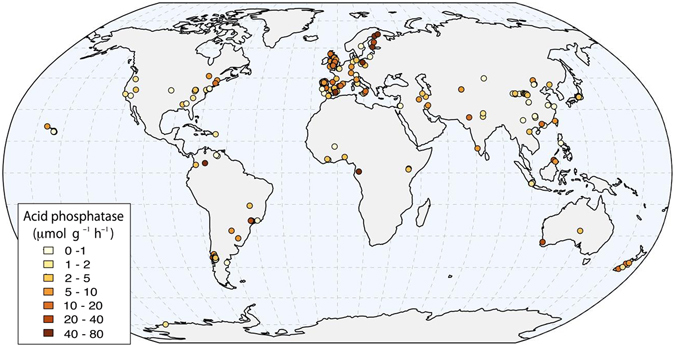
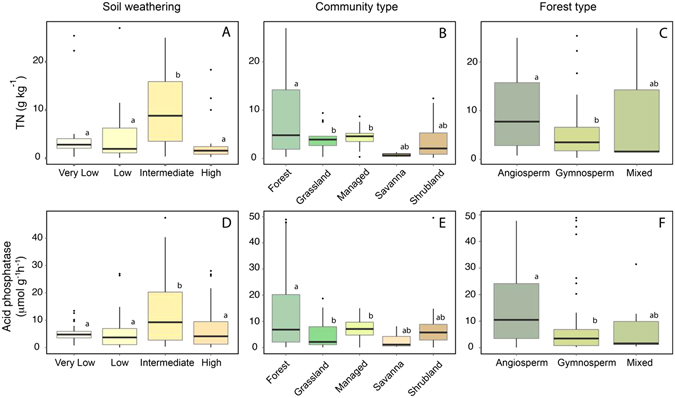
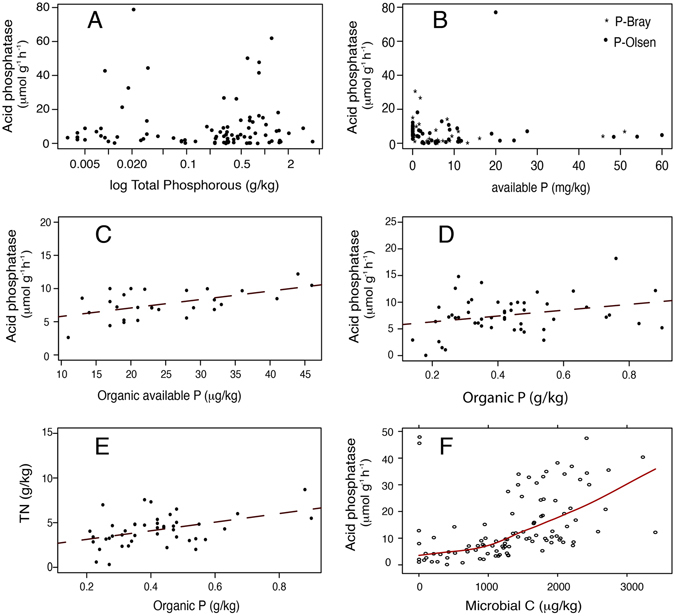
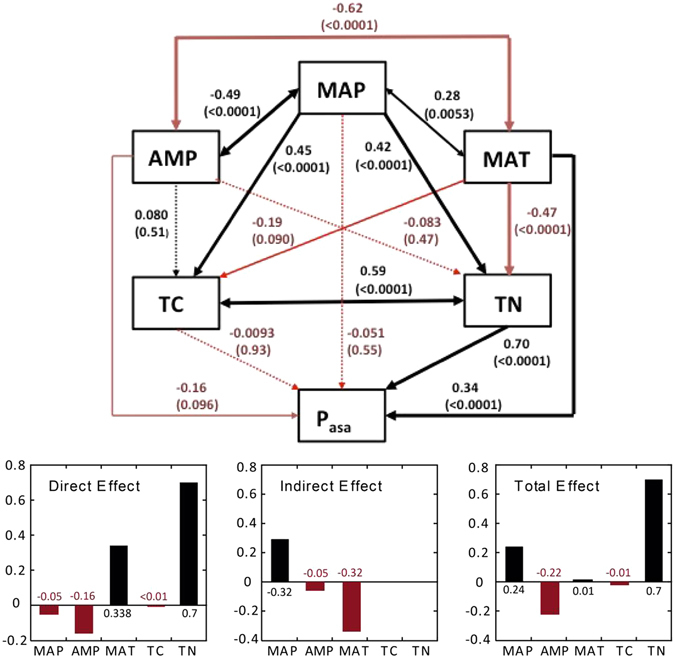
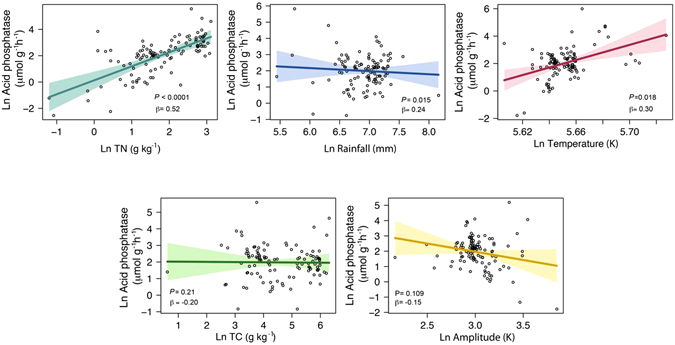
Soil phosphatase levels strongly control the biotic pathways of phosphorus (P), an essential element for life, which is often limiting in terrestrial ecosystems. We investigated the influence of climatic and soil traits on phosphatase activity in terrestrial systems using metadata analysis from published studies. This is the first analysis of global measurements of phosphatase in natural soils. Our results suggest that organic P (P), rather than available P, is the most important P fraction in predicting phosphatase activity. Structural equation modeling using soil total nitrogen (TN), mean annual precipitation, mean annual temperature, thermal amplitude and total soil carbon as most available predictor variables explained up to 50% of the spatial variance in phosphatase activity. In this analysis, P could not be tested and among the rest of available variables, TN was the most important factor explaining the observed spatial gradients in phosphatase activity. On the other hand, phosphatase activity was also found to be associated with climatic conditions and soil type across different biomes worldwide. The close association among different predictors like P, TN and precipitation suggest that P recycling is driven by a broad scale pattern of ecosystem productivity capacity.
土壤磷酸酶水平强烈控制着生命必需元素磷(P)的生物途径,而磷在陆地生态系统中通常是有限的。我们利用已发表研究的元数据分析,研究了气候和土壤特征对陆地系统中磷酸酶活性的影响。这是对天然土壤中全球磷酸酶测量的首次分析。我们的结果表明,有机磷(P)而不是有效磷,是预测磷酸酶活性的最重要磷组分。使用土壤全氮(TN)、年平均降水量、年平均温度、热振幅和总土壤碳作为最可用预测变量的结构方程模型,解释了磷酸酶活性空间变异性的 50%。在这项分析中,无法测试磷,而在其余可用变量中,TN 是解释磷酸酶活性观测到的空间梯度的最重要因素。另一方面,还发现磷酸酶活性与全球不同生物群落的气候条件和土壤类型有关。P、TN 和降水等不同预测因子之间的密切关联表明,P 循环是由生态系统生产力能力的广泛模式驱动的。