García Molinos J, Burrows M T, Poloczanska E S
Arctic Research Center, Hokkaido University, Kita-21 Nishi-11 Kita-ku, Sapporo, Hokkaido 001-0021, Japan.
Global Station for Arctic Research, Global Institution for Collaborative Research and Education, Hokkaido University, Hokkaido, Sapporo, Japan.
Sci Rep. 2017 May 2;7(1):1332. doi: 10.1038/s41598-017-01309-y.
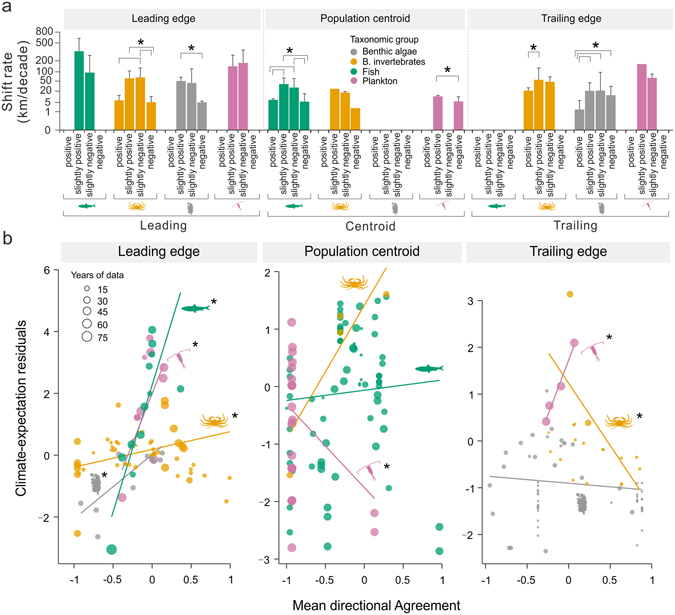
Biogeographical shifts are a ubiquitous global response to climate change. However, observed shifts across taxa and geographical locations are highly variable and only partially attributable to climatic conditions. Such variable outcomes result from the interaction between local climatic changes and other abiotic and biotic factors operating across species ranges. Among them, external directional forces such as ocean and air currents influence the dispersal of nearly all marine and many terrestrial organisms. Here, using a global meta-dataset of observed range shifts of marine species, we show that incorporating directional agreement between flow and climate significantly increases the proportion of explained variance. We propose a simple metric that measures the degrees of directional agreement of ocean (or air) currents with thermal gradients and considers the effects of directional forces in predictions of climate-driven range shifts. Ocean flows are found to both facilitate and hinder shifts depending on their directional agreement with spatial gradients of temperature. Further, effects are shaped by the locations of shifts in the range (trailing, leading or centroid) and taxonomic identity of species. These results support the global effects of climatic changes on distribution shifts and stress the importance of framing climate expectations in reference to other non-climatic interacting factors.
生物地理变化是全球对气候变化普遍存在的一种响应。然而,观察到的不同分类群和地理位置的变化差异很大,且只有部分归因于气候条件。这种多变的结果是由局部气候变化与跨物种分布范围起作用的其他非生物和生物因素之间的相互作用导致的。其中,诸如洋流和气流等外部定向力影响着几乎所有海洋生物和许多陆地生物的扩散。在此,我们利用一个关于海洋物种观测到的分布范围变化的全球元数据集表明,将水流与气候之间的定向一致性纳入考量,可显著提高方差解释比例。我们提出了一个简单的指标,用于衡量洋流(或气流)与热梯度的定向一致程度,并在预测气候驱动的分布范围变化时考虑定向力的影响。结果发现,洋流根据其与温度空间梯度的定向一致性,既促进也阻碍分布范围的变化。此外,这些影响还受到分布范围变化位置(尾部、前端或中心)以及物种分类特征的影响。这些结果支持了气候变化对分布范围变化的全球影响,并强调了结合其他非气候相互作用因素来构建气候预期的重要性。